Little Numbers, Big Discoveries: Engaging Math Play Activities for Babies
Introduction: The Hidden Mathematics in a Baby’s World
When we think of mathematics, we often picture complex equations, abstract symbols, or the rigid memorization of multiplication tables. Yet for a baby—a being who has just entered the world—mathematics is not a subject to be taught, but a language to be lived. From the rhythmic repetition of a lullaby to the spatial awareness required to stack two wooden blocks, every interaction an infant has with their environment is a silent lesson in math. The key is not to force numbers onto a tiny mind, but to weave mathematical thinking into the fabric of everyday play. This article explores a range of developmentally appropriate, joyful math play activities for babies (from birth to approximately 18 months) that nurture early number sense, pattern recognition, spatial reasoning, and logical thinking—all through the lens of love, curiosity, and safe exploration.
1. Sensory Patterns: The Foundation of Early Math
Before a baby can recognize the numeral “2,” they must first understand the concept of “two” as a quantity, and before that, they must feel the rhythm of patterns. The sensory system is a baby’s primary learning tool, and math play can begin on day one.
1.1 Rhythmic Repetition and Sequencing
From the gentle rocking of a cradle to the predictable “peek-a-boo” game, babies thrive on repetition because it helps them predict what comes next—a core mathematical skill. You can turn everyday caregiving into a pattern-building activity. For example, while changing a diaper, gently tap a rhythm on your baby’s tummy: *tap, tap, pause; tap, tap, pause*. Use a soft, sing-song voice: “One, two, three… one, two, three…” Over weeks, your baby may begin to anticipate the pause, cooing or wiggling in response. This is not just a game; it is the earliest form of sequencing and counting.
1.2 Textured Patterns for Touch Exploration
Create a “pattern board” by gluing different materials onto a flat piece of cardboard: a strip of soft felt, a strip of bumpy bubble wrap, a strip of smooth satin. Let your baby lie on their tummy (under supervision) or sit and feel the board. As you guide their hand across the textures, say, “Soft… bumpy… smooth… soft… bumpy… smooth.” This tactile pattern recognition builds the neural pathways for recognizing sequences and sets—the building blocks of mathematics.
2. Counting and Quantity: Beyond Memorizing Numbers
Babies are naturally attuned to quantities. Even newborns can distinguish between a set of two and three objects in a controlled experiment. The goal of early counting play is not to have your baby recite “one, two, three” but to help them internalize the meaning of “more” and “less,” “one” and “many.”
2.1 One-to-One Correspondence with Safe Objects
Around six months, when your baby can grasp and hold objects, introduce a small basket of soft, safe items like large wooden rings or silicone teethers. Sit with your baby and slowly place one ring onto a stack, saying clearly, “One ring.” Then place a second, “Two rings.” Then a third, “Three rings.” Let your baby knock them down—they will love it. Each time you rebuild, repeat the slow, intentional counting. The key is *action* paired with *word*. Your baby learns that “three” corresponds to three distinct objects, not just a word.
2.2 The “More” Game
Use snack time (with age-appropriate, safe foods like puffs or soft pieces of banana) to explore quantity. Place one puff on your baby’s tray. After they eat it, place two puffs. Look at them and say excitedly, “Now you have two puffs! More!” Then place one puff again. “Now you have one. Less.” This simple, repetitive comparison teaches the concept of “more than” and “less than” long before formal arithmetic. You can also use blocks: stack two blocks, then three, and let your baby see the difference in height.
3. Shapes and Spatial Awareness: The Geometry of Play
Geometry begins the moment a baby reaches for a toy. Understanding shapes, sizes, and spatial relationships is crucial for later mathematical skills like geometry, measurement, and even algebra.
3.1 Shape Sorting in a Gentle Way
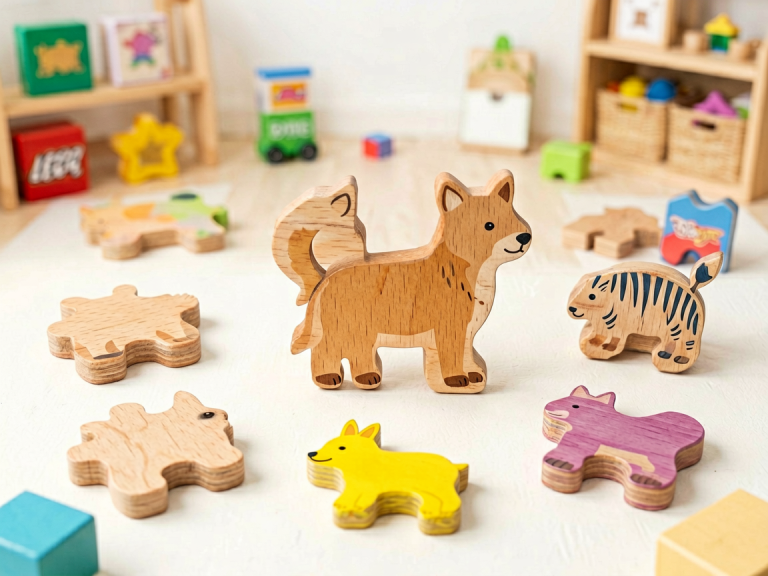
While plastic shape-sorting toys are common, they can be frustrating for babies under one year because the precision required is too high. Instead, create a simpler version. Take a shallow cardboard box and cut large holes in the lid: a circle, a square, and a triangle (make them generous so any orientation works). Give your baby a few large, chunky wooden shapes. Show them how to drop a shape through the matching hole. But do not expect perfection. Instead, allow them to explore the shapes by mouthing them (safe, non-toxic paint) and banging them together. As you play, narrate: “This round shape rolls. This square shape has corners.” The goal is exposure, not mastery.
3.2 Nesting and Stacking: Size Relationships
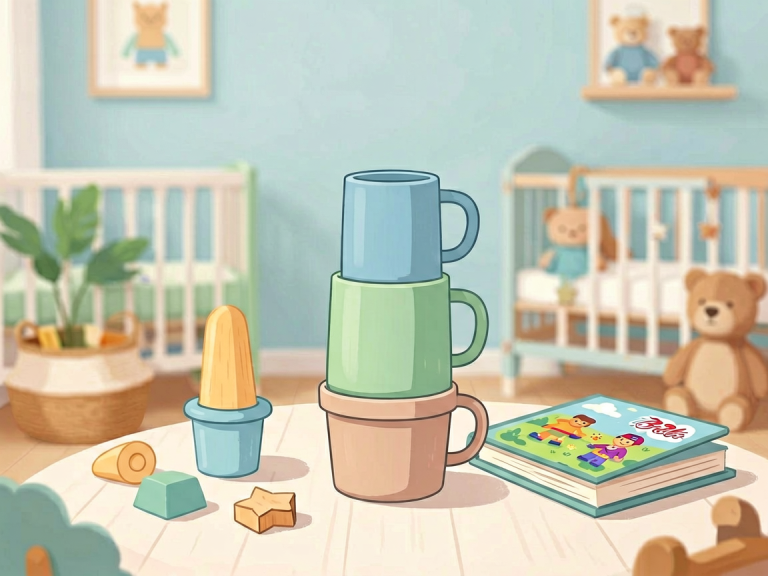
A set of nesting cups or stacking rings is a classic math toy for a reason. When a baby tries to put a large cup inside a smaller one and fails, they are learning about size and containment—a fundamental geometric concept. Sit beside your baby and stack the rings in order from largest to smallest, saying, “Big ring, then smaller, then even smaller.” Let them try to copy you; even if they simply knock the stack over, they are learning cause and effect and size comparison. For added fun, hide a small toy under the largest cup and ask, “Where did it go?” This introduces object permanence and spatial memory.
4. Music and Movement: Math in Rhythm and Motion
Music is inherently mathematical. Beats, tempo, and rhythm all involve patterns, counting, and fractions. For babies, movement combined with sound creates a multisensory math experience.
4.1 Simple Action Songs with Counting
Sing “Five Little Ducks” or “Five Little Monkeys Jumping on the Bed” with your baby on your lap. As you sing, hold up your fingers one by one. When you get to “zero,” throw your hands up and say, “All gone!” Your baby will soon anticipate the “zero” moment and may smile or bounce. This playfully introduces subtraction (one less) and the concept of zero. You can also adapt “Row, Row, Row Your Boat” and rock your baby forward and backward in a steady rhythm—two rocks forward, two rocks back. The rhythm creates a sense of pattern and timing.
4.2 Bouncing to a Beat
Hold your baby securely and gently bounce them on your knees while chanting a simple counting rhyme: “Bounce, bounce, one… bounce, bounce, two… bounce, bounce, three… and we stop!” At “stop,” freeze and look at them with wide eyes. This activity strengthens their ability to anticipate a sequence and feel the duration of numbers. Over time, you can change the tempo: faster bouncing for “quick numbers,” slower for “slow numbers.” This is an early, embodied lesson in measurement and rate.
5. Everyday Routines as Math Moments
The most powerful math play activities for babies are those that are seamlessly integrated into your daily routine, requiring no special toys or extra time. By reframing ordinary moments as mathematical invitations, you can create a rich learning environment.
5.1 Diaper Changes as Measurement and Comparison
During a diaper change, you have a captive audience. Use this moment to talk about size: “Your feet are so small! Let’s measure them with my hand. Look, your foot is almost as long as my thumb.” Or count your baby’s toes slowly, touching each one: “One, two, three, four, five!” Then switch feet: “Now let’s count this foot. One, two, three, four, five! We have ten toes in total.” You are not only counting but also demonstrating that the same count applies to two different sets—a subtle lesson in the conservation of number.
5.2 Mealtime Patterns and Sorting
When your baby starts eating solids, the tray becomes a math lab. Arrange three pieces of banana in a line and say, “Look, a line of banana.” Then move them into a circle: “Now it’s a circle!” Let your baby rearrange the pieces. You can also sort foods by color (e.g., orange carrots vs. green peas) and narrate: “These are all orange. These are all green. They are different groups.” This early sorting is a precursor to set theory and categorization.
5.3 Bath Time Volume and Motion
In the bath, give your baby a few plastic cups of different sizes. Show them how to scoop water from a large cup into a smaller one. The water spills—your baby sees that the small cup cannot hold all the water from the big cup. This is a direct, physical experience of volume and capacity. Add a floating rubber duck and count how many times it bobs: “One bob, two bobs, three bobs!” The water’s resistance and movement also teach cause and effect.
6. The Role of the Caregiver: Patience and Joy
Perhaps the most critical element in math play for babies is the attitude of the adult. Babies are extraordinary intuitive learners; they read your facial expressions, tone, and energy. If you approach these activities with stress or a goal-oriented mindset (e.g., “My baby must learn to count to three by nine months”), the play becomes a chore. Instead, embrace the spirit of curiosity and wonder. If your baby ignores the stacking rings and chews on a block instead, that is still a valuable exploration of shape and texture. Follow your baby’s lead. If they are interested in the sound of a rattle, shake it three times, pause, shake it three times again—you have just created a musical pattern. The math is there, embedded in the interaction. Your role is not to teach, but to notice, to narrate, and to delight in the discoveries alongside your little one.
Conclusion: A Lifelong Love for Numbers Starts Here
Mathematics is not a distant, intimidating subject reserved for schoolrooms. It is the rhythm of a lullaby, the surprise of a third block balancing on two, the joy of watching water overflow from a cup. For a baby, every moment of play is a moment of learning, and every interaction with a loving caregiver is an opportunity to build the neural foundations for logical thinking, problem-solving, and number sense. By incorporating simple, sensory-rich math play activities into your daily routine, you are not just “teaching” math—you are gifting your baby with a mindset that sees patterns, appreciates order, and embraces the joyful chaos of discovery. Let the blocks tumble, let the numbers sing, and let the math unfold naturally, one tiny discovery at a time.