Building Little Scientists: The Power of Science Toys for Preschoolers
Introduction: More Than Just Play
In the quiet hours of a rainy afternoon, a three-year-old sits on the living room floor, carefully stacking colorful plastic rings onto a peg. To the casual observer, this is simple play. But look closer. The child is testing gravity, observing cause and effect, and building a mental model of balance and stability. This is the beginning of scientific thinking. For preschoolers, the world is a vast, uncharted laboratory, and every object they touch is a potential experiment. Science toys are not merely entertainment; they are the tools that transform innate curiosity into foundational knowledge. In an era where STEM education dominates conversations about future careers, the early introduction of science toys for preschoolers is not a luxury—it is a necessity. This article explores the profound impact of these toys, offering guidance on selection, types, and the essential role of adult facilitation.
The Critical Role of Play in Early Learning
Before diving into specific toys, it is essential to understand the cognitive landscape of a preschooler. Children aged two to five are in what developmental psychologist Jean Piaget called the preoperational stage. They are ego-centric, struggle with abstract logic, and learn primarily through direct, concrete experiences. Play is their primary mode of learning. When a preschooler builds a tower with blocks, they are not just stacking; they are engaging in informal physics, testing balance and gravity. When they play with water and funnels, they are exploring fluid dynamics and volume.
Research in early childhood education consistently shows that play-based learning fosters creativity, problem-solving skills, and social-emotional development. Science toys leverage this natural tendency. They turn abstract concepts like “magnetism” or “buoyancy” into tangible, observable phenomena. The best science toys for preschoolers do not lecture; they invite discovery. They allow a child to fail safely—a block tower crashes, a boat sinks, a magnet fails to pick up a wooden block—and in that failure, the seeds of hypothesis testing are planted. The child learns to ask, “What if I try a different block? What if I put the magnet closer?” This is the essence of the scientific method, simplified for tiny hands.
Why Science Toys Matter: Beyond the Buzzwords
The term “STEM” (Science, Technology, Engineering, and Mathematics) has become a ubiquitous buzzword, but its application in early childhood is often misunderstood. For preschoolers, science toys are not about teaching advanced equations or memorizing periodic tables. They are about building cognitive frameworks. The benefits are multifaceted:
First, science toys cultivate inquiry-based thinking. When a child plays with a magnifying glass, they naturally ask, “Why does this ant look bigger?” This question sparks curiosity, which leads to observation, comparison, and eventually, a rudimentary understanding of magnification and optics.
Second, these toys promote fine motor skills and hand-eye coordination. Activities like pouring water, screwing caps on bottles, or manipulating gears require precise movements. These are the building blocks for later writing, drawing, and even surgical precision.
Third, science toys introduce cause and effect in a controlled environment. A preschooler who presses a button on a simple circuit toy and sees a light turn on learns that actions have consequences. This understanding is foundational for logic and reasoning.
Fourth, they encourage language development. As children interact with science toys, they need vocabulary to describe what they see. Parents or caregivers who ask, “What happened when you added more water?” help the child articulate observations, using words like “float,” “sink,” “hot,” “cold,” “heavy,” and “light.”
Finally, science toys build resilience. Experiments often “fail” – the volcano doesn’t erupt, the kaleidoscope pattern looks messy. But in a supportive environment, these “failures” become learning opportunities. The child learns that not every attempt works, and that’s okay. This resilience is a critical life skill, far more valuable than any single piece of knowledge.
Key Types of Science Toys for Preschoolers
The market is flooded with toys claiming to be “educational,” but not all are equally effective. The best science toys for preschoolers share common traits: they are open-ended, safe, age-appropriate, and encourage active participation rather than passive observation. Below are several categories, each targeting different scientific domains.
1. Sensory Exploration Toys: The Foundation of Observation
Sensory play is perhaps the most fundamental science activity for preschoolers. Water tables, sand pits, playdough, and kinetic sand allow children to explore texture, temperature, and material properties. A child squishing playdough is learning about plasticity and elasticity. Pouring water from one container to another introduces volume and conservation. Adding natural materials like leaves or stones to a sensory bin sparks questions about nature. These toys require minimal adult intervention yet yield maximum cognitive benefit. They are the “pure science” of early childhood—unstructured, messy, and essential.
2. Building and Construction Sets: Engineering on a Small Scale
Classic wooden blocks, magnetic tiles, LEGO Duplo, and interlocking gears are engineering toys in disguise. When a preschooler builds a bridge that collapses, they learn about weight distribution and support. When they connect gears and see one turn the other, they grasp the concept of mechanical advantage. These toys teach spatial reasoning, planning, and iterative design. The best building sets are those that allow for both free play and guided challenges. For instance, asking “Can you build a tower as tall as your arm?” introduces measurement without formal numbers.
3. Magnets and Simple Physics Kits
Magnets are a perennial favorite. A simple set of magnetic wands, horseshoe magnets, and assorted metal and non-metal objects lets children explore attraction and repulsion. They learn that not all metals are magnetic, and that magnets can work through paper or plastic. This is a direct application of physical science. Similarly, toy ramps and cars teach about gravity, incline, and momentum. A child who rolls a car down a steeper ramp and sees it go faster is conducting a controlled experiment. These toys are excellent for introducing vocabulary like “force,” “speed,” and “direction.”
4. Chemistry Kits for Little Hands (Non-Toxic, Safe)
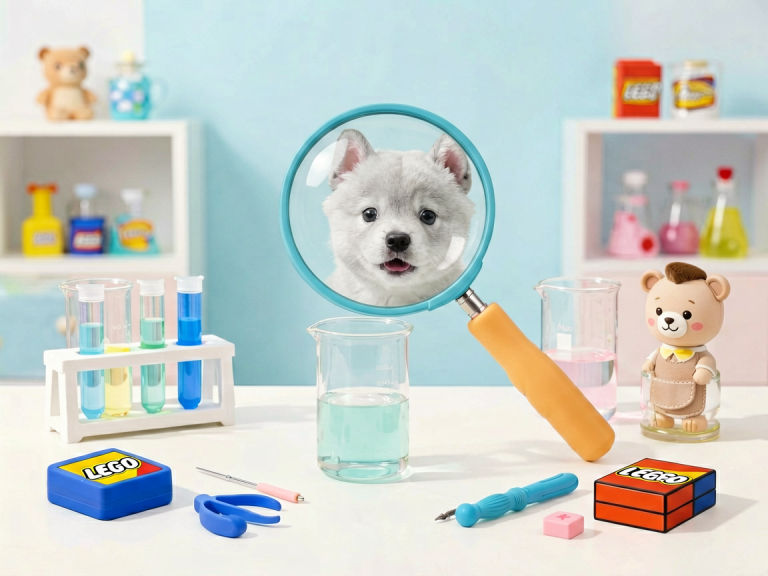
While traditional chemistry sets are for older children, there are now many safe, preschool-friendly alternatives. Baking soda and vinegar volcanoes, color-mixing tablets, and safe slime or oobleck recipes are classics. These activities introduce the concept of chemical reactions—a solid and a liquid combining to create a gas (bubbles). Color-mixing teaches primary and secondary colors, blending art and science. Because these activities often require adult supervision, they also build the parent-child relationship and model scientific safety.
5. Observation Tools: Magnifying Glasses, Bug Catchers, and Microscopes
Early science is about looking closely. A sturdy magnifying glass turns a simple walk in the garden into a field expedition. A bug catcher with a clear container allows a child to observe an insect’s legs, antennae, and movements safely. For more advanced preschoolers, a simple digital microscope that connects to a tablet can show the hidden world of a leaf’s veins or a grain of salt. These tools cultivate the habit of careful observation, which is the bedrock of all scientific inquiry.
6. Nature and Outdoor Science Toys
Dirt, rocks, leaves, and water are the most accessible science toys. A simple digging kit with a shovel and sieve introduces the concept of soil layers. A rain gauge helps measure precipitation. A bird feeder turns the backyard into an ecosystem study. Preschoolers who spend time exploring nature develop a sense of wonder and respect for living things. These experiences are unstructured, but they are rich with learning opportunities—from identifying different types of leaves to observing how a worm moves.
How to Choose the Right Science Toys
With so many options, parents and educators often feel overwhelmed. The key is to prioritize process over product. A science toy that simply displays a pre-determined result (like a plastic volcano that lights up when you press a button) is less valuable than one that invites exploration. Look for toys that:
- Have multiple uses. A set of magnetic tiles can be used for construction, color sorting, pattern making, and free play. The more ways a child can use a toy, the better.
- Encourage trial and error. Avoid toys with only one “correct” way to play. The best toys allow for mistakes and discovery.
- Are age-appropriate. Preschoolers have short attention spans and need choke-hazard-free materials. Check labels for recommended ages.
- Involve the senses. Toys that engage sight, sound, touch, and sometimes even smell or taste (if safe) create richer learning.
- Are easy to clean. Messy science is great, but if the cleanup is too daunting, parents will avoid it. Choose toys that can be wiped down or washed.
Additionally, consider the social aspect. Science toys that can be used with siblings or friends encourage collaboration, sharing, and communication. A child explaining to another child why their block tower fell is practicing oral argument and reasoning.
The Parent's Role in Guided Discovery
A science toy, no matter how sophisticated, is only a tool. The true catalyst for learning is the adult who facilitates the experience. For preschoolers, guided discovery is the ideal approach. This does not mean hovering and correcting every mistake. It means creating an environment where questions are welcomed and exploration is safe.
Practical strategies include:
- Ask open-ended questions. Instead of “See, the magnet picks up the paperclip,” ask “What do you think will happen if I bring the magnet near the plastic spoon?” This encourages prediction.
- Model curiosity. Let your child see you wonder. Say, “I wonder why the water flows faster from this funnel than that one.” Your own curiosity is contagious.
- Introduce vocabulary naturally. While your child is playing with a balance scale, you might say, “That side is heavier, so it goes down. This side is lighter, so it goes up.” Use words like “equal,” “comparison,” “estimate,” and “observe.”
- Allow for repetition. Children learn through repetition. Don’t be frustrated if they want to do the same experiment ten times in a row. Each repetition reinforces the concept.
- Celebrate questions, not answers. The child who asks “Why is the sky blue?” is more valuable than the child who can recite the answer. You don’t need to know everything—saying “Let’s find out together” is a powerful lesson in scientific humility.
Conclusion: A Foundation for Lifelong Learning
Science toys for preschoolers are far more than a passing trend. They are a bridge between the innate curiosity of childhood and the structured thinking of adulthood. When a child watches a magnet defy gravity, or mixes blue and yellow paint to create green, or watches a seed sprout in a clear cup, they are not just playing. They are building the mental architecture for critical thinking, creativity, and resilience.
The investment in quality science toys—and, more importantly, in the time spent facilitating their use—pays dividends for years to come. A preschooler who learns to ask “why” and “what if” will become a student who challenges assumptions, a citizen who values evidence, and an adult who never stops exploring. In a world that increasingly demands innovation and adaptability, the little scientist playing with blocks today may be the inventor of tomorrow’s solutions. The journey begins with a single toy, a single question, and a single moment of wonder. So, let them play. Let them question. Let them build their world, one experiment at a time.