Nurturing Young Minds: A Parents Guide to Supporting Learning at Home for 4-Year-Olds
The early years of a child’s life are a whirlwind of discovery, curiosity, and rapid brain development. By age four, children have already absorbed an astonishing amount of information from their environment, and their capacity for learning continues to expand exponentially. As a parent, you are your child’s first and most influential teacher. But supporting learning at home for a four-year-old does not mean replicating a classroom or drilling flashcards. It means creating a rich, playful, and responsive environment that nurtures natural curiosity, builds foundational skills, and fosters a lifelong love of learning. This guide will walk you through the key principles, practical strategies, and everyday activities that can turn your home into a vibrant learning space, all while keeping the experience joyful and stress-free for both you and your child.
—
Why Home Learning Matters for 4-Year-Olds
At age four, children are in a sensitive period for language acquisition, social-emotional development, and cognitive growth. Research in early childhood education consistently shows that the home environment has a profound impact on school readiness and later academic success. However, the goal is not to accelerate formal instruction but to build a strong foundation through meaningful interactions. When parents engage in conversations, read aloud, play games, and provide open-ended materials, they are wiring their child’s brain for problem-solving, emotional regulation, and creativity. Moreover, home learning reinforces the idea that education is not confined to a building or a schedule—it happens everywhere, from the kitchen to the backyard. This understanding helps children develop agency and confidence.
—
Creating a Conducive Learning Environment
Before diving into specific activities, consider the physical and emotional space where learning will take place. A supportive environment does not need to be elaborate.
Designate a Flexible Learning Area. A small child-size table with chairs, a shelf with accessible baskets of toys and books, and a comfortable rug can work wonders. Keep materials organized but within the child’s reach so they can make independent choices. Rotate toys and learning tools every few weeks to maintain novelty.
Minimize Distractions. While some background noise is inevitable, try to keep the area relatively calm during focused activities. Turn off the television and put away phones when you are interacting directly with your child. Your full attention is one of the most powerful learning tools you can offer.
Prioritize Safety and Comfort. Ensure furniture is stable, sharp corners are covered, and art supplies are non-toxic. A child who feels safe and physically comfortable is more open to exploring and taking risks.
Embrace Mess and Movement. Learning at this age is messy, noisy, and kinetic. Allow your child to spill water while pouring, splatter paint while experimenting, and wiggle while listening to a story. Stifling these natural impulses can inhibit learning. Instead, set clear boundaries (e.g., “We paint at the table”) and have cleaning supplies handy.
—
Key Areas of Development and Learning
A holistic approach to home learning covers multiple domains. Below are five critical areas with simple, practical strategies.
Language and Literacy
Language is the bedrock of all learning. For a four-year-old, the emphasis should be on oral language development, phonological awareness (the ability to hear and manipulate sounds), and print awareness.
- Read Aloud Every Day. Choose a mix of picture books, rhyming stories, and informational books. Use different voices for characters, point to the words as you read, and pause to ask open-ended questions like “What do you think will happen next?” This builds comprehension and vocabulary.
- Play with Sounds. Sing nursery rhymes, clap syllables in words (e.g., “but-ter-fly” – three claps), and play “I spy” with initial sounds (“I spy something that starts with /b/”).
- Create a Print-Rich Environment. Label objects around the house with simple words (door, chair, cup). Encourage your child to “read” labels and signs when you are out on walks.
- Encourage Storytelling. After a trip to the park or a family event, ask your child to tell you a story about what happened. Write down their words and read them back. This shows that their thoughts have value.
Early Math Concepts
Math for a four-year-old is not about worksheets; it is about hands-on exploration of numbers, shapes, patterns, and measurement.
- Count Everything. Count stairs while walking up, crackers while eating, and toys while cleaning up. Use one-to-one correspondence (touching each object as you count).
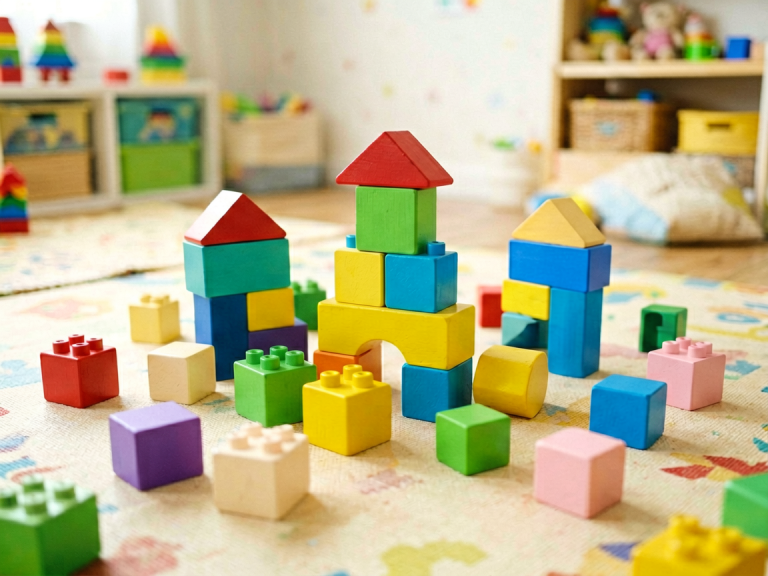
- Sort and Classify. Give your child a basket of mixed buttons, shells, or Lego bricks and ask them to sort by color, size, or shape. Sorting is a foundational logical skill.
- Explore Shapes and Spatial Relations. Build with blocks, puzzles, and magnetic tiles. Talk about “above,” “below,” “behind,” and “next to.” Encourage your child to copy simple patterns (red, blue, red, blue) and then create their own.
- Measure and Compare. Let your child help you measure ingredients while cooking (cups, spoons). Fill different containers with water during bath time to compare capacity. Ask questions like “Which tower is taller? Which jar holds more?”
Science and Exploration
Four-year-olds are natural scientists who constantly ask “why?” and “how?”. You can channel that curiosity into simple investigations.
- Observe Nature. Go on a “listening walk” to identify bird calls and rustling leaves. Collect leaves, rocks, or acorns and examine them with a magnifying glass. Plant a seed in a cup and track its growth over weeks.
- Conduct Simple Experiments. Fill a bin with water and provide spoons, funnels, and cups for pouring and measuring. Freeze small toys in a block of ice and let your child figure out how to free them (salt, warm water, hammer – under supervision).
- Cooking as Chemistry. Baking a cake involves measuring, mixing, and watching ingredients change. Let your child whisk, pour, and taste. Talk about how heat turns batter into a solid.
- Ask Open-Ended Questions. Instead of providing answers, prompt your child to think: “What do you think will happen if we add more water to the mud? How can we find out?”
Creative Arts and Expression
Art and music are not just fun; they develop fine motor skills, emotional regulation, and divergent thinking.
- Provide Open-Ended Art Materials. Offer crayons, washable markers, play dough, safety scissors, glue sticks, and recycled materials (cardboard boxes, bottle caps). Avoid coloring books that require staying inside the lines; instead, let your child draw freely.
- Process over Product. Focus on the act of creating, not the final result. Ask “Tell me about your painting” rather than “What is it?”. Praise effort and experimentation.
- Incorporate Music and Movement. Sing songs, play simple instruments (shakers, drums), and dance to different genres. Make up silly rhymes. Musical activities boost memory and coordination.
- Dramatic Play. Set up a “pretend” area with dress-up clothes, a toy kitchen, or a cardboard box turned into a spaceship. Dramatic play builds social skills, vocabulary, and narrative thinking.
Social and Emotional Growth
Learning is not just intellectual; it is deeply emotional. A child who feels secure and understood is far more ready to take on new challenges.
- Name and Validate Emotions. Use books and conversations to help your child identify feelings. Say, “I can see you are frustrated because the block tower fell. It is okay to be angry. What can we do to fix it?” This builds emotional intelligence.
- Encourage Empathy. During play, gently prompt your child to think about others: “How do you think your friend feels when you take her toy? What could you do instead?”
- Model Conflict Resolution. When disagreements arise with siblings or friends, guide your child through simple problem-solving steps: identify the problem, think of two solutions, choose one, and evaluate.
- Teach Self-Regulation. Practice deep breathing when upset. Use a “calm-down corner” with a soft pillow and a book. Children learn to manage big emotions when they have a safe space and a trusted adult to guide them.
—
The Power of Play-Based Learning
It cannot be overstated: play is the work of childhood. For a four-year-old, play is the primary vehicle for learning. Through play, children practice social roles, experiment with cause and effect, develop language, and build physical skills. Structured “lessons” that last more than ten minutes often backfire at this age. Instead, weave learning into play.
- Floor Time. Sit on the floor with your child and follow their lead. If they want to build a zoo out of blocks, ask questions about the animals, count the blocks, and invent stories. This is called “scaffolding”—adding complexity just above their current level.
- Games with Rules. Simple board games like Candyland or cooperative games where everyone wins teach turn-taking, counting, and resilience (dealing with losing).
- Sensory Play. Bins filled with rice, sand, or water-soaked pasta engage multiple senses and promote calm, focused exploration. Add scoops, containers, and small figurines for open-ended play.
—
Practical Daily Routine Ideas
Consistency is comforting for a four-year-old, but flexibility is equally important. A sample daily rhythm might look like this:
- Morning: Outdoor time (park, garden, or just the backyard). Fresh air and movement wake up the brain.
- Late Morning: A focused “learning moment” – perhaps reading a book together, then an art project or a simple science experiment. Keep it under 20 minutes.
- Lunch and Quiet Time: After a meal, allow for rest, which could be napping, listening to audiobooks, or quiet play with puzzles.
- Afternoon: Child-directed play. This is when you can set out a sensory bin or let them build with blocks while you observe and occasionally interact.
- Evening: Family time – cooking together, playing a game, or a bedtime story routine. The best learning happens when connection is prioritized over curriculum.
—
Managing Screen Time
Screens are a reality of modern life, but for four-year-olds, passive consumption can hinder active learning. The American Academy of Pediatrics recommends no more than one hour per day of high-quality programming, and that time should be co-viewed with a parent. Choose interactive, educational apps (e.g., those that practice letter sounds or simple puzzles) rather than fast-paced cartoons. Better yet, use screens as a tool: watch a video about how rainbows form, then go outside to look for one. The key is to turn screen time into a springboard for conversation and real-world exploration.
—
Supporting Your Child Without Pressure
Perhaps the most important part of this guide is a reminder: avoid the trap of comparison and performance pressure. Every child develops at their own pace. Some four-year-olds can write their name; others are still mastering scissor skills. Neither is a cause for concern. Your role is to provide a rich environment and respond to your child’s cues with warmth and encouragement. If an activity seems to cause frustration, put it aside and try something else. Praise effort, not outcome. Say “You worked so hard on that puzzle!” instead of “You are so smart.” This fosters a growth mindset that will serve your child for years to come.
Also, take care of yourself. You cannot pour from an empty cup. When you feel patient, engaged, and curious, that energy transfers directly to your child. So give yourself permission to have quiet days, skip a planned activity, or simply snuggle on the couch and talk. Those moments are just as educational as any flashcard.
—
Conclusion
Supporting learning at home for a four-year-old is less about teaching and more about being present, playful, and intentional. By creating a safe environment, embracing the messy magic of childhood, and focusing on the whole child—mind, body, and heart—you lay a foundation that extends far beyond early academics. Remember that you are already enough. Your lap is a classroom, your voice is a curriculum, and your love is the most powerful learning tool in the world. Enjoy the journey, ask questions alongside your child, and celebrate every small discovery. That is what real learning looks like at four.