The Power of Play: A Comprehensive Guide for Parents on Learning Through Play
Introduction
In the rush of modern parenting, it’s easy to mistake play for mere downtime—a pleasant distraction before the “real” work of learning begins. Yet decades of developmental science tell a different story: play is the brain’s favorite way to learn. When a child builds a block tower that topples, when they pretend to be a shopkeeper or a dinosaur, they are not simply passing time; they are constructing neural pathways, testing hypotheses, and developing social and emotional muscles that will serve them for a lifetime. This guide is designed for parents who want to understand how to intentionally harness the power of play without turning it into a chore. Whether your child is a toddler discovering sand or a ten-year-old designing elaborate board games, this guide will help you become a confident partner in their playful learning journey.
—
What Exactly Is “Learning Through Play”?
Learning through play is not about replacing joy with worksheets. Instead, it is about recognizing that children naturally acquire skills during play—if the environment and adult involvement are calibrated correctly. The key characteristics of true learning-through-play experiences include:
- Active engagement: The child is physically or mentally involved, not passively watching.
- Meaningful context: The play connects to the child’s own interests or experiences.
- Iterative experimentation: The child tries, fails, adjusts, and tries again.
- Social interaction (often): Play with peers or adults teaches negotiation, empathy, and language.
Crucially, learning through play does not mean drilling letters during a game of hide-and-seek. It means trusting that the hide-and-seek itself teaches spatial awareness, impulse control, and turn-taking. The parent’s role is to facilitate, not to direct.
—
Why Play Matters: The Science Behind the Fun
To understand why parents should prioritize play, consider what happens inside a child’s brain during free play. The prefrontal cortex—responsible for decision-making, self-regulation, and problem-solving—lights up. Meanwhile, the amygdala, which processes stress, calms down when a child is deeply engaged in play. Neuroscientists call this the “play state,” and it is the optimal condition for learning: low stress, high curiosity, and active exploration.
- Cognitive benefits: Pretend play strengthens working memory and flexible thinking. A child who pretends a cardboard box is a spaceship must hold multiple mental models simultaneously (the box stays a box, but also becomes a ship). This dual representation is a precursor to abstract math and reading comprehension.
- Social-emotional benefits: Unstructured play with peers forces children to read social cues, share resources, and resolve conflicts. These skills cannot be taught by lecture; they must be practiced.
- Physical benefits: Running, climbing, and balancing develop gross motor skills, which are linked to fine motor control needed for writing. Sensory play—mud, water, sand—builds neural connections that support attention and memory.
—
Play Across Ages: What to Expect and How to Support
Infants and Toddlers (0–2 Years)
At this stage, play is sensory and relational. Babies learn by mouthing objects, watching faces, and hearing voices. Your job as a parent is to provide safe, rich sensory experiences and to be a responsive play partner.
- What it looks like: Peek-a-boo, rattles, stacking cups, crinkly paper, and naked tummy time on different textures.
- Parent guide: Narrate what your baby is doing (“You grabbed the red ball! It’s soft.”). Let them lead—if they drop a toy, pick it up and hand it back. This repetition teaches cause and effect and builds trust.
- Avoid: Over-stimulating with flashing lights or passive screen time. The most powerful toy is your face.
Preschoolers (3–5 Years)
This is the golden age of pretend play. Children begin to create elaborate scenarios, assign roles, and follow internal rules. Language explodes, and so does the ability to understand other perspectives.
- What it looks like: Dress-up, kitchen play, building forts, drawing, simple board games (like Candy Land), and outdoor treasure hunts.
- Parent guide: Follow your child’s narrative. If they say, “You’re the customer and I’m the doctor,” accept the role and ask open-ended questions (“My tummy hurts—what should I do?”). Provide loose parts: fabric scraps, cardboard boxes, pinecones. These encourage open-ended creativity.
- Avoid: Correcting “wrong” play (e.g., “That’s not how you brush a doll’s teeth”). Instead, model gently if safety permits.
School-Age Children (6–12 Years)
Play becomes more complex: games with rules, collaborative projects, fantasy worlds with detailed backstories, and physical sports. This age starts to distinguish between “work” and “play,” so parents must protect unstructured time.
- What it looks like: Board games (Monopoly, chess), building with LEGO or K’NEX, coding simple programs, inventing sports rules, crafting, or playing strategy video games in moderation.
- Parent guide: Encourage game design—ask your child to invent a new game for the family. Use board games to teach patience, losing gracefully, and math skills (counting money, probability). Provide materials for engineering challenges (paper bridges, catapults).
- Avoid: Scheduling every minute. Boredom is a powerful trigger for creative play.
—
How to Design a Play-Friendly Home Environment
Your home doesn’t need to look like a preschool classroom. But small changes can dramatically increase opportunities for learning through play.
- Create “yes” spaces: Designate an area where your child can play without constant “no’s.” A corner of the living room with a low shelf of open-ended toys (blocks, art supplies, play dough) works well.
- Rotate toys: Children overstimulated by a hundred toys will flit from one to another. Keep only two-thirds of toys accessible; rotate every few weeks to reignite interest.
- Embrace messes: Learning through play is messy. Flour on the counter for pretend baking, paint on the table, and leaves tracked inside are signs of active learning. Set clear boundaries (e.g., paint only in the kitchen) but don’t ban messy play outright.
- Limit screens purposefully: Digital play can be learning through play (e.g., creative apps like Scratch or drawing programs), but passive consumption is the opposite. Co-view and discuss what your child plays.
—
The Parent as Play Partner: Balancing Guidance and Freedom
Many parents fall into two traps: the helicopter guide who directs every moment of play, or the laissez-faire adult who provides no input at all. The sweet spot is “scaffolded play”—providing just enough support for the child to stretch a little.
- Ask rather than tell: Instead of “Let’s sort these shapes by color,” try “I wonder how you could group these?”
- Match their energy: If your child is building a tall tower, sit beside them and build your own. Comment on their process (“It’s wobbling—what if you put a larger block at the base?”).
- Join without taking over: When invited into pretend play, take a secondary role. “I’ll be the bus passenger; you be the driver. Where are we going?”
- Reflect and extend: After play, talk about it. “You worked so hard on that sand castle. What made it fall?” This turns play into a learning conversation without killing the fun.
—
Play and Academic Learning: Finding the Natural Connection
One common worry is that if children “only play,” they will fall behind in reading and math. The truth is that high-quality play builds the foundational skills for academics.
- Literacy: Dramatic play involves storytelling, new vocabulary (e.g., “stethoscope,” “recipe”), and narrative structure. Writing a menu for a pretend restaurant or making signs for a fort supports early writing.
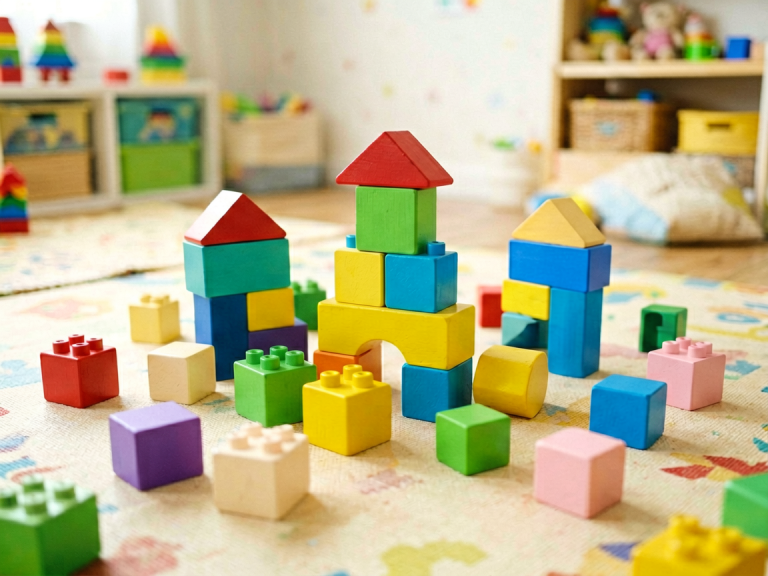
- Math: Building with blocks introduces geometry, symmetry, and balance. Playing store teaches addition, subtraction, and money management.
- Science: Water play explores volume and displacement; mixing colors teaches cause and effect; gardening teaches life cycles.
- Executive function: Card games and complex pretend play develop impulse control, flexible thinking, and working memory—predictors of later academic success stronger than early reading ability.
Therefore, rather than replacing play with worksheets, enrich play with subtle academic elements. Offer a tape measure during block play. Provide pads of paper and crayons in the pretend grocery store. The learning will happen organically.
—
Common Misconceptions About Learning Through Play
- Misconception 1: “Play is only for young children.”
*Reality:* Adolescents and even adults learn through play—think of debate as verbal play, or sports as physical play. The principles adapt with age.
- Misconception 2: “Educational toys are better than classic toys.”
*Reality:* The best toy is the one that allows multiple uses. An expensive electronic toy that only does one thing is less educational than a simple cardboard box.
- Misconception 3: “Structured activities (dance, music lessons) are better than free play.”
*Reality:* Structured activities are wonderful for skill acquisition, but they lack the child-directed experimentation of free play. Children need both.
- Misconception 4: “I need to be teaching all the time.”
*Reality:* Children learn from your presence, not your lessons. Sitting quietly and observing your child’s play, smiling at their discoveries, is deeply supportive.
—
Practical Play Activities to Try This Week
- The Obstacle Course (ages 2–12): Use pillows, blankets, and chairs. Let your child design and test the course. This teaches planning, gross motor skills, and resilience when they fall.
- Sensory Bins (ages 1–6): Fill a shallow bin with rice, beans, or sand. Add scoops, funnels, and small toys. No direction needed—just watch their concentration.
- Story Dice (ages 4–10): Draw or find six pictures (a castle, a dragon, a key, etc.). Roll them and create a story together. Builds narrative skills and collaboration.
- Murder Mystery for Kids (ages 8–12): Adapt a simple mystery; assign roles. Teaches deductive reasoning, listening, and cooperation.
- The Great Egg Drop (ages 5–12): Provide straws, tape, paper, and cotton. Challenge your child to build a container that protects a raw egg when dropped. Engineering, creativity, and failure-tolerance in action.
—
Conclusion: Trust the Play
As a parent, the most important thing you can do is to trust that your child is wired to learn through play. Your job is not to be a teacher in the traditional sense, but to be the gardener—creating a rich, nourishing environment where play can bloom. Protect time for unstructured fun. Resist the urge to fill every moment with lessons. And when you see your child lost in a world of their own making, know that you are witnessing the most profound kind of learning there is. Step back, smile, and let the play begin.