The Power of Play: How Educational Math Toys Shape Young Minds
Introduction: The Intersection of Fun and Learning
Mathematics is often perceived as a daunting subject, a collection of abstract symbols and rules that many children – and even adults – struggle to embrace. Yet beneath the surface of equations and algorithms lies a world of patterns, logic, and creativity. The key to unlocking this world for young learners is not through rote memorization or endless worksheets, but through play. Educational math toys for kids are revolutionizing the way children engage with numbers, shapes, and problem-solving. These tools transform mathematical concepts into tangible, interactive experiences that spark curiosity, build confidence, and lay the foundation for lifelong numeracy. In this article, we will explore why math toys matter, examine the diverse categories available, highlight their cognitive and developmental benefits, and offer practical guidance for parents and educators seeking to incorporate them into a child’s daily life.
Why Math Toys Matter in Early Childhood Development
The early years of a child’s life are a critical window for brain development. Between birth and age eight, the brain forms neural connections at an astonishing rate, and experiences during this period have a lasting impact on learning abilities, emotional regulation, and social skills. Mathematics, often considered a “hard skill,” is actually deeply embedded in everyday experiences: stacking blocks, dividing snacks, recognizing patterns in nature. Educational math toys capitalize on this natural curiosity by providing structured yet open-ended opportunities to explore numerical and spatial relationships.
Research in developmental psychology consistently shows that hands-on learning outperforms passive instruction. For instance, a 2019 study published in *Child Development* found that preschoolers who played with number-based board games significantly improved their counting and number recognition compared to peers who engaged in non-math games. The tactile feedback of manipulating physical objects helps children internalize abstract ideas like addition, subtraction, and geometry. Moreover, math toys reduce anxiety by normalizing mistakes. When a child stacks a tower of blocks that collapses, they learn about balance and symmetry without the fear of a red mark on a test. This low-stakes environment encourages experimentation, a core component of mathematical thinking.
Categories of Educational Math Toys
The market for educational math toys has exploded in recent years, offering a rich variety of tools tailored to different ages and skill levels. Understanding these categories helps parents choose toys that align with their child’s developmental stage.
Counting and Number Recognition Toys
For toddlers and preschoolers, the journey into math begins with counting. Classic tools like abacuses, counting bears, and number puzzle boards allow children to associate quantities with symbols. The Melissa & Doug Abacus, for example, features brightly colored beads that slide along wires, enabling kids to count by ones, fives, or tens. Similarly, wooden number puzzles with chunky pieces help develop fine motor skills while teaching number order. These toys often incorporate multiple senses – sight, touch, and sound – which reinforce memory.
Geometry and Spatial Awareness Toys
Understanding shapes, angles, and spatial relationships is fundamental to geometry and later to fields like engineering and art. Pattern blocks, tangrams, and magnetic tiles are staples in this category. Magna-Tiles, translucent magnetic shapes that snap together, allow children to build 2D and 3D structures, exploring concepts like symmetry, area, and volume. Geo boards with rubber bands let kids create polygons and discover that triangles are rigid while squares are not. Such toys nurture visual-spatial intelligence, a skill linked to success in STEM fields.
Logic and Problem-Solving Puzzles
Mathematics is as much about reasoning as it is about numbers. Logic puzzles, such as Sudoku for kids, Rubik’s Cubes, and mazes, challenge children to use deductive thinking and pattern recognition. The ThinkFun Math Dice game, for instance, requires players to roll dice and combine numbers using basic operations to reach a target – a game that feels more like a competition than a lesson. These toys teach strategic thinking, patience, and the value of trying multiple approaches.
Digital and Interactive Math Toys
In the digital age, screen-based tools can also be educational when used appropriately. Apps like DragonBox Numbers or Prodigy Math Game use adaptive algorithms to tailor challenges to a child’s skill level, providing immediate feedback and rewards. Digital math toys often incorporate storytelling and gamification, which can be particularly engaging for children who resist traditional methods. However, experts recommend balancing screen time with physical toys to ensure holistic development.
Key Benefits: Cognitive, Motor, and Social Skills
Educational math toys are not merely instruments for learning arithmetic; they nurture a broad spectrum of abilities that extend far beyond the math classroom.
Cognitive Development
The most direct benefit is the strengthening of mathematical reasoning. When a child arranges counting bears into groups of ten, they are internalizing the concept base-ten, a cornerstone of our number system. Playing with measurement-based toys like balance scales teaches comparison and estimation. Moreover, these toys enhance executive functions – skills such as working memory, cognitive flexibility, and inhibitory control. For example, a child playing a memory card game with numbers must hold multiple pieces of information in mind, ignore distractions, and adapt strategies as the game progresses. Research from the University of Oxford suggests that children who engage in structured play with math toys display stronger problem-solving abilities in later academic years.
Fine and Gross Motor Skills
Many math toys require precise hand movements. Picking up small counters, fitting puzzle pieces into slots, or manipulating spinning gears all refine fine motor control. These activities prepare children for writing, drawing, and using tools. Larger toys, such as floor puzzles or building sets, also engage gross motor skills as children move their bodies to reach, stack, and balance. The connection between physical movement and cognitive processing is well-documented; the cerebellum, which coordinates movement, also plays a role in attention and learning.
Social and Emotional Growth
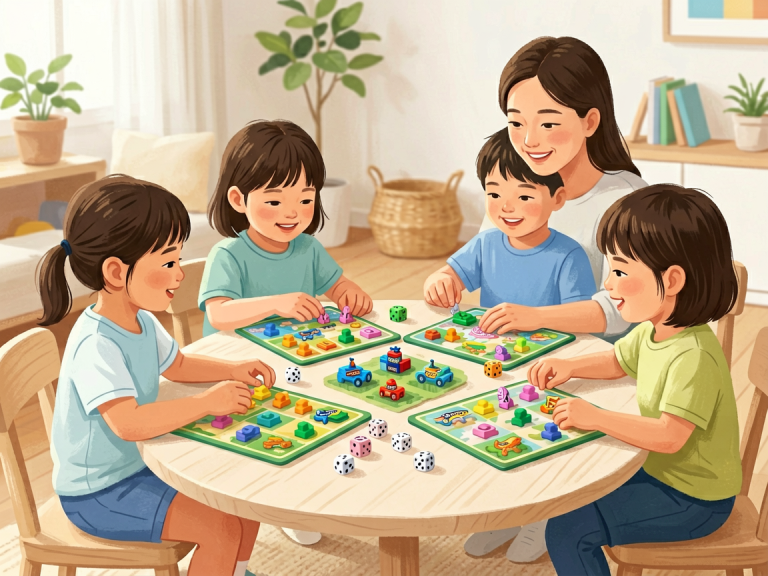
Math toys often become a medium for social interaction. Board games like *Sum Swamp* or *Race to 10* require turn-taking, communication, and cooperation. When children play together, they learn to explain their reasoning, negotiate rules, and handle both winning and losing gracefully. These experiences build emotional resilience and empathy. For children who are naturally shy or anxious about math, collaborative play with a supportive peer or adult creates a safe space to take risks. A 2021 study in the *Journal of Educational Psychology* found that parent-child play with math toys significantly improved children’s attitudes toward mathematics, even among those who initially showed low interest.
How to Choose the Right Math Toys for Your Child
With countless options available, selecting the right educational math toy can feel overwhelming. The key is to match the toy to the child’s age, interests, and current math understanding.
Age Appropriateness
For infants and toddlers (0–2 years), focus on toys that introduce basic concepts like cause and effect, object permanence, and simple counting (e.g., nesting cups, soft blocks with numbers). Preschoolers (3–5 years) benefit from toys that involve sorting, patterning, and number sequencing – think counting bears, number puzzles, and simple board games. School-age children (6–10 years) can handle more complex logic puzzles, multiplication-based games, and introductory geometry kits. Always check age recommendations on packaging, as toys with small parts can be choking hazards.
Open-Ended vs. Structured Play
Both types have value. Open-ended toys (e.g., wooden blocks, pattern tiles) allow children to create their own rules and explore concepts at their own pace, fostering creativity and divergent thinking. Structured toys (e.g., math card games, workbooks disguised as puzzles) provide clear goals and built-in progression, which can be motivating for children who thrive on challenges. A balanced approach works best: rotate between open-ended building sessions and structured game nights.
Child’s Interests
A child who loves dinosaurs might engage with a counting game featuring dinosaur figures; a budding artist might enjoy geometry through kaleidoscopes or symmetry drawing toys. By linking math to a child’s passions, you make the learning organic. For instance, a Lego kit that requires following instructions to build a model inherently teaches measurement, proportion, and sequencing. The more the toy feels like play, the less resistance the child will show.
Practical Tips for Parents and Educators
Integrating educational math toys into a child’s routine requires intention, but it does not have to be complicated. Here are actionable strategies:
Create a “Math Corner”
Designate a small area at home or in the classroom where math toys are always accessible. Use low shelves or bins so children can independently choose and return toys. Rotate the selection every few weeks to maintain novelty. Include a mix of counting items, puzzles, and building sets.
Model a Positive Math Mindset
Children pick up on adult attitudes. If you express frustration with numbers, they may mirror that anxiety. Instead, talk aloud when using math toys: “I wonder how many blocks we need to make this tower as tall as the table?” or “Let’s count how many steps to the door.” Celebrate mistakes as learning opportunities. When a puzzle piece doesn’t fit, say, “Oops, that’s interesting! Let’s try turning it.”
Incorporate Math into Daily Life
Math toys are most effective when complemented by real-world applications. While cooking, ask your child to measure ingredients (fractions!). At the grocery store, have them count items or compare prices. During car rides, play number games like “I spy something that comes in a set of four.” These small moments reinforce that math is not confined to a toy box.
Encourage Peer Play
Arrange playdates centered around math games. Cooperative games where everyone works toward a common goal (e.g., completing a giant floor puzzle of a number line) build teamwork and reduce competition. For older children, math-based escape room kits (like *Math Escape* by Learning Resources) can be a thrilling group activity.
Conclusion: Investing in a Love for Mathematics
Educational math toys for kids are far more than passing fads or educational trends. They are powerful allies in raising a generation that approaches mathematics with curiosity, confidence, and joy. By transforming abstract concepts into something concrete and fun, these tools break down barriers that have long separated children from a subject that is essential to understanding the world. Whether it is a toddler stacking rings that teach relative size, a kindergartner playing a board game that introduces addition, or a third grader assembling a geometric construction, every interaction with a math toy plants a seed. With the right guidance from parents and educators, these seeds can bloom into a lifelong appreciation for the patterns, logic, and beauty of mathematics – a gift that will serve children in every future endeavor, from solving everyday problems to pursuing careers in science, technology, engineering, and beyond. So go ahead: buy the abacus, the tangram set, the counting dice. Then sit down on the floor, roll up your sleeves, and play. In those moments of shared discovery, you are not just teaching math; you are building a foundation for a curious, resilient, and numerate mind.