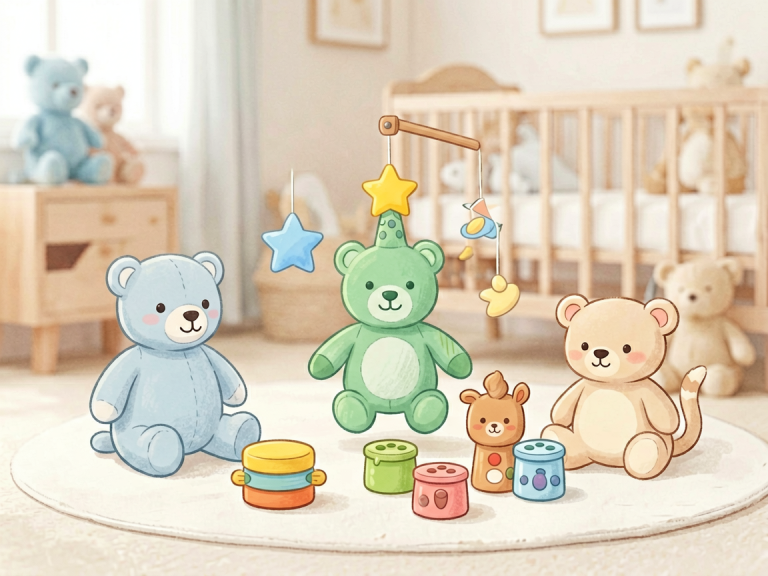
Beyond the Glow: Nurturing Your Two-Year-Old’s Brain with Screen-Free Play
Introduction
In the quiet hum of modern parenthood, the tablet has become an almost irresistible pacifier. A crying toddler in a restaurant, a frazzled parent needing ten minutes of calm, or a long car ride that seems endless—all these moments invite the glowing screen into tiny hands. For a two-year-old, the allure of swiping, tapping, and watching colorful animations is magnetic. Yet beneath that placid digital surface lies a growing body of evidence that screen time at such a young age can subtly undermine the very foundations of healthy development. The alternative—screen-free play—is not a nostalgic luxury but a critical necessity. This article explores why replacing tablet time with hands-on, unstructured play is one of the most powerful gifts you can give your two-year-old, and offers practical, evidence-based strategies to make the transition joyful and sustainable.
—
The Hidden Cost of Tablet Time for Toddlers
When a two-year-old stares at a tablet, what is actually happening inside their rapidly developing brain? The answer is complex and surprisingly sobering. The American Academy of Pediatrics recommends that children under 18 months avoid all screen time except for video chatting, and for children aged 2 to 5, screen time should be limited to one hour per day of high-quality programming, co-viewed with a caregiver. Yet many toddlers today far exceed these guidelines. The problem is not merely the quantity of screen time but its qualitative impact on neurological development.
At age two, the brain undergoes explosive growth, forming more than one million neural connections every second. These connections are shaped primarily through real-world, multisensory experiences: touching a rough pinecone, hearing the crackle of fallen leaves, feeling the weight of a wooden block, seeing the expression on a parent’s face during a game of peek-a-boo. A tablet screen, by contrast, delivers a two-dimensional, pre-packaged stream of stimuli that requires little active participation. The child becomes a passive consumer rather than an active explorer.
Research published in *JAMA Pediatrics* found that higher screen time at age one was associated with lower performance on developmental screening tests at ages two and four, particularly in communication and problem-solving. Moreover, excessive screen exposure in early childhood has been linked to delayed language development, reduced attention span, and impaired executive function—the very skills that underpin self-regulation, planning, and social interaction. The reason is straightforward: every minute spent on a tablet is a minute not spent crawling under a table, stacking blocks, scooping sand, or babbling with a caregiver. These “live” activities are neurologically rich in ways that no app can replicate.
—
The Magic of Unstructured Play: Why “Doing Nothing” Is Everything
Screen-free play for a two-year-old does not mean “doing nothing.” It means engaging in the most sophisticated learning activity known to human development: unstructured, self-directed play. This type of play has no script, no timer, no right or wrong answer. It is messy, repetitive, and often bewildering to adults—but it is precisely the chaos that builds resilient, creative, and emotionally intelligent brains.
When a toddler dumps a basket of toy cars onto the floor and then sorts them by color, abandons that task to stack them into a tower, then knocks the tower down and laughs, they are not wasting time. They are engaging in what child developmentalists call “schema play”—exploring patterns of trajectory, positioning, and cause and effect. When they pretend to feed a stuffed animal with an empty spoon, they are building theory of mind, the ability to understand that others have thoughts and feelings. When they struggle to fit a square peg into a round hole and try, fail, and try again, they are wiring persistence and problem-solving circuits in the prefrontal cortex.
A key difference between screen-based and screen-free play is the role of the caregiver. With a tablet, the device becomes the primary interaction partner. The child learns to respond to a machine rather than a human. In screen-free play, the caregiver’s presence—whether actively playing alongside or simply nearby—provides a secure base from which the child can explore. The back-and-forth of shared attention, joint referencing, and responsive language is irreplaceable. Studies show that the number of conversational turns a toddler experiences (adult speaks, child responds, adult responds to the child’s response) is a stronger predictor of later language and cognitive ability than even socioeconomic status. Tablets rarely facilitate such turns; live play does, naturally and continuously.
—
Practical Screen-Free Play Ideas for Two-Year-Olds
Transitioning away from tablet time can feel daunting, especially if the device has already become a daily habit. But the goal is not to eliminate screens overnight; it is to replace them with experiences that are more engaging, more developmentally appropriate, and more joyful. Here are six categories of screen-free play that work beautifully for two-year-olds, designed to fill the gaps that tablets leave behind.
1. Sensory Bins and Messy Play
Two-year-olds are sensory scientists. A simple bin filled with dry rice, scoops, small cups, and a few plastic animals can occupy a toddler for 20 minutes or more. Add water, shaving cream, or cooked spaghetti (dyed with food coloring), and you have a full-scale sensory laboratory. Messy play supports fine motor development, cause-and-effect understanding, and emotional regulation—yes, getting messy teaches children to tolerate discomfort and adapt. The key is to set up the activity in a contained space (a plastic tablecloth on the floor works wonders) and to join in with enthusiasm, modeling language: “You are scooping the rice! It’s falling down, plop, plop!”
2. Open-Ended Building Materials
Blocks, Duplo, magnetic tiles, and simple stacking toys are the gold standard for cognitive development. Unlike a digital puzzle that lights up when the correct piece is inserted, physical blocks allow infinite combinations. A two-year-old can stack, knock down, sort by size, line up, and create towers that “sleep” under a blanket. Building activities strengthen spatial reasoning, hand-eye coordination, and early math concepts such as balance and symmetry. Resist the urge to “correct” their creations; let the tower fall, and let them learn gravity the hard way.
3. Pretend Play with Real Objects
Two-year-olds love to imitate adult activities. Provide safe, real-world objects: a wooden spoon and a plastic bowl, an old purse with a few scarves inside, a play phone (not a real one) for “calling Grandma.” Pretend play is the foundation of social-emotional intelligence. When your toddler “feeds” you a pretend cookie, they are practicing empathy and turn-taking. When they put a doll to bed and cover it with a cloth, they are processing their own bedtime routine. This type of play requires no batteries, no Wi-Fi, and no subscription—just a little imagination and a lot of patience.
4. Outdoor Exploration
Nature is the ultimate screen-free playground. A 20-minute walk with a two-year-old can take an hour because they stop to examine every pebble, leaf, and puddle. Outdoor play supports gross motor development (running, climbing, balancing), sensory integration (feeling wind, mud, and bark), and executive function (deciding which path to take). Even a small backyard or balcony can be a habitat for wonder: fill a shallow tray with water and add leaves for “boats,” or bury small toys in a patch of dirt and dig for treasure. The unpredictability of nature—the squirrel that suddenly appears, the cloud that changes shape—captivates a toddler’s attention far more effectively than any algorithmically curated video.
5. Music and Movement
Two-year-olds are naturally rhythmic. Put on a song without a screen and watch them bounce, spin, and wave their arms. Provide simple instruments: a tambourine, a shaker made from a sealed bottle of dried beans, a pan and a wooden spoon. Music engages both hemispheres of the brain, supporting language acquisition, memory, and emotional expression. Call-and-response games (“If you’re happy and you know it, clap your hands!”) train attention and social coordination. There is no need for a “learning app” when a live voice and a clapping parent can do ten times more.
6. Art Without Instructions
Finger paints, chunky crayons, playdough, and stickers are staples of toddler art. The key is process over product. Do not ask, “What is it?” Instead, remark on the process: “I see you are making circles. The blue is very dark.” Art allows a two-year-old to express emotions they cannot yet verbalize. It also strengthens fine motor control necessary for later writing. And the best part? It can be done on a highchair tray, on newspaper spread across the floor, or even in the bathtub for easy cleanup.
—
Building a Screen-Free Routine That Works
Replacing tablet time is not about removing a “bad” thing; it is about filling the void with something better. A two-year-old who is genuinely engaged in play does not miss the screen. The challenge is that screens are engineered to be highly addictive, and toddlers who have grown accustomed to them may initially protest the change. The solution is a gentle, structured transition.
Start by identifying the most problematic “tablet moments” in your day—perhaps the 5 p.m. witching hour, or the time you need to prepare dinner. Replace that single slot with a predictable screen-free activity. For example, set out a sensory bin every afternoon at 4:30 p.m. and sit down to play together for fifteen minutes. Consistency builds trust; soon the child will anticipate the bin and look forward to it.
Limit the total number of choices available. Two-year-olds can be overwhelmed by too many toys. Rotate a small selection of open-ended materials (e.g., blocks on Monday, playdough on Tuesday, cars on Wednesday) so that each day feels fresh without requiring constant novelty. Keep the tablet physically out of sight—in a drawer or closet—so it is not a visual temptation.
Most importantly, lower your own expectations. Screen-free play is messy, loud, and unpredictable. But every time you resist the urge to hand over the tablet, you are investing in your child’s long-term cognitive, emotional, and social health. You are saying, “I believe you are capable of boredom, and I know that boredom is the birthplace of creativity.”
—
Long-Term Benefits: Why the Screen-Free Investment Pays Off
The benefits of replacing tablet time with screen-free play extend far beyond the toddler years. Children who spend their early years in rich, unstructured play environments tend to develop stronger self-regulation, better social skills, and higher intrinsic motivation. They learn to tolerate frustration because they have repeatedly experienced the struggle of fitting a puzzle piece or stacking an unstable tower. They become better problem-solvers because they have faced real, physical obstacles rather than algorithmically adjusted digital ones.
Academically, the advantages are equally clear. A 2021 study in *Early Childhood Research Quarterly* found that preschoolers with high levels of pretend play showed greater narrative language skills, a precursor to reading comprehension. The very act of making up a story with a toy dinosaur and a block tower is a rehearsal for literacy. Meanwhile, fine motor skills developed through finger painting and block building directly translate into pencil grip and handwriting readiness.
Emotionally, screen-free play teaches children to regulate their own feelings. A two-year-old who is upset and then calms down by hugging a stuffed animal or by rocking in a corner has developed an internal coping strategy. A child who is handed a tablet during every moment of distress learns to rely on external distraction—a habit that can persist into adulthood as doom-scrolling or gaming. The early years are a window for building the neural circuitry of self-soothing, and that window cannot be opened through a screen.
Finally, there is the gift of connection. When you sit on the floor with your two-year-old, rolling a ball back and forth, narrating their play, laughing at a silly noise, you are doing something that no tablet can replicate: you are co-creating a relationship. That relationship becomes the foundation of your child’s sense of security, their trust in the world, and their capacity for love. No app can teach that. No screen can replace it.
—
Conclusion: Choosing the Real Over the Digital
In a world saturated with screens, choosing screen-free play for a two-year-old is a radical act of love. It requires presence, patience, and a willingness to embrace mess and boredom. Yet the rewards—a child who is curious, resilient, imaginative, and deeply connected to the people around them—are immeasurable. The tablet will always be waiting. But the toddler years will not wait. The time to put down the screen and pick up a wooden spoon, a muddy leaf, or a handmade block tower is now. Because in the end, the best memories are not swiped; they are built, one messy, glorious, screen-free moment at a time.