Igniting Curiosity: The Ultimate Guide to Science Toys for 7-Year-Olds
Introduction
At the age of seven, children are in a sweet spot of cognitive development. Their reading skills have strengthened, their attention spans have lengthened, and their innate curiosity about the world is at an all-time high. They ask "why" relentlessly—why the sky is blue, why a ball bounces, why magnets stick. This is the perfect moment to channel that wonder into structured, hands-on exploration. Science toys for 7-year-olds are not merely playthings; they are tools that bridge the gap between imaginative play and the foundational principles of physics, chemistry, biology, and engineering. The right science toy can transform a living room into a laboratory, a backyard into a field station, and a rainy afternoon into a memorable discovery session. But with countless options flooding the market, how do parents and educators choose the best ones? This article dives deep into the world of science toys designed specifically for seven-year-old minds, offering a comprehensive guide to selecting, using, and maximizing the educational impact of these remarkable resources.
The Importance of Science Toys at Age 7
At seven, children typically enter what developmental psychologist Jean Piaget called the "concrete operational stage." They begin to think logically about concrete events, understand cause and effect, and grasp basic conservation concepts—like the idea that the amount of water remains the same even when poured into a different-shaped glass. Science toys capitalize on this newfound logical ability. For example, a simple pulley system toy teaches mechanical advantage not through abstract equations, but through lifting a bucket of marbles with surprising ease. This hands-on encounter etches the concept into the child's neural pathways far more effectively than any textbook diagram.
Moreover, science toys foster what Carol Dweck famously termed a "growth mindset." When a child builds a circuit and the bulb fails to light, they don't see a failure; they see a puzzle. They try different wire connections, check the battery orientation, and eventually succeed. That iterative process—hypothesis, experiment, observation, revision—is the very heartbeat of scientific thinking. According to a 2019 study published in *Science Education*, children who engaged in structured exploratory play at age seven demonstrated significantly higher scientific reasoning skills by age nine compared to peers who received only passive instruction. In other words, science toys are not just fun; they are predictive of future academic confidence in STEM fields.
Key Criteria for Choosing Science Toys for 7-Year-Olds
Not all "science toys" are created equal. Some are glorified novelties that break within a week, while others are genuinely rich learning platforms. Parents should evaluate potential purchases against four critical criteria:
1. Open-Ended Play Value
A toy that does only one trick—say, a volcano that fizzes once—will lose its appeal after a few minutes. The best science toys allow for multiple experiments, variations, and creative deviations. A crystal growing kit, for instance, can be used to grow different colors, shapes, and sizes depending on solution temperature and time. A programmable robot can be reconfigured to navigate mazes, draw patterns, or respond to sound.
2. Alignment with Developmental Stage
The toy must challenge without frustrating. A chemistry set with real chemicals and glass beakers is inappropriate for a seven-year-old (and often dangerous). Instead, look for "lab kits" with safe, non-toxic materials like baking soda, vinegar, and plastic graduated cylinders. Similarly, a telescope should have a simple mount and large eyepiece, not complex equatorial tracking systems.
3. Safety and Durability
Seven-year-olds are still developing fine motor control and impulse inhibition. Toys should be robust, with no small parts that could be swallowed, no sharp edges, and no toxic substances. Look for certifications like ASTM (American Society for Testing and Materials) or CE marking. Avoid kits that require adult supervision for every step—opt for those where children can independently explore while a parent reads the instructions.
4. Engagement with Real Scientific Concepts
The best toys don't just look like science; they *are* science. A magnetic building set that demonstrates polarity, attraction, and repulsion is superior to a plastic "lab coat" costume. The toy should introduce vocabulary (e.g., "hypothesis," "circuit," "catalyst") in a natural, contextual way.
Top Categories of Science Toys for 7-Year-Olds
1. Chemistry and Reaction Kits
At this age, children are fascinated by visible, dramatic changes. Color-changing liquids, bubbling pots, and growing polymers provide immediate gratification while teaching basics of chemical reactions. Look for kits that include multiple experiments—like the "National Geographic Mega Science Series" which offers volcano, slime, and crystal growth activities in one box. The key is that each experiment introduces a new concept: acids and bases, polymerization, or supersaturation.
2. Physics and Engineering Building Sets
Construction toys have been around for decades, but modern versions incorporate gears, pulleys, levers, and even simple motors. The "LEBO" brand (a lesser-known but excellent alternative to LEGO Technic) offers sets that allow children to build a working compound machine. Meanwhile, "Snap Circuits Jr." is a perennial favorite: plastic modules snap together to create light flashers, sirens, and flying fans, teaching the flow of electricity without any soldering or wiring. These toys develop spatial reasoning, problem-solving, and patience.
3. Biology and Nature Exploration Tools
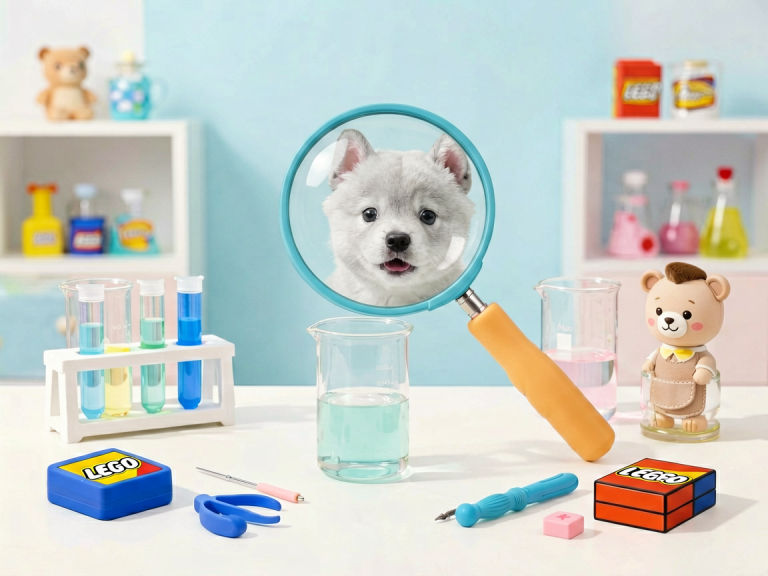
Seven-year-olds are naturalists. They love bugs, leaves, and rocks. A quality magnifying glass with a built-in LED light is a gateway to a million micro-adventures. A bug catcher with a ventilated chamber and lens lets them observe a caterpillar's metamorphosis up close. A "nature journal" kit with watercolor pencils and a field guide to local birds or trees encourages systematic observation and documentation—the very skills of a field biologist.
4. Earth and Space Science Kits
The night sky captivates children at this age. A beginner telescope (like the "Celestron FirstScope") or a planetarium projector that maps constellations onto the ceiling can spark a lifelong interest in astronomy. Similarly, rock and mineral excavation kits allow children to chisel out "fossils" or gemstones from a plaster block, mirroring the work of paleontologists. These toys teach patience and fine motor skills while connecting children to the vastness of Earth's history.
Recommended Specific Toys for 7-Year-Olds
While many toys claim to be educational, a few have stood the test of time and rigorous parent reviews.
- "ThinkFun Gravity Maze" – This marble-run logic game combines structural engineering with sequential thinking. Children must place towers to guide a marble from start to finish, solving increasingly difficult puzzles. It teaches spatial reasoning and the physics of inclined planes and gravity.
- "Thames & Kosmos Kids First Robot Engineer" – A storybook-driven kit where children build 10 different robots that correspond to characters in the narrative. Each robot introduces a mechanical concept (like a four-bar linkage or a worm gear) in a context that feels like play.
- "Learning Resources Primary Science Deluxe Lab Set" – A no-frills but highly durable set with a real microscope (plastic but functional), test tubes, droppers, and activity cards. It encourages open-ended exploration—children can examine a leaf, a strand of hair, or a grain of salt.
- "SmartLab Toys Squishy Human Body" – For the child obsessed with how their own body works, this kit allows them to remove and examine squishy organs, bones, and muscles from a plastic torso. It demystifies biology and dispels the fear of "gross" things by turning them into science.
Safety Considerations and Adult Involvement
Even the best science toys require a degree of supervision—not to restrict the child, but to scaffold their learning. For a seven-year-old, a parent or older sibling should be present for the first few experiments to demonstrate correct technique. Emphasize safety rules: washing hands after handling chemicals (even safe ones like cornstarch), not tasting any substances, and cleaning up spills immediately. Also, discuss the science behind the fun: "Do you think the baking soda and vinegar will react the same way if we use cold vinegar? Let's test that hypothesis."
It's also crucial to avoid the trap of "over-instruction." Allow the child to make mistakes. If they try to connect a battery backwards and the motor doesn't spin, resist the urge to fix it immediately. Ask guiding questions: "What do you notice? Which way is the battery facing? Could the direction matter?" This preserves the critical thinking experience.
Conclusion
Science toys for 7-year-olds are far more than distractions; they are investments in a child's intellectual future. By choosing toys that are open-ended, developmentally appropriate, safe, and conceptually rich, parents can turn playtime into a foundation for lifelong learning. The goal is not to create a mini-scientist who can recite the periodic table, but to cultivate a curious, resilient, and observant human being who sees the world as a place of endless questions and delightful answers. Whether it's building a circuit that lights up a bulb, watching a crystal form over three days, or discovering the hidden veins in a leaf, each experience plants a seed. And with the right toy in hand, a seven-year-old can water that seed every single day.