Building Words, Building Worlds: The Best Toys for 6-Year-Old Girls to Boost Language Development
Introduction
At six years old, a girl’s brain is a sponge for language. She has moved beyond simple phrases and is now mastering complex sentences, storytelling, and the nuances of social communication. This is a critical window for vocabulary expansion, narrative skills, and phonological awareness—all of which lay the foundation for reading and writing. While screens and passive entertainment abound, the most powerful tools for language growth are often the simplest: toys. But not just any toys. The right toys for a 6-year-old girl do more than entertain; they actively engage her in conversation, problem-solving, and imaginative play. This article explores the most effective types of toys that nurture language development in six-year-old girls, offering concrete examples and the linguistic principles behind them.
Storytelling Kits and Puppet Theaters: Giving Voice to Imagination
A 6-year-old girl’s capacity for narrative is blossoming. She can sequence events, create characters, and even add dialogue. Toys that encourage storytelling directly strengthen her ability to organize thoughts and use descriptive language.
Puppet theaters, for instance, are a classic yet powerful choice. When a child manipulates a puppet and speaks for it, she is practicing perspective-taking and dialogue. A set of hand puppets representing family members, animals, or fantasy creatures invites her to create scenarios. She might act out a morning routine, a trip to the zoo, or a fairy tale. Each new character requires a different voice, tone, and vocabulary. For example, a grumpy bear puppet might use words like “disappointed” or “frustrated,” while a cheerful butterfly might say “delightful” or “fluttering.” This role-playing forces her to stretch her lexical choices.
Similarly, storytelling kits—boxes filled with picture cards, small figurines, and setting boards—provide structured prompts. A kit with a “magical forest” theme might include a tree, a fairy, a talking squirrel, and a treasure chest. The girl must weave these elements into a coherent tale. She learns transition words (“first,” “then,” “suddenly”), cause-and-effect language (“because,” “so that”), and emotional vocabulary (“the squirrel felt brave”). Studies have shown that children who engage in regular storytelling play demonstrate higher syntactic complexity in their spoken language. The repetition of narrative patterns also builds memory and sequencing skills—essential for reading comprehension later.
Word Games and Spelling Toys: Playful Phonics and Vocabulary
At six, many girls are beginning to read and write independently. Toys that make phonics and word recognition fun are invaluable. The key is to avoid drills that feel like schoolwork; instead, integrate language into playful competition or discovery.
Alphabet magnets on a whiteboard or magnetic poetry sets allow a child to manipulate letters and form words. For a 6-year-old girl, you can introduce “word families.” Provide a set of magnets with endings like “-at,” “-an,” “-op,” and let her add beginning consonants to create “cat,” “bat,” “hat,” or “fan,” “man,” “pan.” This explicit phonemic awareness—understanding that words are made of smaller sound units—directly predicts reading success. Turning it into a game, such as “Who can make the most words in one minute?” adds motivation.
Another excellent toy is a “scramble word” game with letter dice or tiles. For example, a set that requires players to roll dice and then spell a word related to a category (animals, foods, feelings) encourages quick retrieval of vocabulary. For a girl who loves princesses or unicorns, you can create custom word cards with those themes—she’ll be far more engaged spelling “sparkle” or “castle” than “dog” and “cat.”
Crossword puzzles for kids, available as board games or digital apps, also reinforce spelling and vocabulary in context. The key is that these toys are *interactive*: they require the child to say the words aloud, explain her reasoning, or ask for help from an adult or sibling. That verbalization is crucial. When she says, “I think this word is ‘beautiful’ because it starts with B and has nine letters,” she is not only practicing spelling but also metacognitive language—talking about her own thinking process.
Role-Play Sets: Real-World Language in Action
Six-year-old girls are fascinated by adult roles—they pretend to be teachers, doctors, chefs, or shopkeepers. Role-play toys are arguably the richest context for language development because they demand authentic, context-driven communication.
A “doctor’s kit” with a stethoscope, bandages, and prescription pad is more than a toy; it’s a script. When she plays doctor with a friend or parent, she must ask questions (“Where does it hurt?”), give instructions (“Take this medicine three times a day”), and express empathy (“Don’t worry, you’ll feel better soon”). This is pragmatic language—the social rules of conversation. She learns turn-taking, how to ask for clarification (“What color is the pain?”), and how to use polite forms (“Please open your mouth”).
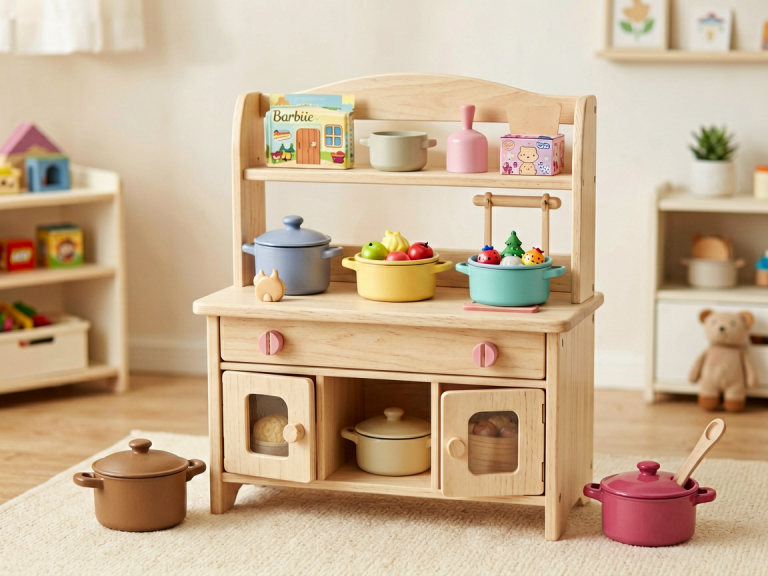
Similarly, a “kitchen set” with play food, pots, and a cash register encourages ordering, cooking, and selling. She might say, “I’d like a pizza with mushrooms and extra cheese, please,” or “That costs five dollars. Do you have change?” These scripts are not just repetitive; they are generative. She can improvise based on new inputs. If you add a menu with unfamiliar items like “quinoa” or “zucchini,” she will ask what they are, expanding her vocabulary.
For girls who love animals, a veterinary clinic playset works wonders. She can diagnose a sick puppy, describe symptoms (“He has a fever and a runny nose”), and offer treatments. The emotional language (“Don’t be scared, little bunny”) builds her ability to express care and concern—a key component of social-emotional language.
Construction and Building Toys: Language Through Planning and Description
Traditionally associated with boys, construction toys like LEGOs, magnetic tiles, or wooden blocks are equally powerful for girls’ language development—especially when combined with narrative. The act of building requires planning, problem-solving, and describing spatial relationships.
A set of colorful magnetic tiles can be used to build a “castle,” a “spaceship,” or a “house for a fairy.” As she builds, she talks through her process: “I need a square for the base, and then I’ll put a triangle on top for the roof. The door has to be big enough for the princess to walk through.” This is *private speech*—talking to oneself to guide action—which Vygotsky identified as a critical step in cognitive and language development. When she later explains her creation to a parent or friend, she must use precise adjectives (“tall,” “shiny,” “crooked”) and sequential language (“First I built the walls, then I added the window”).
Parents can scaffold this by asking open-ended questions: “What is the purpose of this tower?” “How did you decide to put the bridge there?” “Tell me a story about who lives in this house.” Such prompts push her to elaborate beyond one-word answers. Some construction sets come with storybooks or online prompts that encourage following instructions—another form of language comprehension.
Interactive Electronic Toys: Tech That Talks Back—Thoughtfully
Not all screen-based toys are harmful. Carefully chosen electronic toys can enhance language if they are designed for conversation, not passive consumption. For a 6-year-old girl, a voice-enabled interactive toy that asks questions and responds to answers can be a powerful language partner—if used with an adult present to mediate.
For example, some smart toys are essentially “talking” storybooks that pause to ask the child to predict what happens next. One popular toy is a plush animal that “remembers” the child’s name and tells personalized stories, requiring the child to answer questions like “What color is the dragon’s scales?” This turns listening into dialogue.
Another category is programmable robots that require simple voice commands or written instructions. A child might say, “Robot, move forward two steps. Turn left. Say hello.” This teaches syntax and conditional language (“if-then” patterns). Also, digital language-learning games that use voice recognition—such as apps that ask the child to repeat words and then give feedback—can reinforce pronunciation and vocabulary, especially for multilingual households.
However, caution is needed: these toys should never replace human interaction. The American Academy of Pediatrics recommends that digital play be co-viewed and discussed with an adult. So a parent can say, “The robot asked you to say ‘sunshine.’ Can you spell it? What rhymes with sunshine?” This turns a solitary activity into a shared language experience.
Art and Craft Supplies: Describing, Explaining, and Creating
Art is inherently language-rich. A 6-year-old girl with crayons, clay, or collage materials is not just making a picture; she is composing a visual story. Language flows naturally as she labels colors (“turquoise,” “magenta”), describes shapes (“a squiggly line,” “a jagged edge”), and explains her choices (“I used purple because it’s a sad color for the storm”).
Sticker books with hundreds of tiny stickers (animals, vehicles, food) are a deceptively simple tool. She must sort, categorize, and talk about placement: “I’ll put the lion in the jungle and the polar bear in the snow. The fish goes in the water because it can’t breathe air.” This forces classification and explanation—a precursor to scientific language.
Even simple modeling clay can become a language activity. If you give her a prompt like “Make a creature that lives on a cloud,” she will invent a name, describe its features (“It has three eyes and wings made of rainbows”), and tell you its habits. Encouraging her to write a short story about her clay creation further bridges oral and written language.
Board Games: Social Language Under a Structured Umbrella
Board games are exceptional for language because they combine rules, turn-taking, and unexpected events that require verbal navigation. For a 6-year-old girl, games like “Zingo!” (a fast-paced image-matching game), “Story Cubes” (picture dice that spark story generation), or “Scrambled States of America” (geography with vocabulary) all demand that she speak to express herself.
In “Story Cubes,” each roll gives different images (a key, a moon, a fish). She must connect them into a coherent story within a time limit. This works on fluency, creativity, and syntax. In “20 Questions” style games, she practices question formation (“Is it bigger than a breadbox?” “Does it have fur?”). Even simple card games like “Go Fish” require specific linguistic structures: “Do you have any bears?” “Not yet—go fish!” These repetitive phrases build automaticity in polite requests and negation.
Moreover, board games teach the language of mathematics—counting spaces, comparing numbers, discussing probability (“If I roll a 6, I’ll win!”). The emotional language of winning and losing (“Good game!”, “That was close”, “I’ll try harder next time”) builds resilience and social pragmatics.
Conclusion
Language development at age six is not a solitary skill; it is woven into every interaction, every game, every story. The best toys for a 6-year-old girl are those that invite her to *talk*—to describe, explain, narrate, question, and negotiate. Whether through a puppet theater that sparks fantasy, a word-building game that strengthens phonics, or a doctor’s kit that demands real-world dialogue, these tools transform play into a language laboratory. Parents and caregivers can amplify the effect by participating actively: asking open-ended questions, adding new vocabulary in context, and celebrating her verbal creations. When a toy gives a girl the power to build stories instead of just consuming them, she builds not only words but the confidence to use them. And that is the greatest gift of all.