Building Words and Worlds: The Best Toys for 6-Year-Old Boys to Foster Language Development
Introduction: Why Play Matters for Language Growth
At age six, boys are at a pivotal stage of cognitive and linguistic development. They have moved beyond simple two-word phrases and are beginning to master complex sentences, understand story structures, and engage in longer conversations. Their vocabulary expands rapidly—from roughly 2,000 to over 10,000 words by the end of elementary school—and they start to grasp abstract concepts such as time, sequence, and cause-and-effect. However, language development does not happen in a vacuum. It thrives in contexts that are meaningful, interactive, and joyful. Toys, when chosen wisely, become powerful tools for nurturing these skills. For six-year-old boys, who often learn best through hands-on exploration and imaginative play, the right toys can transform everyday moments into rich opportunities for vocabulary building, storytelling, and social communication. This article explores specific categories of toys that effectively support language development in six-year-old boys, offering practical guidance for parents and educators.
The Role of Imaginative and Dramatic Play in Language Acquisition
One of the most effective ways to stimulate language in a six-year-old boy is through dramatic play—pretend scenarios where he takes on roles, creates narratives, and negotiates with others. Toys that encourage this type of play are invaluable.
Costumes, puppets, and play sets (e.g., a firefighter helmet, a doctor’s kit, or a puppet theatre) invite a child to step into another character’s shoes. When a boy dresses up as a chef and “cooks” a meal for his stuffed animals, he naturally uses vocabulary related to food, actions, and sequences: “First, I need to chop the carrots. Then I’ll stir the soup. It’s too hot! Let it cool down.” This kind of self-directed dialogue builds syntactic complexity and narrative skills. More importantly, when he plays with a peer or an adult, he must listen, respond, and adjust his language to maintain the story—a core component of pragmatic language development.
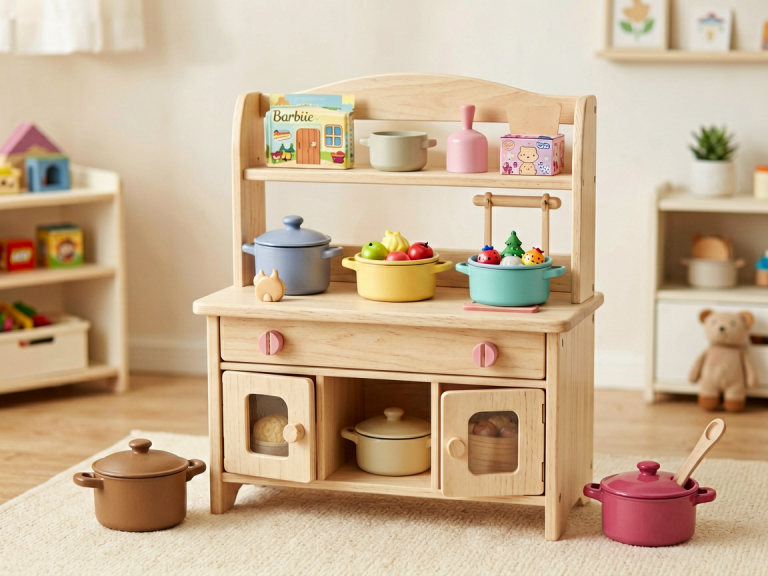
Key examples: A wooden food set with utensils, a veterinarian play kit, or a remote-control car with a garage and ramp. The latter may seem purely physical, but when a boy narrates his actions (“The car is speeding up the ramp—boom! It crashes into the blocks!”), he is practicing past tense, prepositions, and descriptive adjectives. Parents can amplify this by asking open-ended questions: “What happened after the crash? How will you fix it?”
Construction Toys: Building Sentences, One Block at a Time
Construction and building toys, such as LEGO sets, magnetic tiles, and wooden blocks, are often marketed as spatial-awareness tools, but their contribution to language is equally significant. For a six-year-old, the process of following instructions—whether a simple picture guide or a step-by-step manual—requires careful listening and comprehension. As he builds, he learns to use sequential language (first, next, finally) and problem-solving vocabulary (fit, tighten, support, balance).
Moreover, construction play naturally invites descriptive and explanatory talk. When a boy builds a castle, he might announce, “This tower has a secret trapdoor, and the knight goes through it to find the dragon.” Encouraging him to describe his creation to a sibling or parent forces him to organize his thoughts, choose precise words, and use spatial terms like “underneath,” “behind,” “on top of.” Even a simple LEGO set with a theme (e.g., a pirate ship or a fire station) provides a built-in narrative context that fuels language.
Best choices: Look for sets that are open-ended rather than rigidly prescribed. For example, magna-tiles (magnetic building shapes) allow endless reconfiguration, and each new design invites a new story. Also, consider construction toys that include people or animals, as they encourage dialogue between characters. A set of wooden blocks with printed letters or sight words can merge building with early literacy—a child might build a tower and then place a block labeled “big” on top, saying, “The big block is the king.”
Board Games That Spark Conversation and Cooperation
Board games are often overlooked as language tools, but they are among the most effective for developing turn-taking, vocabulary, and spontaneous speech. For a six-year-old boy, games that involve word recall, description, or storytelling can be both educational and highly engaging.
Classic examples include *Guess Who?*, where players ask yes/no questions to identify a character—a fantastic exercise for formulating questions, using adjectives (hair color, hat, glasses), and listening carefully to responses. *Story Cubes* (dice with pictures on each face) challenge a child to roll the dice and create a story using the images, fostering narrative structure, creativity, and verb tense consistency. *Scrabble Junior* or *Bananagrams* introduce letter-sound correspondence and simple word building in a fun, competitive context.
Even non-verbal games like *Jenga* can be language-rich if played with a twist: before each turn, a player must describe something they did that day or answer a question like, “What is your favorite animal and why?” This turns a physical challenge into a conversational exchange. The key is to choose games that require at least some verbal interaction, rather than silent strategy. Cooperative games (where players work together, e.g., *Outfoxed!*) are especially good for reluctant speakers, as they reduce pressure and encourage collaborative problem-solving talk.
Technology-Enhanced Toys: Using Digital Tools Mindfully
While screen time requires caution, certain digital and electronic toys can meaningfully support language development when used with adult mediation. Interactive storybooks (e.g., *LeapFrog LeapReader* or similar devices) allow a child to touch words to hear them pronounced aloud, building phonics and vocabulary in context. Some tablets have educational apps designed for storytelling, such as *Toontastic*, where a child can create animated stories and narrate dialogue—a powerful blend of creativity and language practice.
Voice-activated toys like the *Yoto Player* or *Tonies* boxes offer audio stories that children can control by inserting cards or figurines. Listening to stories expands a child’s exposure to diverse sentence structures, idioms, and vocabulary that he might not encounter in everyday conversation. He can then retell the story to a parent, practicing recall and sequencing. However, these toys should supplement—not replace—live human interaction. A parent who listens alongside the child and asks, “What do you think will happen next?” or “Why did the fox trick the crow?” turns passive listening into active language learning.
The Importance of Parental Interaction: The Secret Ingredient
No toy, no matter how well-designed, can substitute for the rich language input provided by a caring adult. The most powerful language-building “toy” is, in fact, the parent or caregiver who engages with the child during play. While a six-year-old boy may play independently for short periods, language development accelerates when an adult scaffolds the play—asking open-ended questions, expanding on the child’s utterances, and modeling more complex language.
For example, if a boy is playing with a toy crane and says, “Crane lift up,” the parent can expand: “Yes, the crane is lifting the heavy box very slowly. What do you think is inside the box?” This simple addition introduces an adverb (“slowly”), an adjective (“heavy”), and a question that invites a speculative answer. Similarly, when a child is building with blocks, instead of saying “That’s nice,” a parent can say, “I see you made a tall tower with blue blocks. How many blocks did you use? Can you count them with me?” Such interactions embed counting, color vocabulary, and number language naturally.
Parents should also use narrative talk during play: describing what they are doing, modeling the past tense (“I just put the red Lego piece on top”), and predicting future events (“If we add another block, the tower might fall”). This kind of language “input” is far richer than what any toy alone can provide.
Conclusion: Choosing Toys That Grow With the Child
Selecting toys for a six-year-old boy to build language development does not require a complex curriculum or expensive gadgets. The best toys are those that invite interaction, imagination, and conversation. Construction sets that demand descriptive language, dramatic play kits that nurture storytelling, board games that require turn-taking and questioning, and audio tools that expand comprehension all serve a vital purpose. However, the true catalyst is the human connection. When a parent sits beside a child, genuinely curious about his play, and engages in meaningful dialogue, every toy becomes a language-building device.
As you shop for your six-year-old boy, look beyond the flashy packaging. Ask yourself: Will this toy encourage him to talk, question, explain, or invent? Will it give him a reason to use new words? Will it require him to listen and respond? If the answer is yes, you have found a tool that will not only entertain but also empower him to become a confident, articulate communicator. In the end, the most enduring gift we can give a child is the ability to express himself fully—and the right toys, combined with loving interaction, pave that path.