Hands-On Activities for 6-Month-Olds: Building Foundations Through Play
Introduction
The sixth month of life marks a remarkable developmental milestone. At this age, infants transform from passive observers into active explorers of their world. They can typically sit with support, grasp objects deliberately, transfer items from one hand to another, and exhibit intense curiosity about everything within reach. Their brains are developing at an astonishing rate, forming neural connections at a pace that will never be repeated. This critical period makes hands-on activities not merely entertaining diversions but essential tools for cognitive, physical, and emotional growth.
Hands-on activities for 6-month-olds are specifically designed to engage their emerging senses, encourage cause-and-effect thinking, and strengthen the fine and gross motor skills that will support later milestones like crawling and self-feeding. Unlike passive entertainment such as screen time, purposeful hands-on play invites babies to touch, taste, hear, see, and manipulate their environment. Each interaction builds a tiny bridge between their understanding and the physical world. This article explores a variety of safe, developmentally appropriate, and engaging hands-on activities that parents, caregivers, and early childhood educators can incorporate into daily routines to maximize this precious window of discovery.
Why Hands-On Activities Matter at Six Months
Brain Development and Neural Pathways
At six months, an infant’s brain has already reached about half of its adult size, but its real magic lies in the sudden explosion of synaptic connections. Every time a baby reaches for a rattle, feels the texture of a crinkly fabric, or drops a spoon to see what happens, their brain fires and wires new neural pathways. Hands-on activities provide the rich sensory input that drives this process. Unlike abstract learning, which is impossible at this age, concrete, tactile experiences help babies understand object permanence, spatial relationships, and the consequences of their actions. For example, when a 6-month-old shakes a bell and hears a sound, they begin to associate motor action with auditory feedback — a precursor to later scientific thinking.
Physical Development Milestones
By six months, most babies can roll over both ways, sit with support or briefly unsupported, and bear weight on their legs when held upright. Their pincer grasp (using thumb and index finger) is still developing, but they can rake small objects into their palm. Hands-on activities specifically target these emerging skills. Lifting lightweight toys strengthens shoulder and arm muscles needed for crawling. Grasping different shapes and sizes trains hand-eye coordination. Pulling to stand at a low surface becomes possible later, but the preparatory work — reaching, balancing, and weight-shifting — begins now through guided play.
Social-Emotional Growth
Hands-on activities also serve as powerful bonding tools. When a caregiver sits face-to-face with a baby, models how to play with a toy, or celebrates a successful grab, the baby experiences safety and attachment. This mutual engagement builds trust and emotional regulation. Moreover, activities that involve repetition — like stacking and knocking over blocks — teach babies that their actions have predictable outcomes, fostering a sense of agency and confidence.
Sensory Play Activities for Tactile and Visual Stimulation
Texture Treasure Basket
One of the most effective hands-on activities for 6-month-olds is the texture treasure basket. Unlike a toy box filled with plastic objects, a treasure basket contains natural, everyday items selected for their varied textures, weights, and appearances. Choose a low, shallow basket (approximately 30 cm in diameter) with no sharp edges. Fill it with items such as a wooden spoon, a silk scarf, a large corduroy square, a metal whisk (ensure no sharp prongs), a stainless steel bowl, a pine cone (cleaned and sealed with non-toxic varnish), a soft sponge, and a smooth river rock. Place the baby in a supported sitting position on a blanket or in a baby seat, and set the basket within easy reach. Do not direct the baby’s play — instead, observe as they explore each object by mouthing, banging, and transferring them. This self-directed activity develops sensory discrimination, concentration (babies may focus on one object for five to ten minutes), and fine motor skills.
Homemade Sensory Bags
Sensory bags are mess-free alternatives to finger painting. Fill a sturdy, double-sealed zip-lock bag (freezer-grade, 1-gallon size) with a small amount of hair gel or clear dish soap, add a few drops of food coloring (optional, and only if the bag is securely sealed), and include safe objects like large sequins, feathers, or plastic buttons. Tape the bag to the floor or a high chair tray using strong packing tape, sealing all edges. The baby can then press, pat, and slide the contents, watching the colors swirl and the objects move. This activity strengthens wrist and finger muscles while introducing cause and effect. Supervise closely, and discard the bag at the first sign of wear.
Mirror Play for Self-Awareness
A large, unbreakable mirror (acrylic or specially designed baby mirror) provides endless fascination. Lay the baby on a soft play mat with the mirror propped securely at a 45-degree angle. Alternatively, attach the mirror to the side of a playpen or crib (following safety guidelines). The baby will gaze at their own reflection, eventually reaching out to touch it. This activity supports visual tracking, self-recognition (which typically emerges between 5 and 8 months), and social development when a caregiver sits beside the mirror and makes faces.
Fine Motor Skill Development Activities
Grasping and Reaching Games
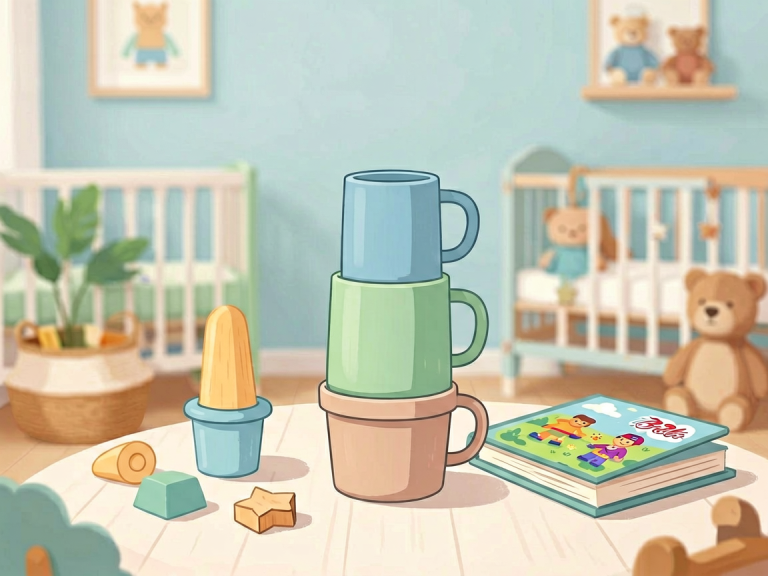
At six months, voluntary grasping is still a challenge, but it improves rapidly with practice. Offer toys that are easy to hold: wooden rings (diameter 7–10 cm), soft fabric blocks, or plastic stacking cups with textured surfaces. Hold a toy just out of the baby’s reach and encourage them to stretch for it. When they grasp it, praise enthusiastically. Progress to handing the toy to the baby with one hand, then holding out your hand to receive it back — this back-and-forth game teaches social turn-taking and the concept of releasing objects. For a variation, tie a soft toy to a short ribbon (maximum 20 cm long, never longer than the baby’s arm to avoid strangulation hazards) and dangle it gently so the baby can bat at it.
Baby Drumming
Babies love making noise, and drumming is an excellent hands-on activity for arm strength and rhythm awareness. Place an overturned plastic bowl, a metal pot (cooled and clean), or a small wooden box in front of the baby. Child-safe wooden spoons or maracas (with no small parts) make ideal drumsticks. Show the baby how to tap the surface, then let them experiment. They will quickly learn that different surfaces produce different sounds — a metal pot rings, a plastic bowl clunks, a cardboard box thuds. This activity reinforces cause-and-effect, auditory discrimination, and bilateral coordination (using both arms together or alternately).
Pincer Grasp Practice with Snacks
If the baby has started solids (typically around 6 months, after consultation with a pediatrician), finger foods offer a perfect fine motor challenge. Offer small, soft, dissolvable puffs, cooked pea-sized pieces of carrot, or banana slices. Place them on the high chair tray or a clean surface. The baby will rake them into their palm at first, but repeated practice helps them develop the pincer grasp — using thumb and forefinger to pick up tiny objects. Always supervise to prevent choking, and ensure foods are soft enough to squash easily between tongue and palate.
Tummy Time and Gross Motor Activities
Pillow Obstacle Course
Tummy time remains crucial at 6 months, but many babies grow impatient lying flat. Make it engaging by creating a soft obstacle course. Use firm pillows, rolled blankets, or a nursing pillow to create gentle inclines. Lay the baby on their tummy on the lowest incline, and place a favorite toy just beyond their reach on the next mound. Encourage them to push up, pivot, and possibly scoot forward. This strengthens neck, shoulder, and back muscles for crawling. Always supervise to ensure the baby’s airway remains clear, and vary the layout daily to maintain interest.
Assisted Standing and Bouncing
Many 6-month-olds love to bear weight on their legs when held under the arms. Stand them on a soft mat and gently bounce them up and down while singing a song like “Row, Row, Row Your Boat.” This activity strengthens leg muscles and hip joints, and the rhythmic motion provides vestibular stimulation. For variety, let the baby stand facing a low, sturdy coffee table (with rounded corners) and place a few toys on the surface. The baby will enjoy supporting themselves while reaching for objects. Do not force standing; if the baby’s legs give way, simply lower them to sitting.
Rolling Games
Rolling is a major gross motor milestone at this age. Help the baby practice by using a toy to encourage side-to-side rolling. Lie the baby on their back, hold a colorful rattle or crinkle book to one side, and slowly move it over their head to the other side. As they follow the toy with their eyes and turn their head, their body will naturally begin to roll. If needed, gently help by lifting the hip or shoulder. Celebrate each roll, no matter how accidental. This activity builds core strength and body awareness.
Sensory-Motor Combination Activities
Water Play (Supervised)
Fill a shallow plastic tub or a baby bathtub with 2–3 inches of lukewarm water. Place it on a waterproof mat on the floor. Let the baby sit securely (with support if needed) and splash, pat, and scoop the water. Provide a few waterproof toys: a plastic cup, a floating rubber duck, a small sieve. Babies learn about volume, buoyancy, and temperature through this activity. Always stay within arm’s reach, never leave the baby unattended around water, and keep the water temperature comfortable (around 90°F / 32°C). Limit sessions to 10–15 minutes to prevent chills.
Fabric Scarf Tug-of-War
Cut a piece of brightly colored silk or lightweight cotton fabric into a strip about 60 cm long and 15 cm wide. Sit facing the baby, holding one end of the scarf. Let the baby grasp the other end. Gently pull and release, creating a gentle tugging motion. The baby will feel the resistance and eventually learn to pull back. This activity develops grip strength, arm strength, and the concept of physical cause and effect. It also encourages eye contact and social play. Supervise to ensure the scarf does not wrap around any body part.
Safety Considerations for All Activities
Supervision and Environment
No hands-on activity for a 6-month-old is safe without direct, constant supervision. Babies at this age explore primarily through their mouths, so any object small enough to fit through a toilet paper tube (approximately 4 cm in diameter) poses a choking hazard. Check all items for loose parts, sharp edges, and toxic materials. Natural objects like pine cones or shells should be thoroughly cleaned and sealed with non-toxic varnish. Never use balloons, latex gloves, or small magnets.
Hygiene and Cleanliness
Because babies mouth everything, wash all toys and activity materials before and after each use. For sensory bags, inspect the seal each time and replace if any leaks appear. For food-based activities (like finger snacks), ensure surfaces are sanitized, and remove any uneaten food promptly. Rotate toys regularly to maintain novelty and reduce germ buildup.
Positioning and Support
Always place the baby in a safe, comfortable position. Never prop a baby into a sitting position if they cannot sit unsupported; instead, use a supportive seat like a Bumbo (on the floor, never on a raised surface) or place pillows around them for stability. Tummy time should always be on a firm, flat surface. Avoid soft bedding or sofas that increase suffocation risk.
Conclusion
Hands-on activities for 6-month-olds are far more than simple pastimes — they are the very foundation of early learning. Through sensory bins, grasping games, tummy time challenges, and water play, babies build the neural pathways, physical skills, and emotional bonds that will carry them through childhood and beyond. Each activity, no matter how simple, provides a rich context for discovery: a wooden spoon becomes a lesson in texture and weight; a mirror reveals the mystery of self; a soft scarf teaches the joy of interaction.
Parents and caregivers need not invest in expensive toys. The best hands-on materials often come from the kitchen, the laundry basket, or the garden — everyday objects transformed by the magic of a baby’s curiosity. What matters most is presence: sitting on the floor, making eye contact, narrating the experience with a gentle voice, and allowing the baby to lead their own exploration. In these quiet moments of play, a 6-month-old is not just playing — they are learning how to learn. And that is the most extraordinary activity of all.