The Power of Play: Fostering Language Development in 4-Year-Olds Through Creative Activities
Introduction
The age of four is a remarkable period in a child’s life. It is a time when vocabulary explodes, sentences become more complex, and the ability to express thoughts, emotions, and imaginative ideas blossoms. At this developmental stage, children are naturally curious, endlessly energetic, and driven to explore the world around them. While structured lessons and flashcards may have their place, research in developmental psychology and early childhood education consistently points to one of the most effective and joyful vehicles for language growth: play.
Play is not merely a pastime; it is the child’s primary mode of learning. Through play, four-year-olds practice social interaction, experiment with new words, develop narrative thinking, and refine their listening skills. The key is to design play activities that are rich in language opportunities without turning them into formal drills. This article offers a variety of play ideas specifically tailored for four-year-olds, each designed to naturally boost vocabulary, sentence structure, conversation skills, and phonological awareness. By weaving language development into the fabric of everyday fun, parents and educators can empower children to become confident, articulate communicators.
—
1. The Language-Rich Environment: Setting the Stage for Words
Before diving into specific activities, it is essential to understand that language development begins with the environment. A four-year-old thrives in a space where words are everywhere—spoken, written, sung, and whispered. The physical setup of a play area can encourage conversation. For instance, placing a small chalkboard or whiteboard in the playroom allows children to scribble letters and attempt to write their names, while parents can model labeling objects around the room (“This is a red block. Can you find another red block?”).
Another powerful tool is the use of word walls or picture cards at the child’s eye level. Instead of overwhelming them with too many words, choose a theme for the week—such as “animals,” “transportation,” or “feelings”—and display five to six new words with pictures. During play, casually refer to these words. For example, if the word “safari” is on the wall, you might say, “Your toy elephant is going on a safari! Where is it exploring?” This simple environmental cue invites a child to use the word in context.
Even the arrangement of toys matters. Rotate toys periodically to create novelty, which sparks curiosity and gives the child reasons to ask questions (“What is this new thing?”). When the environment is intentionally language-rich, every play session becomes a conversation starter.
—
2. Pretend Play: Building Vocabulary and Narrative Skills
Four-year-olds are masters of make-believe. Pretend play is perhaps the single most powerful context for language development because it demands that children take on roles, negotiate with playmates, and create storylines. According to the renowned psychologist Lev Vygotsky, imaginative play allows children to operate “a head taller” than their actual age, using language to plan, regulate behavior, and express abstract ideas.
Play Idea 1: The Grocery Store
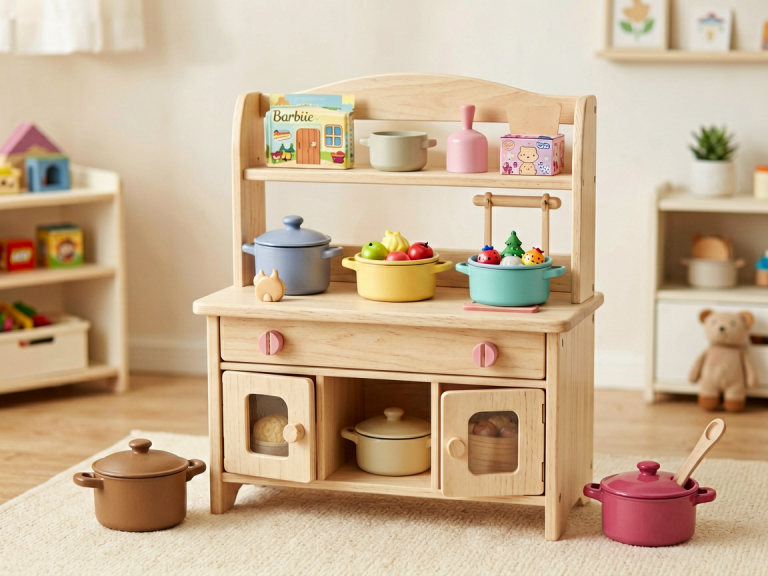
Set up a small pretend grocery store with empty food boxes, a toy cash register, play money, and baskets. As the child becomes the “customer” or the “cashier,” they must use language to request items, ask for prices, and thank the other person. The adult can model phrases like “I would like three apples, please” or “Do you have any milk?” Over time, the child will internalize these sentence structures and vocabulary. To make it more advanced, introduce problem-solving: “Oh no, I only have five dollars. Can you help me count how many items I can buy?” This turns a simple role-play into a rich linguistic and cognitive exercise.
Play Idea 2: Doctor’s Office
A toy doctor’s kit (or even a homemade one with a plastic stethoscope and Band-Aids) invites the child to play the doctor, nurse, or patient. As they examine a stuffed animal, they naturally use words like “stomachache,” “fever,” “prescription,” and “temperature.” The adult can ask open-ended questions: “What do you think is wrong with Teddy? How can we make him feel better?” This encourages the child to form complete sentences and explain a sequence of actions. Furthermore, because empathy is involved, the play also fosters emotional vocabulary—words like “worried,” “brave,” or “comfortable.”
—
3. Interactive Storytelling and Book-Based Play
Reading aloud is a cornerstone of language development, but for a four-year-old, the key is to move beyond passive listening. Interactive storytelling turns a book into a springboard for active language use.
Play Idea 1: “Finish the Story”
Choose a familiar picture book, such as *The Very Hungry Caterpillar* or *Brown Bear, Brown Bear, What Do You See?* After reading it once together, go back and pause at key moments, asking the child to “read” the next line from memory or even invent a new ending. For instance, after the caterpillar eats through the foods, ask: “What do you think would happen if the caterpillar ate a pizza?” The child’s imaginative response—whether it’s “It would turn into a pizza butterfly!” —is a goldmine for language practice because it forces them to construct a novel sentence.
Play Idea 2: Story Props and Puppets
Gather simple props (a toy leaf, a small apple, a piece of string) related to a story you have just read, and let the child retell the story using the objects. Better yet, use finger puppets or sock puppets to create dialogues. The act of manipulating a puppet while speaking helps shy children overcome the fear of speaking because the puppet becomes an intermediary. Encourage the child to change the voices for different characters—a high squeaky voice for a mouse, a deep growl for a bear. This practice improves intonation, articulation, and the understanding of character perspectives.
Play Idea 3: Storytelling Dice or Cards
You can create or purchase dice with pictures of characters, settings, and objects (e.g., a princess, a forest, a magic wand). Together, roll the dice and weave a story: “Once upon a time, a little dragon went into a dark cave and found a golden key.” Taking turns adding a sentence not only builds narrative cohesion but also teaches the concept of sequence (first, then, next, finally). For an extra language boost, ask “why” questions: “Why did the dragon go into the cave?” prompting the child to explain cause and effect.
—
4. Music, Rhymes, and Word Games
Phonological awareness—the ability to hear and manipulate sounds in words—is a strong predictor of later reading success. Music and rhyming games are perfect for four-year-olds because they are inherently rhythmic, repetitive, and joyful.
Play Idea 1: Silly Song Substitutions
Take a well-known nursery rhyme like “Twinkle, Twinkle, Little Star” and change the words to incorporate new vocabulary. For example, “Twinkle, twinkle, little car, how I wonder where you are.” Or substitute the child’s name: “Bounce, bounce, little ball, you can bounce against the wall.” As you sing, ask the child to come up with their own silly versions. This playful manipulation of sounds and words strengthens phonemic awareness while expanding vocabulary.
Play Idea 2: “I Spy” with Sounds
The classic game “I Spy” can be adapted for language development in a powerful way. Instead of just saying “I spy with my little eye… something blue,” try “I spy with my little ear… a word that starts with /b/.” Then the child searches the room for an object beginning with the letter B (like a ball or book). This game teaches letter-sound correspondence and listening skills. Another variation: “I spy something that rhymes with ‘cat’ ” (hat, mat, bat). At age four, children may not yet be able to generate rhymes easily, so you can offer a few choices: “Does ‘dog’ rhyme with cat or frog?”
Play Idea 3: Action Songs and Dancing
Songs that require movement, such as “Head, Shoulders, Knees, and Toes,” “If You’re Happy and You Know It,” or “The Hokey Pokey,” integrate kinesthetic learning with language. The child must listen to the words and translate them into physical actions, reinforcing the meaning of each word. For four-year-olds, you can slow down the song and emphasize the vocabulary: “Put your right hand in, take your right hand out.” Later, you can make up your own verses using new words: “If you’re excited and you know it, stomp your feet!” This helps children learn adjectives and verbs in a memorable, embodied way.
—
5. Outdoor and Sensory Play for Language
Language development does not have to happen indoors or at a table. The outdoors provides a rich sensory landscape that naturally invites descriptive talk.
Play Idea 1: Nature Scavenger Hunt
Create a simple list with pictures and words: “Find something rough,” “Find a yellow leaf,” “Find a stick that looks like a letter Y.” As the child searches, engage in running commentary: “Wow, you found a bumpy bark! How does it feel? Does it look like a dinosaur’s skin?” Using comparative and descriptive language (smooth, jagged, crinkly, heavy, light) expands the child’s adjective bank. At the end, have the child tell you a story about the objects they collected: “This stone is a magic egg, and this leaf is its blanket.”
Play Idea 2: Sandbox or Mud Kitchen
Playing with sand or mud is messy, but it is also a perfect opportunity for language. Provide cups, spoons, sieves, and plastic animals. As the child pours and digs, use positional language: “Can you put the turtle under the bridge?” “The water is going through the sieve.” “The bucket is on top of the castle.” These prepositions are difficult to teach through flashcards but become intuitive during hands-on play. Moreover, the child will naturally narrate their own actions: “I’m making a cake for the bear.” Encourage elaboration by asking, “What ingredients are in your cake?”
Play Idea 3: Obstacle Course with Instructions
Set up a simple obstacle course in the backyard using pillows, hula hoops, cones, or chairs. The game can be directed by the adult who gives two-step instructions: “First, crawl under the blanket. Then, hop three times.” To make it more language-focused, have the child be the “teacher” and give you instructions. When a four-year-old directs an adult, they must organize their thoughts and use clear language: “You need to jump over the puddle, then spin around.” If they forget a step, gently prompt them with a question: “What comes next?” This builds executive function along with language.
—
6. The Role of Parents and Caregivers: Guiding Without Overpowering
The success of any play-based language activity depends largely on the adult’s interaction style. Research shows that children learn language best when adults engage in responsive communication—that is, following the child’s lead, expanding on their utterances, and asking open-ended questions.
For example, if a child points to a dog and says, “Doggy,” a parent might expand: “Yes, that’s a big brown doggy. He looks friendly! Do you think he wants to play fetch?” This expansion adds new words (“big,” “brown,” “friendly,” “fetch”) while validating the child’s communication. Avoid the temptation to correct every grammatical error at this age; instead, model the correct form naturally. If the child says, “I goed to the park,” you can respond, “Oh, you went to the park? That sounds fun!”
Equally important is the use of wait time. Four-year-olds often need a few extra seconds to process and formulate their thoughts. If you ask a question and the child is silent, resist the urge to answer it yourself. Instead, look at them expectantly or slightly rephrase: “Hmm, I wonder what we should name our dragon puppet.” This patience gives the child the confidence to take a conversational turn.
Finally, remember that play should remain fun. If a child seems frustrated or uninterested, switch to a different activity or simply let them lead. The goal is not to drill vocabulary but to create a positive emotional association with language. A child who feels safe, loved, and engaged will naturally absorb the words they need.
—
Conclusion: Play as the Foundation of Communication
At four years old, a child’s ability to express themselves is still taking shape. Every game of pretend, every nursery rhyme sung off-key, every sandcastle built and described together weaves the fabric of language. The play ideas outlined in this article—from grocery store role-play to nature scavenger hunts—are not just ways to pass the time; they are powerful, evidence-backed strategies to nurture vocabulary, grammar, narrative skills, and phonological awareness.
By creating a language-rich environment, engaging in interactive storytelling, incorporating music and movement, and taking play outdoors, parents and educators can support the natural unfolding of a child’s communicative abilities. Most importantly, these activities strengthen the bond between adult and child, making every word spoken a shared gift.
So the next time you see a four-year-old building a castle out of blocks or pretending to be a doctor, remember: they are not just playing. They are learning to talk about their world, to connect with others, and to imagine futures yet unwritten. And with a little thoughtful guidance, that play can become the most powerful language lesson of all.