Beyond Play: How Science Toys for 11-Year-Olds Shape Critical Thinkers and Future Innovators
Introduction: The Magic Age of Curiosity
At eleven, a child stands at a remarkable crossroads. The boundless wonder of early childhood has not yet faded, but the cognitive capacity for abstract reasoning, hypothesis testing, and systematic exploration is blossoming rapidly. This is the golden age for science toys—not merely as diversions, but as powerful tools that can ignite lifelong passions and build foundational skills in problem-solving, creativity, and scientific literacy. While many parents and educators still view toys as mere entertainment, the right science toys for 11-year-olds can transform play into a laboratory of discovery. This article explores why this age group is uniquely primed for sophisticated science play, what types of toys offer the most developmental value, and how these seemingly simple objects can shape the innovators of tomorrow.
The Cognitive Landscape of an 11-Year-Old: Why Science Toys Matter Now More Than Ever
From Concrete to Abstract Thinking
By age eleven, most children have entered what developmental psychologist Jean Piaget called the "formal operational stage." This is a monumental shift. No longer limited to concrete, hands-on experiences, they can now think about hypothetical situations, engage in deductive reasoning, and manipulate ideas in their minds. A science toy that demonstrates chemical reactions, for instance, is no longer just a fascinating spectacle—it becomes an opportunity to ask "what if?" and to predict outcomes before they happen. This cognitive leap makes 11-year-olds ideal candidates for kits that involve programming, electronics, chemistry, or engineering, because they can now grasp the underlying principles rather than just mimicking steps.
The Social Dimension of Learning at This Age
Eleven-year-olds are also deeply social creatures. They crave collaboration, competition, and shared discovery. Science toys that can be used in pairs or small groups—such as robotic building kits, marble runs with programmable elements, or even simple physics experiments with multiple variables—capitalize on this social energy. When children work together to troubleshoot why their homemade volcano didn't erupt properly or why their solar-powered car won't move, they are not just playing; they are negotiating, communicating, and developing teamwork skills that are essential for real-world scientific collaboration. Furthermore, this social context makes learning stickier. A concept learned through a joyful, shared experience is far more likely to be remembered than one delivered through a textbook.
Categories of Science Toys That Deliver Maximum Impact
Engineering and Robotics: Building the Architects of Tomorrow
One of the most powerful categories of science toys for this age group is engineering and robotics kits. Products like LEGO Mindstorms or more affordable alternatives such as Makeblock or littleBits allow children to construct motorized models and program them using simple block-based coding interfaces. At eleven, a child can build a robotic arm that picks up objects, a self-balancing robot, or a line-following vehicle. The educational payoff is immense. They learn about gears, levers, torque, and friction in a tactile way that no diagram can replicate. More importantly, they learn the iterative process of design: build, test, fail, modify, and retry. This resilience in the face of failure is perhaps the most valuable lesson of all. Unlike school assignments where getting the "wrong answer" is penalized, engineering toys reward trial and error. This mindset—that failure is feedback, not defeat—is the hallmark of every successful scientist and engineer.
Chemistry and Biology Kits: The Thrill of Safe Discovery
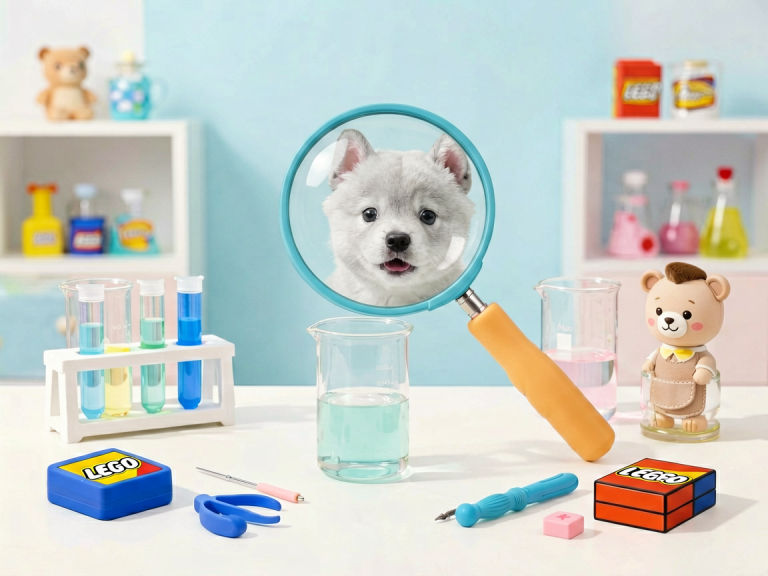
Chemistry kits have come a long way from the simple baking soda volcanoes of early childhood. Modern kits for 11-year-olds include real lab equipment like test tubes, beakers, safety goggles, and chemical reagents that are safe but produce genuinely impressive results. Kits that explore pH indicators, crystal growth, or even DNA extraction from fruits can captivate a young mind. The key is that these toys do not just provide instructions; they encourage open-ended exploration. For example, a kit might ask: "What happens if you add more acid than the recipe calls for?" or "Can you make a crystal grow in a different shape?" This transforms the child from a passive follower into an active investigator. Biology-focused toys, such as microscopes with prepared slides and the ability to collect samples from the backyard, open up an invisible world. When an 11-year-old sees the vein structure of a leaf or the tiny organisms in a drop of pond water, the abstract concept of "life at the microscopic level" becomes visceral and unforgettable.
Physics and Electronics: Understanding How the World Works
Toys that demonstrate principles of physics—such as electricity, magnetism, light, and sound—are particularly effective at this age because they connect directly to everyday experiences. A snap-together electronics kit that lets a child build a working radio, a door alarm, or a lie detector makes the invisible world of electrons tangible. Similarly, optical kits with prisms, lenses, and diffraction gratings can explain why rainbows appear and how telescopes work. The beauty of these toys is that they demystify technology. An 11-year-old who has built a simple circuit understands why a light bulb turns on; they are less likely to see technology as magic and more likely to see it as something they can understand and even improve. This sense of empowerment is crucial. It counters the passive consumption of screens and replaces it with active creation.
Beyond the Toy: How Parents and Educators Can Maximize the Experience
The Role of Guided Discovery
A science toy is only as good as the context in which it is used. An 11-year-old left alone with a complex kit may become frustrated or lose interest. Conversely, an adult who hovers too much can stifle the child's sense of ownership. The sweet spot is what educators call "guided discovery." An adult can ask open-ended questions: "What do you think will happen if you change this variable?" "Why do you think that didn't work?" "Can you think of another way to solve the problem?" These questions encourage metacognition—thinking about one's own thinking—which is a higher-order skill that benefits all areas of learning. Additionally, parents can connect the toy to real-world applications. If the child builds a simple electric motor, the parent might show a video of how motors power electric cars or household appliances. This bridges the gap between the toy and the world, making the science feel relevant and exciting.
Avoiding the Trap of the "Perfect" Toy
There is no single science toy that fits every 11-year-old. Some children are drawn to building and mechanics; others are fascinated by living things; still others love to mix chemicals and observe reactions. The best approach is to observe the child's natural inclinations and choose toys that align with them, while also gently pushing them into new territory. For instance, a child who loves video games might be introduced to coding toys that let them create their own games. A child who loves cooking might be given a chemistry kit that explores the science of baking. The goal is not to force a particular discipline but to use the child's existing interests as a gateway. Furthermore, it is important to remember that the toy itself is only a catalyst. The real learning happens in the conversations, questions, and experiments that follow. A child who spends an afternoon trying to make a rocket fly higher—and fails, adjusts, and tries again—has learned more than a child who successfully follows instructions once.
Conclusion: Planting Seeds for a Lifetime of Inquiry
Science toys for 11-year-olds are far more than Christmas presents or birthday gifts. They are investments in a child's cognitive development, emotional resilience, and intellectual curiosity. At this pivotal age, a well-chosen science toy can spark a passion that leads to a career in engineering, medicine, or research—or simply to a lifelong love of understanding how things work. But even for children who never become scientists, these toys teach essential life skills: critical thinking, persistence, creativity, and the joy of discovery. The world needs more people who can ask good questions, who are not afraid to make mistakes, and who see problems as puzzles to be solved. And that is exactly what the best science toys provide: a safe, joyful, and endlessly fascinating space to practice being human in the most curious way possible. So the next time you see a 11-year-old hunched over a circuit board or staring through a microscope, remember: they are not just playing. They are building the future, one experiment at a time.