STEM on a Shoestring: Inspiring Young Scientists with Budget-Friendly Toys and Activities
Introduction
The term "STEM toys" often conjures images of glossy boxes, expensive robotics kits, and brand‑name microscopes that cost more than a weekly grocery run. For many parents, educators, and caregivers, the price tag alone can feel like a barrier to giving children a head start in science, technology, engineering, and mathematics. Yet the core of STEM education is not about the price of a toy—it is about curiosity, experimentation, and the joy of discovery.
With a little creativity and a willingness to look beyond the toy store aisle, it is entirely possible to cultivate a rich STEM learning environment on a tight budget. In fact, some of the most powerful “toys” cost nothing at all: a cardboard box, a handful of magnets, a bucket of water, or a pile of fallen leaves. This article explores practical strategies, free resources, and low‑cost materials that can transform everyday objects into engaging science and engineering experiences. Whether you are a parent homeschooling on a shoestring, a teacher working with limited classroom funds, or a grandparent who wants to spark wonder without breaking the bank, the ideas that follow will show you that the best STEM toys are often the ones you already have.
—
Why STEM Toys Matter (Even on a Budget)
Before diving into specific suggestions, it is worth understanding why STEM play is so valuable—and why budget constraints should never be a reason to skip it. Research consistently shows that hands‑on, exploratory play builds critical thinking, problem‑solving skills, and a positive attitude toward learning. When children build a tower out of drinking straws, mix baking soda and vinegar, or program a simple sequence using paper cards, they are not just “playing”; they are constructing mental models of how the world works.
Moreover, early exposure to STEM concepts helps bridge the achievement gap. Children from low‑income families are less likely to have access to expensive educational toys, but they are just as capable of developing scientific reasoning if given the right opportunities. The key is to shift focus from *purchased products* to *process and materials*. A child who learns to ask “What happens if…?” with a bucket of water and a sponge is developing the same investigative mindset as a child using a high‑end science kit. In short, budget STEM is not a compromise—it is a different, often more creative, approach to learning.
—
The Philosophy of Budget STEM: Less “Stuff,” More “Do”
The most important shift for a budget‑conscious STEM advocate is to move away from a consumer mindset. Instead of asking “What new toy should I buy?” ask “What problem can I solve, what experiment can I run, or what can I build with what I already have?” This philosophy puts the emphasis on action, not acquisition.
One powerful framework is the “loose parts” theory, popularized by architect Simon Nicholson. He argued that the best play environments are those with open‑ended materials that can be moved, combined, and transformed in countless ways. Loose parts—such as buttons, pinecones, bottle caps, fabric scraps, and cardboard tubes—cost little or nothing but invite endless experimentation. A cardboard box can become a rocket ship, a marble run, a solar oven, or a circuit‑testing station. The same box, in the hands of a child given the right prompts, teaches engineering, physics, and design principles.
Another pillar of budget STEM is the “low‑tech, high‑concept” approach. Simple tools like string, paper clips, rubber bands, and plastic containers can simulate sophisticated experiments. For example, a homemade pulley system using a spool of thread and a coat hanger demonstrates mechanical advantage just as effectively as a commercial pulley kit. Similarly, a plastic water bottle and a straw can be turned into a Cartesian diver that illustrates density and buoyancy. The lesson here is that the concept, not the packaging, is what matters.
—
DIY Science Kits from Household Items
One of the easiest ways to start a budget‑friendly STEM collection is to assemble a “tinker box” or “science drawer” using items already in your kitchen, bathroom, or junk drawer. Below are four DIY kits that cost under five dollars each—often less—and cover core STEM fields.
Chemistry: Mixing, Reactions, and States of Matter
*Materials:* Baking soda, white vinegar, food coloring (optional), plastic cups, spoons, a tray or baking sheet.
*Activities:* Classic volcano (baking soda + vinegar), invisible ink (lemon juice + heat), or making a “fizzing” reaction. To extend learning, ask children to predict what happens when they change the ratio, add dish soap, or use cold versus warm vinegar.
Physics: Simple Machines and Forces
*Materials:* Straws, tape, string, paper clips, bottle caps, a small toy car (or a plastic bottle as a roller), a ruler.
*Activities:* Build a straw bridge (test how many coins it can hold), a lever using a ruler and a pencil, or a rubber‑band‑powered car. Discuss concepts like load, fulcrum, and energy storage.
Engineering: Building and Structures
*Materials:* Toothpicks or spaghetti, marshmallows or clay, a stack of old newspapers, or cardboard boxes.
*Activities:* Construct the tallest tower that can hold a small object, build a dome using newspaper rolls, or design a “earthquake‑proof” structure using toothpicks and marshmallows.
Biology and Earth Science: Observation and Classification
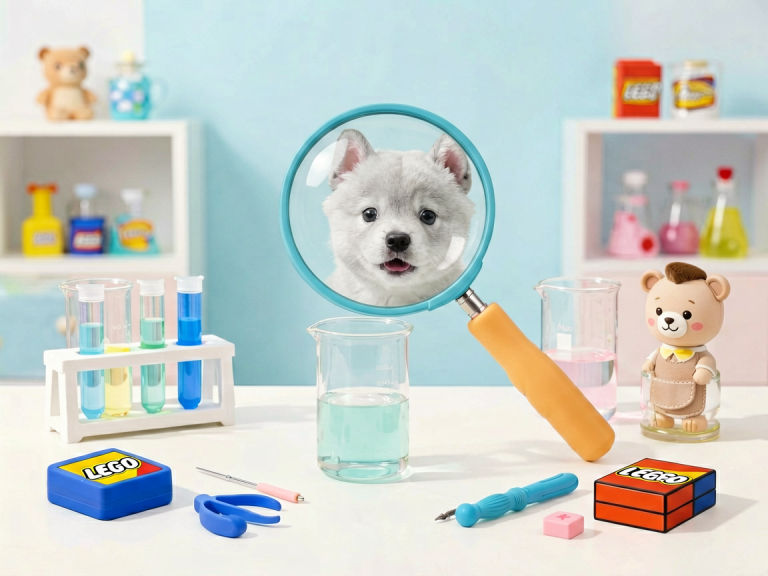
*Materials:* A magnifying glass (often found at dollar stores), clear jars, a ruler, paper, crayons, a small notebook.
*Activities:* Collect leaves, rocks, or insects; draw and measure them; sort them by color, shape, or size. Use a jar to observe a worm habitat or a simple seed‑growing experiment with damp paper towels.
These kits require no special purchase beyond basic pantry items. They are also highly repeatable—children can refine their structures, try different ratios, or test new variables, which is the very essence of the scientific method.
—
Thrift Stores, Dollar Stores, and Second‑Hand Treasures
When you do need to spend a little money, thrift stores, garage sales, and dollar stores can be gold mines for STEM toys. The key is knowing what to look for.
- Building Blocks and Construction Sets: Wooden blocks, plastic interlocking bricks (like LEGO without the brand name), and magnetic tiles often appear at thrift stores for a fraction of retail price. Even if sets are incomplete, they can be used for building challenges. Missing pieces? Use cardboard cutouts as substitutes.
- Simple Electronics: Look for old battery‑operated toys that can be taken apart (with supervision). A broken toy car, for example, contains a motor, wires, and gears that can be salvaged for a new project. Many thrift stores sell “junk” boxes for a dollar where children can safely disassemble items with a screwdriver.
- Science Kits Second Hand: Complete or partial science kits (microscopes, magnifying lenses, crystal growing kits) often appear at charity shops. Check that the microscope lens is not scratched; even without a full set of slides, a child can examine leaves, fabric threads, or salt crystals.
- Dollar Store Finds: Basic materials like string, tape, paper cups, plastic pipettes (sometimes called “eye droppers”), balloons, and craft sticks are extremely cheap. A bag of balloons can be used to demonstrate static electricity, air pressure, and rocket propulsion (by launching a balloon rocket along a string).
Remember that the second‑hand market values the *potential* of an item, not its original price. A worn but functional set of gear wheels or a set of old magnets can inspire hours of tinkering.
—
Free Digital Resources and Apps
In the digital age, a smartphone or tablet—even an old one without a cellular plan—can become a powerful STEM tool. Many high‑quality educational apps and websites are free or cost very little.
- PhET Interactive Simulations (phet.colorado.edu): This University of Colorado Boulder project offers dozens of free, browser‑based simulations covering physics, chemistry, biology, earth science, and math. Children can build atoms, explore forces and motion, design circuits, or run a lab on gene expression—all without spending a penny. No software installation is needed; simulations run on any device with a modern browser.
- Scratch (scratch.mit.edu): Developed by MIT, Scratch is a free programming language designed for ages 8–16. Children can create animations, games, and interactive stories by snapping blocks together. Scratch is also available as a free app for tablets. No paid subscription required.
- NASA’s STEM Engagement (nasa.gov/stem): NASA offers a vast library of free lesson plans, videos, and interactive activities. Children can design a rocket, simulate a Mars landing, or track the International Space Station. Many resources require no special equipment.
- Khan Academy Kids (free app): For younger children (ages 2–8), this app provides engaging, ad‑free activities that cover early math, logic, and scientific thinking. It is funded by donations and completely free.
Additionally, YouTube is a treasure trove of science demonstrations. Channels like “Sick Science!” (Steve Spangler) and “SciShow Kids” present experiments that can be done with household materials. Watching and then doing reinforces learning—and the cost is only the price of internet access.
—
Community Resources: Libraries, Maker Spaces, and Nature
STEM learning does not have to happen at home. Public libraries and community centers often offer free programs, lending libraries, or workshops that put expensive equipment into children’s hands.
- Library Tool Lending: Many public libraries now lend more than books: you can borrow telescopes, microscope sets, Snap Circuits kits, robotics kits, and even 3D printers. Check your local library’s “Library of Things” catalog. These items are often high‑quality and free to reserve.
- Maker Spaces: An increasing number of communities have free or low‑cost maker spaces (sometimes called “fab labs” or “hackerspaces”). These provide access to tools like soldering irons, sewing machines, laser cutters, and 3D printers. Some offer free open‑hours for children on weekends.
- Nature as a Laboratory: The outdoors is the most expansive STEM classroom. A walk in a park can yield data for a weather journal, a collection of leaves for symmetry studies, or an observation of ant behavior. Use a free app like iNaturalist to identify plants and animals—turning a simple hike into a biodiversity survey.
These resources are often underutilized simply because families do not know they exist. A quick search for “library of things [your city]” or “maker space [your city]” can open doors to free or very cheap STEM experiences.
—
Encouraging Creativity with Open‑Ended Materials
Finally, the most important “toy” in budget STEM is the child’s own imagination. Open‑ended materials encourage divergent thinking—the ability to generate many solutions to a single problem. This is a skill that expensive, pre‑programmed toys can sometimes inhibit, because they often have a single correct use.
Consider these low‑cost or free open‑ended materials:
- Cardboard boxes of various sizes – build a castle, a car, a robot costume, a marble maze.
- Plastic containers with lids – store “inventions,” create a water‑proof submarine, or make a drum set.
- Popsicle sticks and clothespins – build bridges, catapults, or simple machines.
- Aluminum foil, string, tape, and paper – create a solar oven, a parachute, or a simple paper rocket.
The role of the adult is to ask questions that spark experimentation: “What do you think will happen if we make the ramp steeper?” “Can you make a structure that is at least 10 inches tall and can hold a book?” “How many different ways can you move this marble from one end of the box to the other?”
By focusing on process over product, children learn that failure is part of the scientific method. A tower that falls is not a mistake—it is data.
—
Conclusion
Science and STEM education should never be a privilege reserved for those who can afford expensive toys. The truth is that curiosity, resourcefulness, and a willingness to explore are far more valuable than any shiny, store‑bought kit. By repurposing household items, leveraging free digital tools, taking advantage of community resources, and embracing an open‑ended, questioning mindset, any caregiver can create a rich STEM environment for the children in their lives—no matter the size of their budget.
The next time you see a cardboard box destined for recycling, pause. That box could be a spaceship, a robot body, or the foundation of a lesson in engineering. The next time you find a handful of magnets at a thrift store, imagine the hours of exploration they can provide. And the next time a child asks “Why?”—answer not with a product, but with an invitation: “Let’s find out together.”
In the end, the most powerful STEM toy on a budget is simply the act of wondering. And that is free for everyone.