Tiny Mathematicians: Nurturing Early Numeracy Through Playful Math Activities for 6-Month-Olds
Introduction
The word “math” often conjures images of complex equations, textbooks, and formal classrooms. Yet for a six-month-old infant, mathematics is not a subject to be studied but a world to be discovered through the most natural of human activities: play. At this tender age, a baby’s brain is developing at an astonishing rate, forming neural connections that will lay the groundwork for all future learning. Research in early childhood development reveals that even before a child can speak or crawl, they are already absorbing fundamental mathematical concepts—patterns, sequences, spatial relationships, quantity, and cause-and-effect—through everyday interactions. The key is to make these experiences joyful, sensory-rich, and developmentally appropriate. This article explores the rationale behind introducing math play to six-month-olds, outlines the core mathematical concepts they can engage with, and provides a wealth of practical, safe, and engaging activities that parents and caregivers can easily incorporate into daily routines. By reframing math as a playful, exploratory, and holistic adventure, we can nurture a positive relationship with numeracy long before a child ever encounters a worksheet.
Why Math for a 6-Month-Old? The Science of Early Numeracy
The idea of teaching mathematics to an infant might seem premature, but the reality is that babies are born with an innate sense of number and spatial awareness. Studies have shown that newborns can distinguish between quantities (e.g., two dots versus three dots) and are surprised when objects violate basic arithmetic rules, such as one object added to another miraculously becoming three. By six months, a baby’s brain is in a critical period for developing foundational cognitive skills. Activities that involve sorting, comparing, stacking, and recognizing patterns stimulate the prefrontal cortex and the parietal lobe, areas associated with problem-solving and spatial reasoning. Moreover, engaging in math play supports language development, as caregivers naturally describe actions (“big block,” “small ball,” “round shape,” “up and down”) while interacting. This simultaneous exposure to vocabulary and mathematical ideas creates a rich, interconnected learning environment. The goal is not to “teach” the baby to count but to provide experiences that allow their developing brain to notice order, regularity, and relationships in the world around them.
The Building Blocks of Infant Math Play
Before diving into specific activities, it is helpful to understand the core mathematical domains that are accessible to a six-month-old. These are not abstract concepts but rather tangible experiences grounded in sensory exploration.
1. Spatial Awareness and Geometry
At six months, a baby is beginning to understand that objects have size, shape, and position. They may reach for a toy, grasp it, and bring it to their mouth to explore its form. They are also developing an awareness of their own body in space—learning that they can move their arms, legs, and head to interact with the environment. Simple geometric concepts such as round versus square, big versus small, and inside versus outside can be introduced through play.
2. Pattern and Sequence
The human brain is wired to seek patterns. For an infant, patterns provide predictability and comfort. Repetitive sounds (e.g., a rattle shaken in a steady rhythm), alternating textures (soft, rough, soft, rough), or visual sequences (stripes on a blanket, alternating colors on a mobile) help the baby learn to anticipate what comes next. This is a precursor to understanding patterns in numbers and later algebraic thinking.
3. Number Sense and Quantity
While a six-month-old cannot count, they can experience quantities in a concrete way. The concept of “more” versus “less” can be explored by offering two blocks versus one, or by filling a container with many small rings versus just one. The baby may not verbalize the difference, but their eyes will linger longer on the larger set, showing recognition of quantity.
4. Cause and Effect (Relations)
Mathematical thinking often involves understanding relationships: if I push this ball, it rolls; if I drop a toy, it falls. These cause-and-effect experiences are foundational for later logic and reasoning. Stacking, knocking down, and making things disappear and reappear are all math-related explorations.
5. Measurement and Comparison
Babies naturally compare sizes (grasping for a larger block over a smaller one), weights (feeling the difference between a lightweight scarf and a heavier wooden rattle), and lengths (reaching for a long ribbon versus a short one). These informal comparisons build intuitive understanding of measurement concepts.
Practical Math Play Activities for 6-Month-Olds
The following activities are designed to be safe, engaging, and developmentally appropriate for a six-month-old. Always supervise play, ensure materials are non-toxic and free of small parts that could pose a choking hazard, and follow the baby’s cues—if they lose interest, it is time to move on or take a break.
1. Sensory Shape Sorting (Geometry and Spatial Reasoning)
Materials needed: A shallow basket or tray, a few large, soft blocks or safe objects of different shapes (e.g., a round ball, a square foam block, a triangle-shaped teether). Avoid small shapes that could be swallowed.
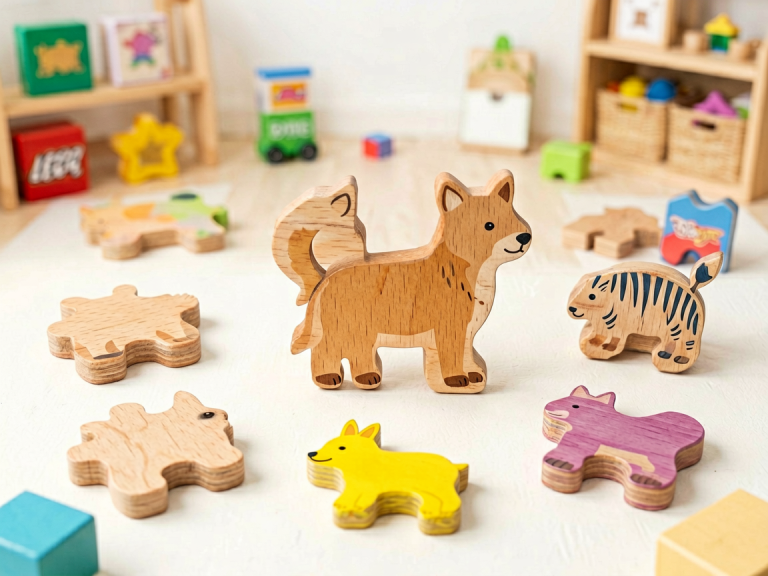
Activity: Place the objects in front of the baby while they are seated in a supportive position (e.g., on your lap or in a high chair with a tray). Allow them to touch, grasp, and mouth the objects. As they explore, describe the shapes: “This ball is round. It rolls away! This block has corners. It feels square.” Encourage the baby to try to fit a round object into a square-shaped container (such as a plastic cup with a wide opening) or to stack a block on top of another. The baby will likely experiment by banging objects together or dropping them, which is a natural part of learning. The goal is not mastery but exposure to difference in form and how objects relate to containers.
Math concept: Recognizing that different shapes have different properties; understanding that round objects roll while square objects stack.
2. Texture Pattern Mat (Pattern and Sequencing)
Materials needed: A large piece of fabric or a play mat with alternating textures (e.g., strips of velvet, corduroy, satin, burlap sewn together in a repeating pattern). Alternatively, use a set of fabric squares with distinct textures that can be placed side by side.
Activity: Lay the mat on the floor and place the baby on their tummy or back on top of it. Encourage them to feel the different textures with their hands and feet. Move the baby slowly from one section to another, narrating: “Here is the soft velvet, and now here is the bumpy burlap. Can you feel the smooth satin? Now back to the soft velvet again.” If the baby can sit, let them lean over and pat the mat. The repetition of the texture sequence helps the brain form pattern recognition. You can also attach small, safe objects (like large buttons sewn onto the fabric) to create a visual and tactile pattern of two alternating colors.
Math concept: Identifying and anticipating patterns; developing memory for sequences.
3. The Disappearing Cup (Cause and Effect and Object Permanence)
Materials needed: Several lightweight, opaque cups or small bowls, and a small toy that the baby enjoys (e.g., a rattle or a soft ball).
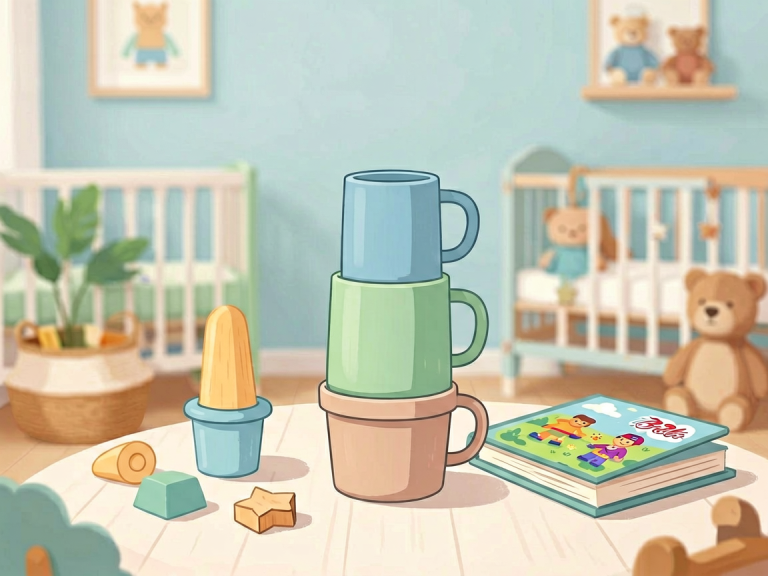
Activity: Sit facing the baby and place the toy on the tray or mat. Let the baby see it, then cover it with one cup. Pause and say, “Where did the toy go? Is it under the cup?” Encourage the baby to reach for the cup and remove it, revealing the toy. Repeat this several times, sometimes using two cups and hiding the toy under one of them. The baby may begin to anticipate which cup hides the toy, a sign of developing logic. You can also vary the activity by stacking two cups, placing the toy inside, and letting the baby knock them over to retrieve it.
Math concept: Understanding that objects still exist even when not visible (object permanence) and that a specific action (removing a cup) leads to a result (finding the toy). This is early problem-solving and logic.
4. Musical Counting and Rhythm (Number Sense and Pattern)
Materials needed: A set of non-breakable musical instruments such as a small wooden drum, maracas, or a chime bar. Alternatively, use your own voice and hands.
Activity: Sit with the baby and create simple rhythmic patterns. For example, tap the drum twice, pause, then tap twice again. Sing a counting song like “One, two, buckle my shoe” while gently moving the baby’s arms or legs in rhythm. Use a maraca to shake in a pattern: shake-shake-pause, shake-shake-pause. The baby will likely respond by smiling, cooing, or moving their body in time. You can also count the number of times you shake a rattle or tap a block on the floor: “One, two, three taps!” Even though the baby does not understand the numbers, they are absorbing the auditory pattern of rhythm and the idea that sounds can be grouped.
Math concept: Recognizing auditory patterns; experiencing the rhythm and flow of counting; connecting movement with quantity.
5. Stacking and Knocking Down (Spatial Relationships and Comparison)
Materials needed: Large, lightweight blocks (foam blocks or cardboard boxes covered in fabric) that are easy for tiny hands to grasp.
Activity: Build a simple tower of two or three blocks while the baby watches. Encourage the baby to knock it over. Then rebuild it, this time using a larger block on the bottom and a smaller one on top. Describe what you are doing: “This big block is on the bottom. The small block is on top. Can you knock it down?” The baby will delight in the cause-effect of the fall. As they get more coordinated, they may attempt to place one block on top of another—a milestone in spatial reasoning. Offer blocks of different sizes and let the baby explore which ones fit on top or inside each other. This is a natural introduction to concepts of size, stability, and balance.
Math concept: Comparing sizes; understanding that order and placement affect stability; experiencing three-dimensional space.
6. Water Play with Floating and Sinking (Measurement and Properties)
Materials needed: A shallow, sturdy water table or a large plastic basin with a few inches of warm water (always supervise closely). Use safe objects that float (e.g., a plastic duck, a cork, a small ball) and sink (e.g., a metal spoon, a smooth stone—ensure they are large enough not to be swallowed).
Activity: Set up the water play in a safe area and dress the baby in a waterproof bib. Let them splash and feel the water. Place a floating toy in the water and say, “The duck is floating on top.” Then gently push a sinking object and say, “The stone went down to the bottom. Where did it go?” Encourage the baby to reach for objects. You can also fill a small cup with water and pour it out, demonstrating concepts of full and empty, more and less. The sensory experience of water is inherently mathematical as it involves volume, displacement, and weight.
Math concept: Experiencing comparisons (floating vs. sinking, full vs. empty); developing an intuitive sense of volume and weight.
Incorporating Math Play into Daily Routines
Math activities do not require elaborate setups. In fact, everyday moments offer abundant opportunities for mathematical thinking. During diaper changing, you can count toes: “One little toe, two little toes, three, four, five!” While feeding, you can offer two pieces of soft food (if solids have been introduced) and say, “You have two pieces. Now you have one. Now none!” During bath time, compare the temperature of water (warm vs. cool) and the size of different cups. While dressing, talk about “this sleeve goes over your left arm, and this sleeve goes over your right arm” (spatial relations). Singing lullabies with repetitive structures—such as “Twinkle, Twinkle, Little Star” with its predictable melody and pattern of rhyming words—reinforces pattern recognition. The consistency of these small interactions builds a rich mathematical vocabulary and a comfort with abstract ideas.
Conclusion: Planting Seeds for a Lifetime of Mathematical Thinking
Engaging a six-month-old in math play is not about accelerating their academic trajectory; it is about honoring their natural curiosity and providing a supportive environment where their developing brain can explore order, pattern, quantity, and space. When a baby reaches for a block, compares two objects, or anticipates the next shake of a rattle, they are practicing skills that are fundamental to mathematics. More importantly, they are associating these concepts with warmth, joy, and connection—the most powerful ingredients for lifelong learning. As a caregiver, your role is not to be a math teacher but a playful guide. Smile, narrate, repeat, and follow the baby’s lead. The mathematical world is wide open, and for a six-month-old, every rattle, every block, every splash of water is an invitation to explore it. By weaving math play into the fabric of everyday life, you are giving the baby not just early exposure to numeracy, but a belief that the world is full of patterns to discover and problems to solve—a belief that will serve them well for years to come.