Smart Play: The Educational Toys for 6-Month-Olds That Are Worth Every Penny
When your baby reaches the six-month milestone, a world of exploration begins. They are no longer a passive newborn; they are actively reaching, grasping, mouthing, and observing everything around them. This is a critical period for brain development, where every sight, sound, texture, and interaction lays the foundation for future learning. But with an overwhelming market of flashy plastic gadgets, loud electronic sing-along toys, and countless “developmental” claims, how do you separate the genuinely educational toys from the overpriced clutter? The answer lies in understanding what a six-month-old truly needs: sensory stimulation, cause-and-effect discovery, fine motor practice, and safe materials that encourage curiosity. In this article, we’ll explore the types of educational toys that are absolutely worth the investment for your half-year-old, why they matter, and how they nurture your child’s cognitive, physical, and emotional growth.
The Importance of Stimulating Play at Six Months
At six months, a baby’s brain is forming connections at a staggering rate—around one million new neural connections per second, according to child development experts. This is the golden window for sensory and motor development. Educational toys designed for this age should not merely entertain; they should invite active participation. A toy that a baby can manipulate, feel, and explore builds neural pathways that support later skills like problem-solving, language, and hand-eye coordination. Worthwhile toys also respect the baby’s natural pace. Unlike many electronic toys that “perform” for the child (flashing lights, pre-recorded songs), the best educational toys require the baby to do the work: reach, shake, bang, push, and mouth. This active engagement is what makes play truly educational. Additionally, at six months, babies are beginning to understand object permanence—the idea that things continue to exist even when out of sight. Toys that incorporate peek-a-boo or hidden elements tap into this emerging cognitive milestone. By choosing toys that align with these developmental phases, you are not just buying a product; you are investing in a tool that scaffolds your baby’s natural learning journey.
Sensory Toys: The Foundation of Learning
Sensory play is the bedrock of early education, and for a six-month-old, no category of toys is more impactful than those that engage multiple senses. Look for soft, high-contrast cloth books that feature black-and-white patterns with splashes of primary colors. Unlike overly busy designs, high-contrast images are easier for a six-month-old’s developing vision to focus on. Books with crinkle pages, squeakers, and fabric tags add auditory and tactile layers, encouraging your baby to grasp, pull, and turn pages—actions that build fine motor strength. Another invaluable sensory toy is the textured silicone teether or sensory ball with varied bumps, ridges, and soft spikes. These offer oral exploration (which is how babies learn about texture and shape) and provide relief for emerging teeth. The best ones are made from food-grade silicone, BPA-free, and easy to clean. A simple unbreakable mirror is also a sensory powerhouse. At six months, babies begin to show fascination with their own reflection. A baby-safe mirror placed on the floor or attached to a play gym helps them practice facial recognition, emotional awareness, and cause-and-effect (I move, the face moves). Combining these sensory tools in a play mat or a low-stimulation environment allows your baby to control their own discoveries, fostering independence and focus.
Motor Skill Development: Grasping, Shaking, and Reaching
Six-month-olds are transitioning from reflexive grabbing to intentional reaching and transferring objects from hand to hand. Toys that target these precise skills are worth every penny because they directly strengthen the small muscles of the hands and fingers—crucial for future writing, self-feeding, and buttoning. A set of soft, lightweight stackable cups or interlocking rings is a classic choice. Your baby will initially bat at them then learn to hold, shake, and eventually stack (with your help). Look for cups with different textures and sizes, which also introduce early concepts of size comparison. Another favorite is the rattle, but not just any rattle—choose one with a comfortable grip, preferably with a central bar that is easy for a small hand to hold. Wooden rattles (with non-toxic paint) offer a satisfying weight and natural sound that electronic rattles cannot replicate. Babies will shake them intentionally, learning that their actions produce a result, a primitive but profound lesson in causality. The activity gym or play bar with hanging toys is also valuable, especially when you adjust the position of the toys to encourage reaching across the midline—a cross-body movement that coordinates both sides of the brain. When these toys are worth it, they are simple, durable, and allow the baby to interact without frustration. Avoid toys with tiny parts that could be choking hazards. Instead, invest in pieces large enough for the baby to hold but light enough to lift and wave.
Cognitive Boosters: Cause-and-Effect Toys
Between six and seven months, babies start to realize that their actions can influence the world around them. This insight is the spark behind all future problem-solving. Cause-and-effect toys that are worth it do not need batteries or screens; they rely on mechanical interactions. A pop-up toy with buttons, levers, or a large push-button that makes a figure pop up is a perfect example. At first, your baby may accidentally activate it, but with repetition they will learn to intentionally press or pull to see the surprise. This builds memory and intentionality. The baby activity cube made of soft fabric or wood with different actions on each side (a mirror, a crinkle flap, a spinning wheel, a squeak) is another excellent investment. These cubes consolidate multiple cause-and-effect experiences into one portable device, encouraging your baby to rotate the cube and find each new activity. An often-overlooked gem is the nesting and stacking set—rings that fit onto a central post, or boxes that fit inside each other. While your baby may merely bang and mouth them at six months, they are absorbing the logic of order. Over the next month or two, they will start to attempt stacking or nesting, which requires fine motor control, spatial reasoning, and persistence. When your baby accidentally knocks over a stack and watches it fall, they are learning about gravity and object interaction. Such toys are worth it because they grow with the baby: a simple set used at six months will still be engaging at twelve months.
Social and Emotional Growth: Interactive and Mirror Toys
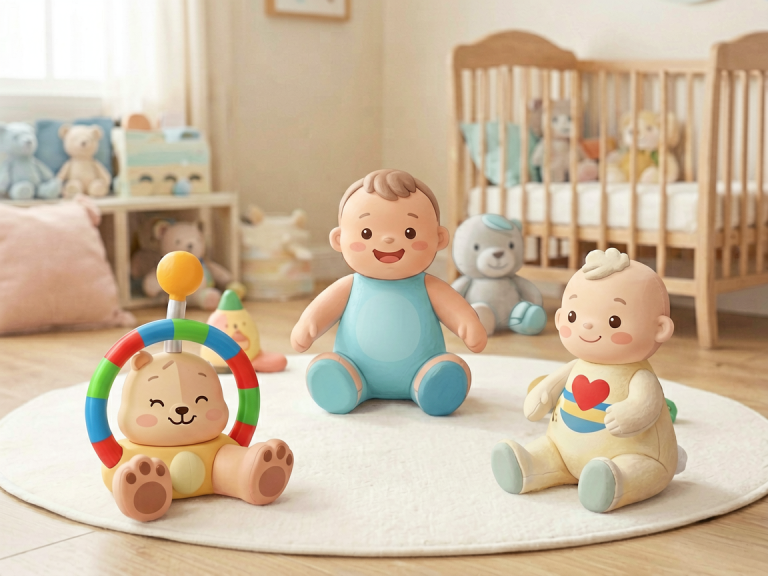
Educational value also extends to emotional intelligence and social skills. At six months, babies are deeply attuned to caregivers’ faces and voices. Toys that facilitate back-and-forth interaction, like soft hand puppets with bright colors and distinct expressions, can be powerful. A simple puppet—especially one with a smiling face or a friendly animal—can engage your baby in “conversation,” encouraging them to coo, smile, and track the puppet’s movement. This type of play models turn-taking, which is foundational for verbal communication. Mirrors, as mentioned earlier, are also social tools. Place a baby-safe mirror at floor level during tummy time; your baby will gaze at themselves, touch the mirror, and eventually smile or vocalize at their reflection. This self-recognition is an early step in the development of self-awareness and empathy. Another category is soft dolls or cloth animals with simple faces. While a six-month-old does not yet engage in symbolic play, holding and cuddling a doll can promote emotional regulation and bonding. If the doll has squeakers or crinkle elements, it becomes an interactive buddy. The key is simplicity—overly detailed dolls with hair, buttons, or small accessories can be distracting or even dangerous. Look for dolls without removable parts and made from washable, nontoxic fabric. When caregivers use these toys to narrate actions (“Look, the bunny is sad! Let’s pat the bunny”), they are building vocabulary and emotional understanding simultaneously.
How to Choose Worthwhile Educational Toys for Your Six-Month-Old
With the above categories in mind, here are practical guidelines to ensure you are making smart purchases. First, prioritize safety. Every toy must be free from sharp edges, toxic paints, and small parts that could fit inside a toilet paper roll (the standard choking-hazard test). Always choose materials labeled BPA-free, phthalate-free, and lead-free. Second, favor open-ended toys. A set of simple blocks, stacking cups, or balls can be used in dozens of ways as your baby grows, unlike a one-trick electronic toy that loses novelty quickly. Third, look for sensory variety. The best toys offer a combination of textures, sounds, weights, and colors. For example, a rubberwood rattle with a natural grain and a gentle bell inside stimulates touch, hearing, and sight without overwhelming the baby. Fourth, check for ease of cleaning. Babies mouth everything, so toys that can be wiped down or tossed into the dishwasher are a practical necessity. Fifth, choose toys that encourage physical movement. A toy that stays stationary may not be as beneficial as one that prompts your baby to crawl, reach, or pivot. For instance, a rolling ball with a chime inside will encourage your baby to chase it, promoting gross motor development. Finally, trust your instincts. If a toy looks overly stimulating, with flashing lights and loud noise, it often is. The quietest toys—a soft fabric book, a wooden ring, a textured ball—are frequently the most educational. When you observe your baby in deep concentration, mouthing a block, turning a page, or shaking a rattle with purpose, you will know you have chosen a toy that is truly worth it.
Conclusion: Investing in Your Baby’s Future Without Breaking the Bank
The best educational toys for a six-month-old are not necessarily the most expensive or the most advertised. They are the ones that align with your baby’s natural developmental path: sensory-rich, safe, and designed to encourage active exploration rather than passive watching. From sensory books and textured teethers to stacking cups and cause-and-effect pop-ups, each of these toys earns its place in your nursery by promoting fine motor skills, cognitive understanding, emotional awareness, and physical movement. Instead of buying a dozen cheap plastic toys that quickly break or bore your baby, invest in a curated selection of high-quality, open-ended playthings. Rotating them periodically will keep your baby engaged without overwhelming their senses. Remember, at six months, the best educator is you—sitting beside your baby, narrating their discoveries, and letting them lead the play. The toys are simply tools. Choose wisely, and you will not only save money but also give your baby a foundation of joyful, meaningful learning that lasts a lifetime.