The Unscripted Path: How Open-Ended Play Nurtures Language Development
Introduction
In an era dominated by structured curricula, screen-based learning apps, and measurable outcomes, the simple act of unstructured play is often undervalued. Yet, a growing body of research in developmental psychology and linguistics suggests that *open-ended play*—play with no predetermined rules, goals, or scripts—is one of the most powerful catalysts for language acquisition in early childhood. Unlike closed-ended activities that demand a single correct answer or a fixed sequence of actions, open-ended play invites children to create their own narratives, negotiate roles, solve emergent problems, and experiment with language in a risk-free environment. This essay explores the multifaceted relationship between open-ended play and language development, drawing on theoretical frameworks, empirical evidence, and practical strategies to argue that giving children the freedom to play without a script is not a luxury but a necessity for robust linguistic growth.
The Theoretical Foundations: Why Open-Ended Play Matters for Language
Vygotsky’s Zone of Proximal Development and the Role of Pretend Play
Lev Vygotsky’s sociocultural theory provides a cornerstone for understanding how open-ended play fosters language. Vygotsky argued that play creates a “zone of proximal development” (ZPD)—the space between what a child can do independently and what they can achieve with guidance. In open-ended pretend play, children spontaneously scaffold each other’s language. For example, when two preschoolers decide to “go camping” in the living room, one child might say, “We need a tent!” and the other responds, “No, it’s a cave. Bears live here!” This negotiation forces them to use language to define objects, assign roles, and advance the plot. The child who introduces “cave” is not only using a new vocabulary word but also explaining a concept, thereby teaching the play partner. Vygotsky emphasized that such social interaction is the primary engine of cognitive and linguistic development, and open-ended play is one of its richest contexts.
Piaget’s Constructivism and the Active Learner
Jean Piaget’s constructivist theory complements Vygotsky by highlighting the child’s active role in building knowledge through experience. Piaget observed that during the preoperational stage (roughly ages 2–7), children engage in symbolic play—using one object to represent another. A block becomes a phone; a cardboard box becomes a spaceship. This semiotic flexibility is fundamentally linguistic. When a child says, “This box is my rocket ship,” they are making a metaphoric mapping that requires understanding that words and objects can stand for other things—the essence of language. Open-ended play provides endless opportunities for such symbolic transformations, each requiring verbal articulation. Moreover, Piaget noted that play allows children to repeat and practice language patterns without fear of error. A child might say “I goed to the store” in play, then later self-correct to “I went” after hearing a peer or adult model the correct form. This self-regulated learning occurs naturally in play far more than in drills.
How Open-Ended Play Stimulates Specific Language Domains
Vocabulary Expansion Through Contextualized Use
One of the most immediate benefits of open-ended play is its capacity to introduce and reinforce vocabulary in meaningful contexts. Consider a child building with wooden blocks. In structured play, the adult might say, “Stack the red block on the blue one.” In open-ended play, the child might announce, “This tower is a castle for the queen. The drawbridge goes up at night to keep out the dragons.” Here, the child spontaneously uses words like “drawbridge,” “castle,” “queen,” and “dragons” because they are needed to advance the narrative. The words are not taught in isolation; they are acquired as tools for a purpose. Research by Dickinson and Tabors (2001) found that children who engaged in rich pretend play with peers and adults had larger vocabularies and more sophisticated narrative skills by kindergarten. The reason is clear: the child is motivated to learn words that serve their imaginative goals.
Syntactic and Grammatical Complexity Through Dialogue
Open-ended play inherently demands dialogue. Unlike solitary play or screen time, collaborative pretend play requires children to speak in complete sentences to make their intentions clear. When playing “restaurant,” one child might say, “I’ll be the chef, and you be the customer. What do you want to eat?” The other responds, “I want a pizza with mushrooms and extra cheese, please.” This exchange uses question formation, polite forms, compound nouns, and sequencing. Moreover, as the play evolves, children must use past tense to recount events (“The chef already cooked the pizza”), future tense to plan (“Then we will go to the park”), and conditional language to negotiate (“If you let me be the cashier, I’ll give you extra fries”). This natural exposure to varied grammatical structures accelerates syntactic development far more effectively than worksheets.
Narrative Competence and Decontextualized Language
A critical milestone in language development is the ability to produce *decontextualized language*—using words to describe events, ideas, or stories that are not present in the immediate environment. Open-ended play, especially sociodramatic play, is a training ground for this skill. When children plan a play scenario, they must talk about absent characters, future actions, and hypothetical outcomes. For example, before starting a spaceship game, a child might say, “Remember last time when our rocket broke down? Today let’s bring extra fuel.” This requires recalling past events and projecting them into a new context—a precursor to storytelling. Studies of narrative development show that children who engage in frequent pretend play produce longer, more coherent, and more imaginative stories than those who do not (Nicolopoulou, 2002). They learn to structure a beginning, middle, and end, and to use transitional phrases like “then,” “so,” and “because.”
Pragmatic Skills: Turn-Taking, Politeness, and Repair
Language is more than vocabulary and grammar; it is a social tool. Open-ended play forces children to practice pragmatics—the rules of conversation. To keep a play scenario going, children must take turns speaking, listen to others, and adjust their language based on feedback. If one child says, “I’m the doctor,” and the other says, “No, you’re the patient,” the first child must decide whether to accept, negotiate, or compromise. Such moments teach children how to use language to persuade, apologize, clarify, and repair misunderstandings. For instance, a child who says, “I meant the other doctor” is learning to repair a communicative breakdown. Additionally, pretend play often involves role-switching (e.g., being a teacher, a baby, a dog), which requires adopting different registers and tones of voice—an advanced pragmatic skill.
Practical Strategies for Parents and Educators
Creating an Environment That Invites Open-Ended Play
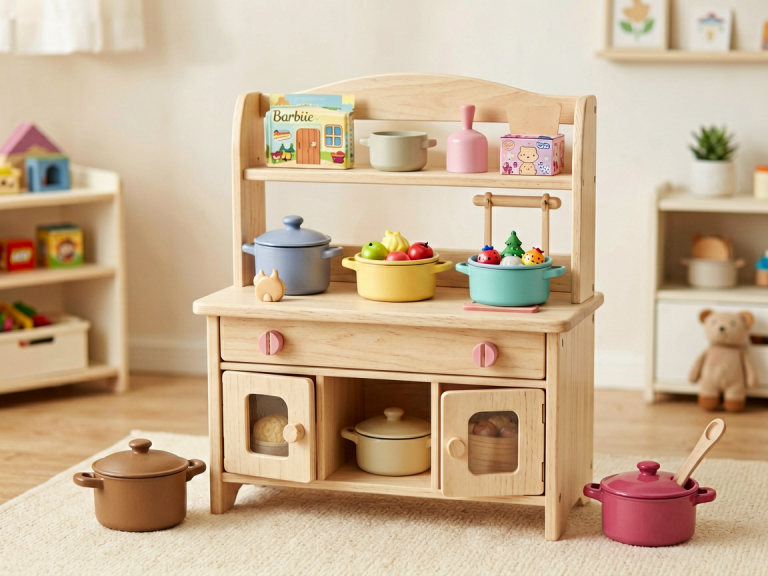
To harvest the language benefits of open-ended play, adults must intentionally design the physical and social environment. First, provide *loose parts*—objects that can be used in multiple ways: blocks, scarves, cardboard tubes, stones, fabric scraps, pots and pans. Avoid toys that dictate a single use (e.g., a plastic cash register that only makes a beeping sound). Second, allow ample *uninterrupted time*. Language development through play is a slow, iterative process. Rushing children from one activity to the next truncates the depth of their narrative-building. Third, reduce screen distractions. In a study by Kirkorian et al. (2020), toddlers produced fewer words during play when a television was on in the background.
The Adult’s Role: Scaffold Without Taking Over
Adults often struggle with open-ended play because they want to “teach” or correct. The most beneficial role is that of a *gentle co-player*. Listen more than you talk. Use open-ended questions: “What happens next?” “How does that character feel?” “Why did the bridge fall?” These prompts encourage the child to verbalize their thinking without imposing a plot. Avoid evaluative praise (“Good job!”) because it can shut down exploration; instead, comment descriptively (“I see you made the tower very tall and put a flag on top.”). When a child uses a novel word or sentence structure, you can extend it: Child: “The dinosaur is eating.” Adult: “Yes, the hungry dinosaur is devouring his giant leaf.” This *recast* models more complex grammar without overt correction.
Integrating Multilingual and Diverse Contexts
For children growing up bilingual, open-ended play is exceptionally valuable. It allows them to code-switch naturally and use both languages as resources. A child might start a game in English, then switch to Spanish to address a “grandmother” character, then back to English. This fluid practice builds metalinguistic awareness. Educators can set up play areas with props from different cultures (e.g., a Chinese tea set, a Mexican molcajete, an African djembe) to invite culturally diverse narratives, which in turn expand vocabulary and social understanding.
Challenges and Considerations
The Pressure of Academic Readiness
In many educational systems, there is increasing pressure to replace play with direct instruction to meet literacy benchmarks. However, a meta-analysis by Lillard et al. (2013) showed that, while some structured interventions have short-term gains in letter recognition, open-ended play outperformed them in long-term language comprehension and narrative skills. Educators and policymakers must resist the temptation to view play as “wasted time.” Instead, they should advocate for a balanced approach where play is integrated into the curriculum, not separate from it.
Children with Language Delays
Open-ended play is not a panacea; some children with significant language delays may need more targeted intervention. However, even for these children, play-based approaches are effective. Speech-language pathologists often use *play-based therapy*, where the entire session unfolds through child-led play. The therapist follows the child’s lead and embeds language modeling naturally. For example, if a child is playing with a toy car, the therapist might say, “The car is going fast! Vroom! Now it’s stopping. Red light!” This child-driven, low-pressure environment is often more productive than flashcard drills.
The Role of Digital Play
Not all open-ended play must be physical. Many digital platforms, such as open-ended drawing apps or sandbox games (e.g., Minecraft’s Creative Mode), can also support language development if used intentionally. The key is that the child *generates* content rather than consuming it. However, digital play lacks the rich face-to-face social cues that drive pragmatic language growth. Therefore, it should supplement, not replace, real-world play.
Conclusion
Open-ended play is not merely fun—it is a sophisticated, self-directed language laboratory where children experiment with vocabulary, grammar, narrative, and social discourse. Through the lens of Vygotsky and Piaget, we see that play provides the ideal conditions for language to emerge: motivation, context, social interaction, and repeated practice without fear of failure. As parents and educators, our role is to step back, offer rich materials and time, and trust the child’s innate drive to learn through imagination. In a world that increasingly measures learning by standardized test scores, we must remember that the most profound linguistic growth often happens when a child, holding a cardboard tube to her ear, announces, “Hello, Grandma? I’m on the moon. I’ll be home for dinner.” That utterance is not a failure to follow instructions; it is a triumph of the unscripted path.