The Linguistic Magic of Pretend Play: How Make-Believe Fuels Language Development
Introduction: More Than Just Fun
In a quiet corner of a kindergarten classroom, a four-year-old girl places a plastic teacup on a tiny table, looks at her stuffed bear, and says with perfect seriousness: “Would you like some tea, Mr. Bear? It’s a little hot, so please blow on it.” This scene, repeated daily in homes and preschools around the world, is far more than whimsical entertainment. It is, in fact, one of the most powerful engines of early language development. Pretend play—also known as symbolic play, imaginative play, or make-believe—allows children to step into roles, build narratives, and experiment with language in ways that direct instruction cannot replicate. Decades of developmental psychology and linguistics research have shown that pretend play provides a rich, low-stakes environment where vocabulary, syntax, pragmatics, and narrative skills flourish. This article explores the multifaceted relationship between pretend play and language development, examining the cognitive and social mechanisms at work, the developmental stages of this play, and practical strategies for parents and educators to harness its potential.
The Cognitive Foundations: Why Pretend Play and Language Are Inseparable
To understand why pretend play is so effective for language growth, we must first recognize that both activities rely on the same cognitive skill: symbolic representation. Language itself is a system of symbols—words stand for objects, actions, and ideas. Pretend play requires a child to mentally transform one object into another (a block becomes a phone) or to adopt an identity different from their own (a child becomes a doctor). This dual symbolization process strengthens the mental “muscle” needed for linguistic abstraction.
Research by psychologist Lev Vygotsky, a pioneer in this area, emphasized that pretend play creates a zone of proximal development—a space where children perform at a level slightly above their current ability. When a child pretends to be a shopkeeper, they use language like “How can I help you?” or “That will be five dollars,” which they may not yet use spontaneously in real life. The play context reduces the pressure of real-world consequences, allowing children to take linguistic risks. They can experiment with new words, complex sentence structures, and different registers of speech (for example, speaking in a “bossy” voice when playing a parent, or using polite forms when playing a customer). This safe experimentation is crucial because language acquisition thrives on trial and error.
Furthermore, pretend play demands that children narrate their actions and coordinate with others. Even when playing alone, a child often talks through their play: “Now the dinosaur is going to the castle, but oh no, the bridge is broken!” This private speech, as Vygotsky called it, gradually internalizes into inner thought and later into more sophisticated verbal reasoning. When playing with peers, the need to negotiate roles, explain scenarios, and resolve conflicts forces children to use language for complex communicative functions—requesting, clarifying, persuading, and even apologizing. These are not just vocabulary exercises; they are authentic opportunities to practice the pragmatics of language.
Developmental Stages: From Simple Imitation to Complex Storytelling
Pretend play evolves in predictable stages, and each stage offers unique linguistic benefits. Understanding these stages helps parents and educators tailor their support.
Stage 1: Simple Imitation (12–24 months)
A toddler might pick up a toy phone and babble into it, imitating a parent’s gestures. At this stage, language use is minimal—often single words or sound effects (“vroom vroom”). The key achievement is the emergence of symbolic thinking: the child recognizes that a toy can *stand for* a real phone. This symbolic leap is fundamental for understanding that words stand for things.
Stage 2: Simple Pretend Sequences (2–3 years)
Children begin to perform short connected actions, like stirring a pot and then pretending to eat. Language expands to include simple descriptions (“I cook soup”) and requests (“More, please”). They also start using decontextualized language—talking about objects not present (“The bunny is sleeping in her house”). This ability to refer to absent objects is a critical milestone for later literacy and abstract reasoning.
Stage 3: Role-Play and Social Pretend (3–5 years)
This is the golden age of pretend play. Children assign roles (“You be the mommy, I’ll be the baby”), negotiate plots (“First we go to the store, then we have a party”), and use metacommunication—talk about the play itself (“Let’s pretend this box is a rocket”). Vocabulary explodes as they adopt role-specific terms (stethoscope, receipt, castle). Sentence complexity grows, with more subordinate clauses (“We have to hurry before the monster comes”). Most importantly, children learn to take the listener’s perspective, adjusting their language to suit their play partner’s understanding. A child explaining the rules to a younger sibling uses simpler sentences than when explaining to a peer.
Stage 4: Fantasy and Elaborate Narratives (5–7 years)
Older children create elaborate imaginary worlds with invented rules, characters, and plot twists. They may write scripts, draw maps, or build forts. Language at this stage mirrors literate language: it includes temporal markers (“first,” “meanwhile”), causal connectors (“because,” “so that”), and evaluation (“That way is smarter”). Research by developmental psychologist Ageliki Nicolopoulou shows that children who engage in rich pretend play later demonstrate stronger narrative abilities—the ability to tell a coherent story with a beginning, middle, and end, which is a foundational skill for reading comprehension.
Empirical Evidence: What Research Tells Us
Numerous studies have confirmed the link between pretend play and language skills. A landmark study by S. W. Russ and colleagues (1999) found that the quality of preschool children’s pretend play—measured by imagination, organization, and affect expression—predicted their vocabulary and story comprehension scores two years later. More recently, a meta-analysis by Lillard et al. (2013) reviewed 30 studies and concluded that while causal claims require caution, the correlational evidence strongly supports that pretend play enhances language, particularly narrative production and social communication.
One particularly striking finding comes from research on children with language delays. Therapists often use pretend play as an intervention tool. For example, a child with limited vocabulary may be more motivated to learn the word “syringe” if it is part of a game where they are a doctor giving bears a shot. The intrinsic motivation of play reduces anxiety and increases engagement. Moreover, the repetitive yet varied nature of pretend scenarios allows children to encounter new words multiple times in meaningful contexts, which is far more effective for vocabulary retention than flashcard drills.
The Role of Adults: Scaffolding Without Taking Over
While children’s self-directed play is vital, adults can significantly enhance the language benefits of pretend play through scaffolding—supporting just enough to extend the play without controlling it. Here are research-backed strategies:
- Model rich language without correcting. If a child says “The dog runned,” don’t interrupt the play to correct grammar. Instead, model the correct form naturally: “Oh, the dog ran? Where did he run to?” Children absorb grammar through repeated exposure, not explicit correction.
- Ask open-ended questions. Instead of “Is the baby sleeping?” (yes/no), ask “What should we feed the baby for dinner?” or “Why is the baby crying?” This encourages longer utterances and causal reasoning.
- Introduce new vocabulary in context. If the play involves a pretend restaurant, use words like “menu,” “waiter,” “order,” “tip,” “delicious.” Children learn words best when they are immediately useful.
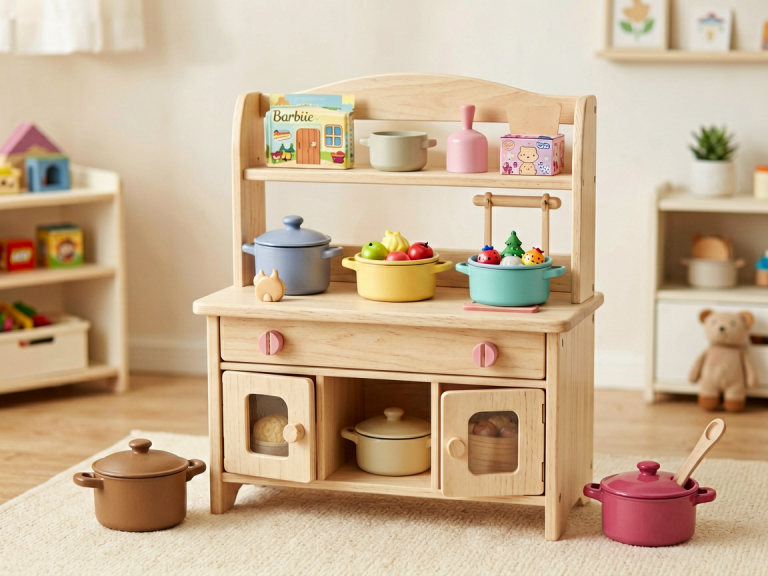
- Provide props that encourage symbolic thinking. A cardboard box can be a car, a castle, or a time machine. Open-ended props (scarves, blocks, empty containers) foster more creativity and language than highly realistic toys that dictate a single use.
- Encourage narrative extension. When a child says “I’m going to the moon,” ask “What will you see there? Who will you meet?” Help them build a mini-story. This practice directly supports narrative skills.
Cultural Considerations and Inclusivity
Pretend play is a universal human activity, but its forms vary across cultures. In some communities, children engage more in socio-dramatic play with siblings and cousins, while in others, adult-guided play is more common. Teachers and parents should respect cultural variations. For example, a child from a culture where elders are highly respected may incorporate that respect into role-play (addressing a pretend grandmother with formal titles). Language development benefits occur across these variations as long as children have the time, space, and freedom to engage in sustained pretend play.
Moreover, pretend play is inclusive by nature. Children with limited mobility or speech can participate using gestures, sounds, and modified props. Augmentative and alternative communication (AAC) devices can be incorporated into play scenarios—a child using a tablet to say “Let’s bake a cake” is engaging in the same symbolic process. The key is the child’s agency and imagination, not the perfection of their speech.
Conclusion: The Playful Path to Proficiency
Pretend play is not a frivolous escape from learning; it is one of the most profound and neurologically enriching activities for language development. By allowing children to step into different worlds, adopt new voices, and negotiate shared fantasies, this form of play builds the very architecture of linguistic competence—from the first symbolic word to the complex narratives of a confident storyteller. In an era of screen-based entertainment and structured academic pressures, we must protect and promote unstructured pretend play. Let children be pirates, astronauts, chefs, and dragons. In their make-believe worlds, they are not just playing—they are sculpting the language of their future lives. The next time you see a child offering a cup of imaginary tea to a teddy bear, know that you are witnessing a small miracle of human cognition, one that no app or worksheet can replicate. And if you are invited to join the tea party, say yes. You will be speaking the language of learning.