Engaging Play Activities for 6-Month-Olds: Simple Toys, Big Developmental Leaps
Introduction
At six months old, a baby is no longer a passive newborn. This is a period of explosive growth: most infants can sit with support, roll over both ways, reach for objects with increasing accuracy, and begin to understand cause and effect. Their vision sharpens, their hand-eye coordination improves, and they become fascinated by textures, sounds, and faces. While the market is flooded with expensive, flashy baby gadgets, research in child development consistently shows that the most effective play tools are often the simplest. A cardboard box, a set of wooden blocks, or a soft scarf can provide richer sensory and motor experiences than a battery-operated toy. This article explores a range of play activities designed for 6-month-olds that use only simple, everyday toys—or toys you can easily make at home. Each activity is structured to support specific developmental domains: sensory exploration, fine and gross motor skills, cognitive growth, and social-emotional bonding.
Sensory Exploration: Awakening the Senses with Everyday Objects
Why Sensory Play Matters at Six Months
At six months, babies are sensory scientists. They learn about the world by touching, tasting, hearing, seeing, and smelling. Simple toys that offer varied textures, weights, and sounds stimulate neural connections. Sensory play also helps babies regulate their own arousal levels—calming when overloaded or alerting when under-stimulated.
Activity 1: Texture Treasure Basket
A texture treasure basket requires no special purchase—just a low-sided basket or box and a collection of safe household items. Include a clean, unused paintbrush (soft bristles), a silk scarf (smooth), a wooden spoon (hard and cool), a piece of faux fur (soft and fluffy), a crinkly piece of wax paper or a clean plastic lid, and a silicone spatula. Sit your baby in a supportive seated position (or lying on their tummy if they cannot sit yet) and place the basket within reach. Watch as they instinctively grasp, mouth, and bat at each object.
The key is to let the baby lead. Resist the urge to “teach” them how to use each item. Instead, observe: they may shake the spoon, rub the fur against their cheek, or stare at the crinkly paper. This unstructured exploration builds curiosity and neural flexibility. Change the contents every few days to maintain novelty.
Activity 2: Water Play in a Shallow Tray
Fill a shallow, sturdy plastic container with about an inch of lukewarm water. Place it on a towel on the floor. Add a few simple toys: a clean sponge, a plastic cup, a rubber duck (if available), or a few large pebbles (supervised). Let your baby sit in front of the tray—either supported by you or in a baby seat. They will splash, dip, and try to grasp floating objects. Water play strengthens hand muscles and teaches cause and effect (“When I hit the water, it splashes!”). Always stay within arm’s reach and never leave a baby alone with water.
Fine Motor Development: Grasping, Reaching, and Releasing
Why Fine Motor Skills Are Crucial at This Age
Around six months, babies transition from a reflexive grip to a voluntary one. They start using a “raking” motion (using all fingers to pull objects toward them) and may even begin a pincer grasp (thumb and forefinger) by the end of the month. Simple toys that require reaching, holding, and transferring from one hand to another are ideal.
Activity 3: The Magic of a “Sock Rattle”
Take a clean, white athletic sock. Fill it with a few dry, uncooked beans or rice. Tie a tight knot at the top. For extra sensory appeal, you can put the filled sock inside another colorful sock. Present the sock rattle to your baby. They will grab it, shake it, and likely bring it to their mouth. The soft fabric is gentle on gums, and the sound is intriguing but not overwhelming. Encourage your baby to transfer the rattle from one hand to the other. This bilateral coordination is a foundational skill for later tasks like holding a book or using scissors.
Activity 4: Sticky Tape Pull
This activity is delightfully simple. Tear off several pieces of masking tape (about 4–6 inches long) and stick them to the edge of a table, a high chair tray, or a clean, smooth surface—partially hanging off. Place your baby in a position where they can reach the dangling tape. Babies love the challenge of peeling tape off a surface. The sticky resistance strengthens finger muscles and teaches problem-solving. As they pull the tape, they learn about texture (sticky vs. non-sticky) and cause and effect. Supervise closely so they do not put the tape in their mouth for long—though a brief taste is harmless, remove it before it becomes a choking hazard.
Gross Motor Activities: Building Strength and Coordination
The Importance of Gross Motor Play
At six months, babies are working hard to control their bodies. Some can sit unsupported for a few seconds; others are rolling like little logs. Gross motor play helps strengthen the neck, back, and leg muscles needed for crawling, standing, and eventually walking. Simple toys can motivate movement.
Activity 5: The Rolling Ball Game
Use a soft, lightweight ball (about the size of a small melon) that is easy for small hands to grasp—a fabric ball with a bell inside or a simple crocheted ball works perfectly. Sit facing your baby with your legs spread in a “V” shape. Gently roll the ball toward them. At first, they may just stare or bat at it. Over time, they will learn to reach out, push it back (accidentally), or try to grab it. This back-and-forth activity promotes visual tracking, trunk control, and early social reciprocity. You can also place the ball just out of reach during tummy time to encourage rolling or scooting.
Activity 6: Tummy Time with a Prop
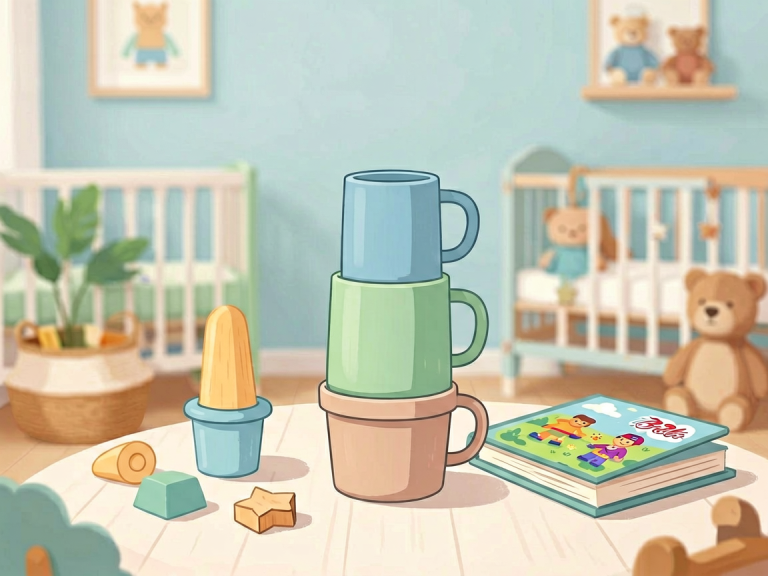
Tummy time becomes more engaging when paired with a simple toy. Place a rolled-up hand towel under your baby’s chest to elevate them slightly. Then, put a few colorful stacking cups or wooden rings just in front of them. The elevation makes it easier to lift their head and reach. As they stretch for the toys, they strengthen their arms, shoulders, and neck. For variety, hang a simple ribbon or a piece of tulle from a low-hanging laundry line or a cup hook—just out of their grasp. The visual target motivates them to lift higher.
Cognitive Play: Cause, Effect, and Object Permanence
Understanding the Infant Mind
At six months, babies begin to grasp that objects exist even when hidden (object permanence). They also enjoy repeating actions that produce a satisfying result. Simple toys that allow for “disappearing and reappearing” or that make noise when shaken are powerful cognitive tools.
Activity 7: Peek-a-Boo with a Scarf
While classic peek-a-boo with your face is wonderful, using a simple scarf adds a new dimension. Take a lightweight, semi-transparent scarf (like a gauze scarf) and hold it over your baby’s face briefly, then pull it away with a cheerful “Peek-a-boo!” Then, let your baby try. Place the scarf on their lap or over their own hand. They may pull it off themselves. This activity teaches the concept of hidden and revealed, builds memory, and sparks laughter. You can also hide a small rattle under a cloth and let your baby find it.
Activity 8: The Cup-and-Ball Drop
You need a large plastic cup (like a yogurt container) and a few lightweight balls (ping-pong balls or wiffle balls). Show your baby how you drop a ball into the cup—it makes a satisfying thud or rattle. Then, encourage them to try. At first, they may just mouth the cup or the ball. Gradually, they will attempt to put the ball inside. Even if they miss, the act of releasing the ball is a major fine motor and cognitive milestone. When the ball disappears inside, it reinforces object permanence. Let them dump the cup out and start again.
Social-Emotional Development: Bonding Through Play
The Role of Interaction
Play is not just about skills—it is about connection. Six-month-olds are highly attuned to facial expressions, tone of voice, and touch. Simple toys become tools for shared joy, turn-taking, and emotional regulation.
Activity 9: Mirror Play with Expressions
Use an unbreakable baby mirror (or a stainless steel bowl that reflects). Sit your baby in front of the mirror. Point at their reflection and say their name. Make silly faces: puff your cheeks, stick out your tongue, raise your eyebrows. Babies will study their own reflection and eventually try to imitate you. You can also hold a simple toy, like a rattle, up to the mirror so they see the toy’s reflection. This activity supports self-awareness, social referencing, and emotional expression.
Activity 10: Singing with a Prop
Pick a simple song like “Twinkle, Twinkle, Little Star” or “The Itsy Bitsy Spider.” Use a prop—a small stuffed animal, a wooden spoon to tap, or a scarf to wave. As you sing, move the prop in time with the rhythm. Let your baby hold the prop and “help” you move it. The combination of melody, rhythm, and physical movement strengthens auditory processing and social bonding. Moreover, you are modeling turn-taking: you sing, they respond with a coo or a smile.
Safety Considerations and Parent Guidelines
Choosing and Using Simple Toys Safely
Before engaging in any activity, ensure that all toys are:
- Large enough to not fit through a toilet paper tube (choking hazard).
- Made of non-toxic materials (avoid small batteries, sharp edges, or lead paint).
- Clean and dry to prevent mold or bacteria growth.
- Supervised at all times, especially with water, tape, or small items.
Also, respect your baby’s cues. If they turn away, fuss, or arch their back, they may be overstimulated or tired. Stop the activity and offer calm cuddles. Play should feel joyful, not pressured. Rotate toys every few days to maintain novelty without overwhelming the baby.
Conclusion
The first year of life is a whirlwind of growth, and six months marks a sweet spot where babies are alert, curious, and ready to interact with the world. You do not need a room full of electronic toys to support this development. A basket of everyday items, a scarf, a cup, and your own face are more than enough. Each of the activities described above targets specific areas—sensory, motor, cognitive, and social—while using toys that cost little or nothing. More importantly, they invite you to be present: sitting on the floor, making eye contact, laughing, and celebrating the small victories of a baby who just managed to grab that sock rattle for the first time. That connection is the richest toy of all.
So gather a few simple objects, clear some floor space, and let your baby lead the way. The play will be simple, but the learning is profound.