Building Problem-Solving Skills in 6-Month-Olds Through Play: A Developmental Guide
The first year of life is a period of extraordinary cognitive growth, and by six months, infants have already begun to demonstrate the early foundations of problem-solving. At this age, babies are no longer passive recipients of sensory input; they actively explore their environment, experiment with cause and effect, and show increasing persistence when faced with obstacles. While we often think of problem-solving as a skill reserved for older children and adults, the truth is that the seeds of logical reasoning, flexibility, and goal-directed behavior are sown through simple, everyday play activities during infancy. For parents, caregivers, and early childhood educators, understanding how to intentionally design play experiences that challenge a six-month-old’s emerging abilities can significantly support their cognitive development. This article provides a comprehensive, research-informed guide to specific play activities that build problem-solving skills in six-month-olds, with clear explanations of the developmental mechanisms at work. Each activity is designed to be safe, engaging, and developmentally appropriate, while also encouraging the infant to think, adapt, and persist.
Understanding Problem-Solving at Six Months: What to Expect
Before diving into activities, it is essential to understand the cognitive landscape of a typically developing six-month-old. At this stage, infants have achieved several critical milestones that make problem-solving possible. They can sit with support, reach for and grasp objects deliberately, transfer items from one hand to another, and bring objects to their mouths for exploration. Their vision has improved to near-adult levels, allowing them to track moving objects and discriminate between familiar and unfamiliar faces. Most importantly, they begin to demonstrate an understanding of object permanence—the realization that objects continue to exist even when out of sight—though this concept is still fragile and incomplete. They also start to engage in secondary circular reactions, a term coined by Jean Piaget to describe the repetition of actions that produce interesting results in the external world. For example, a baby might repeatedly shake a rattle to hear its sound, then intentionally vary the force or angle to see if the sound changes. This is the very essence of early problem-solving: the infant identifies a goal (e.g., making a sound), tries an action, observes the outcome, and adjusts accordingly. The activities below are crafted to build on these nascent abilities, offering just enough challenge to stimulate growth without causing frustration.
Activity 1: The Disappearing Toy Game – Cultivating Object Permanence and Persistence
One of the most powerful problem-solving activities for a six-month-old is a simple variation of peekaboo or hiding games. Begin by choosing a brightly colored, soft toy that your baby enjoys looking at or reaching for. Place the toy on a blanket or towel in front of the baby while they are seated in a supportive position, such as a Bumbo seat or on your lap. Let the baby reach for and touch the toy for a few seconds. Then, slowly lift the edge of the blanket and cover the toy completely, saying, "Where did the toy go?" Pause for a moment, watching your baby’s reaction. Many six-month-olds will show surprise, look at the blanket, or reach toward it. If your baby does nothing initially, gently lift the blanket to reveal the toy, saying, "There it is!" with enthusiasm. Repeat this process several times, gradually increasing the delay before you reveal the toy. After a few rounds, many babies will begin to pull the blanket off themselves or push it aside to uncover the toy. This act—removing the obstacle to retrieve a desired object—is a genuine problem-solving behavior. It requires the baby to hold the mental representation of the hidden toy, formulate a plan (e.g., "I need to move this fabric"), execute a motor action, and evaluate success. To extend the challenge, try hiding the toy under two layers of fabric or behind a small barrier, such as a cardboard box. Always ensure the baby can succeed with some effort; if they become frustrated, simplify the game by using a transparent cloth or partially revealing the toy. This activity not only strengthens object permanence but also teaches persistence—a core component of problem-solving.
Activity 2: Cause-and-Effect Explorations with Simple Mechanisms
Six-month-olds are fascinated by cause-and-effect relationships, and providing toys that respond predictably to their actions allows them to experiment with problem-solving in a controlled context. A classic example is the "push-button sound toy"—a plastic or wooden toy that plays a melody or makes a clicking sound when a large, easy-to-press button is pushed. Place the toy within your baby’s reach during floor play. Initially, demonstrate the action by pressing the button yourself, then place your baby’s hand on the button and gently guide their fingers to press. After a few guided trials, step back and observe. Many babies will begin to intentionally push the button again and again, each time producing the same result. The problem-solving challenge arises when the toy’s mechanism is slightly altered. For example, you can place the toy on an angled surface so that the button is harder to press, or you can cover the button with a lightweight piece of fabric. Now the baby must figure out how to overcome this new obstacle to achieve the desired sound. They might try pushing harder, using both hands, or swiping the fabric away. Each of these attempts represents hypothesis testing: the baby has a goal, tries a strategy, and either succeeds or revises their approach. Another excellent cause-and-effect toy is a simple wooden or silicone "stacker" where a large ring drops onto a peg. While a six-month-old cannot yet stack rings in order, they can be encouraged to grasp a ring and place it over the peg—even if they need help positioning it. The reward is the satisfying "thud" or the ring’s wobble. Over time, the baby learns that aligning the ring with the peg leads to a successful drop, a rudimentary form of spatial problem-solving. Always supervise such activities to ensure no small parts pose a choking hazard.
Activity 3: The Under-the-Blanket Crawl Challenge – Encouraging Goal-Directed Locomotion
By six months, many babies are beginning to scoot, roll, or even crawl short distances. Combining movement with a hidden target can transform a simple physical action into a rich problem-solving experience. Choose a favorite toy that makes a sound or has a high-contrast pattern. While your baby is lying on their tummy or sitting, show them the toy and then move it just out of their reach, placing it behind a small cushion or under a thin blanket that is within rolling or scooting distance. Say, "Get your toy!" in an encouraging tone. The baby now faces a multi-step problem: first, they must remember the toy’s location (object permanence). Second, they must decide on a method to move toward it—rolling, crawling, or dragging themselves. Third, they must adjust their path if an obstacle (the cushion) blocks the direct route. Fourth, they must physically remove or bypass the obstacle to grasp the toy. This entire sequence engages executive functions, motor planning, and spatial reasoning. To increase difficulty, place the toy under a transparent container (like a clear plastic bowl) rather than a blanket. The baby can see the toy but must figure out that the bowl must be lifted or pushed aside. Many babies will first try to reach through the plastic, then realize they need to move the barrier. This cognitive shift—from direct to indirect action—is a hallmark of developing problem-solving. Always celebrate each attempt, even if the baby does not succeed. The process of trying and adjusting is more important than the outcome.
Activity 4: The "Which Hand?" Game – Developing Working Memory and Strategic Thinking
A delightful and brain-building game for a six-month-old involves hiding a small, non-chokable object (such as a large wooden bead or a soft pom-pom) in one of your closed fists. Show your baby both fists, then slowly bring them together and separate them. Let your baby pat or grab one of your fists. When they choose correctly, open your hand and reveal the object with a big smile. If they choose the empty hand, open it to show it is empty, then say, "Not there! Try again?" This simple game challenges the baby’s working memory—they must hold the mental image of where the object was hidden while deciding which hand to explore. It also teaches the basic logic of elimination: if one hand is empty, the object must be in the other. Over time, as the baby becomes familiar with the game, you can add complexity by switching the object between hands behind your back before presenting your fists. This forces the baby to re-evaluate their strategy. Another variation: hide the object under one of three cups or bowls arranged in a line. Let your baby knock over or lift the cups to find the toy. As they explore, they begin to understand that a systematic search—checking each cup in turn—is more efficient than random grabbing. This is an early form of algorithmic thinking. Keep the game lighthearted and short; a six-month-old’s attention span is brief, and the goal is joyful engagement, not perfection.
Activity 5: Textured Treasure Baskets – Open-Ended Problem-Solving through Sensory Exploration
While structured games are valuable, six-month-olds also benefit greatly from open-ended play that allows them to discover problems and solutions on their own terms. A treasure basket is a low container filled with a variety of safe, everyday objects that differ in texture, weight, shape, and sound. Examples include: a large wooden spoon, a silicone spatula, a soft scrubbing brush, a smooth stone (too large to swallow), a crumpled piece of parchment paper, a small knitted doll, and a metal measuring cup. The baby sits in a supported position beside the basket and is free to explore the objects however they wish. Problem-solving emerges naturally as the baby confronts small challenges: How do I pick up this slippery metal cup? What happens if I drop this brush onto the floor? Can I fit the wooden spoon inside the cup? The baby experiments with different grasps, pressures, and orientations. They may try to stack objects, put one inside another, or bang two objects together. Each of these actions is a miniature scientific experiment: "If I do X, will Y happen?" The caregiver’s role is to observe without interfering, offering quiet encouragement only when the baby seems stuck or frustrated. This type of play supports divergent thinking—the ability to generate multiple solutions to a single problem. For example, a baby faced with a cup that keeps rolling away might try holding it with both hands, trapping it against their body, or placing it on its side. Over repeated exposure, the baby builds a mental library of strategies, which is the foundation of flexible problem-solving.
Activity 6: The "Upside-Down" Toy – Encouraging Mental Rotation and Spatial Reasoning
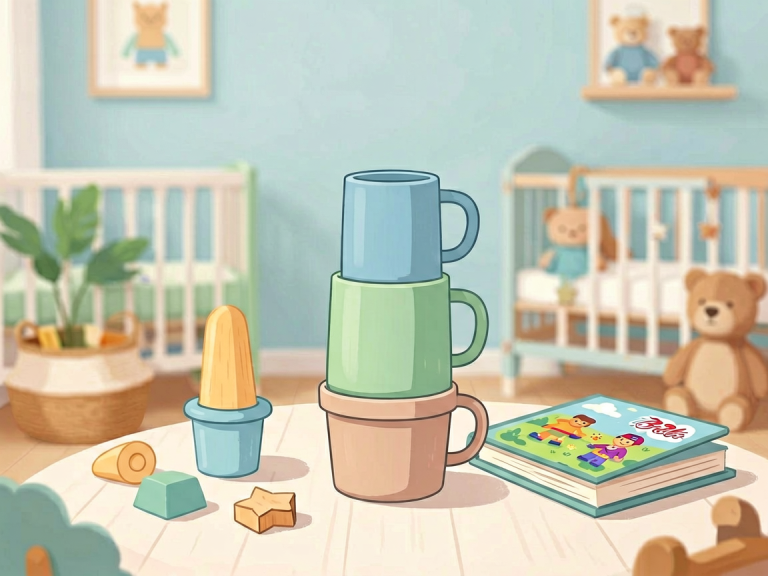
Spatial reasoning is a critical component of problem-solving, and even six-month-olds can engage in basic mental rotation tasks through play. Choose a toy that has a clear "right side up"—for example, a rattle with a handle and a bulbous head, or a small stuffed animal with a face. Show the toy to your baby and let them hold it. Then, deliberately turn the toy upside down and hand it back. Observe how your baby reacts. Many infants will immediately turn the toy back to its correct orientation, especially if they have a preferred way of holding it (e.g., with the face facing them). This action requires the baby to recognize a discrepancy between the expected and observed orientation, form a mental image of the correct position, and execute a motor plan to rotate the object. To build on this, you can present a toy with two possible orientations (e.g., a cup that can be placed upright or upside down). Place the cup upside down on a flat surface and place a small ball on top. The baby will likely try to grab the ball, but because the cup is inverted, the ball may roll off. The problem becomes: "How can I get the ball? Do I need to turn the cup over first?" This simple setup encourages trial-and-error and causal reasoning. As the baby gains experience, they learn to anticipate that some objects need to be repositioned before they can be used effectively—a lesson that will later apply to tasks like using tools or solving puzzles.
Activity 7: Mirror Play – Solving the Problem of Self-Recognition and Imitation
A baby-safe mirror (made of unbreakable acrylic, not glass) is an excellent tool for fostering problem-solving at six months. Place the mirror in front of your baby during tummy time or while they are seated. At first, your baby may simply stare at their reflection, smile, or pat the mirror. As they become familiar, you can introduce a challenge: put a small, colorful sticker or a smear of yogurt on the baby’s nose or cheek, then guide them to look in the mirror. Most six-month-olds do not yet pass the classic mirror test of self-recognition (which typically occurs around 18 months), but they do begin to notice that the face in the mirror moves when they move. This leads to an intriguing problem: "How can I make the face in the mirror do something new?" The baby might experiment by sticking out their tongue, opening their mouth wide, or turning their head. Each movement produces an immediate, predictable response in the mirror, creating a feedback loop that hones the baby’s understanding of agency and control. This is problem-solving at the level of self-regulation: the baby learns that their own actions are the cause of the reflection’s behavior. To extend the activity, place the mirror at an angle where the baby can see a toy behind them. The baby may try to reach for the toy in the mirror’s reflection, then realize they need to turn around. This spatial mismatch—between the apparent location (in the mirror) and the real location (behind)—is a classic cognitive conflict that drives problem-solving development. Always ensure the mirror is securely attached or held by an adult to prevent accidents.
The Role of Caregiver Interaction: Scaffolding Problem-Solving Without Taking Over
While the activities described above are powerful, their effectiveness depends heavily on how the caregiver interacts with the baby. The key principle is scaffolding—providing just enough support to help the baby succeed, then gradually withdrawing that support as the baby gains competence. For example, in the hiding game, if your baby cannot figure out how to lift the blanket, you might first tug at the corner slightly to show them that the blanket moves. Then, place their hand on the edge of the blanket, helping them pull. Finally, let them try alone. Similarly, when a baby struggles to press a button, you can reduce the required force by tilting the toy or holding it steady. The goal is never to solve the problem for the baby, but to make the problem solvable at the baby’s current skill level. Equally important is emotional attunement: celebrate every attempt, whether successful or not. Use a warm, encouraging tone: "You almost got it! Try again!" Avoid showing disappointment if the baby gives up. Problem-solving is inherently challenging, and building resilience requires a safe space to fail. Also, be mindful of the baby’s state: a tired, hungry, or overstimulated baby will not benefit from problem-solving challenges. Choose times when the baby is alert, calm, and interested.
Conclusion: The Lifelong Benefits of Early Problem-Solving Play
The play activities outlined in this article are not just entertaining diversions; they are the building blocks of cognitive flexibility, logical reasoning, and executive function. By engaging a six-month-old in games that require persistence, memory, spatial reasoning, and causal understanding, parents and caregivers lay a strong foundation for later academic and life success. Research in developmental psychology consistently shows that children who experience responsive, challenging play in infancy develop better attention control, frustration tolerance, and problem-solving skills in preschool and beyond. Moreover, these activities strengthen the parent-child bond through shared joy and mutual discovery. The next time you see your six-month-old struggling to reach a toy or puzzling over a hidden object, remember that you are witnessing the birth of a future thinker. Your role is not to hand them the answer, but to provide the tools and the confidence to find their own. With patience, creativity, and a few simple props, you can turn everyday moments into powerful learning experiences that will echo throughout your child’s life. Start today, and watch your baby become an active, curious problem-solver—one playful discovery at a time.