The Wonder of Screen-Free Science Play: Hands-On Adventures That Spark Lifelong Curiosity
—
Introduction: Why Screens Can Wait
In an era dominated by tablets, smartphones, and interactive apps, it is easy to assume that the best way to teach children science is through a glowing screen. Yet some of the most profound scientific discoveries in history—from Newton’s apple to Faraday’s simple wire-and-magnet experiments—happened without a single pixel. Screen-free science play is not a nostalgic retreat into the past; it is a powerful, evidence-backed approach to nurturing observation, problem-solving, and genuine wonder. When children mix baking soda and vinegar, build a cardboard bridge, or watch a caterpillar transform into a butterfly, they are not just playing—they are internalizing the scientific method through their senses, muscles, and emotions. This article explores why unplugged scientific play matters, offers concrete examples, and provides a practical guide for parents, educators, and anyone eager to cultivate a love for science without a single screen in sight.
—
The Hidden Benefits of Unplugged Scientific Exploration
Screen-free science play engages the whole child. Unlike a video that demonstrates a chemical reaction in two minutes, a hands-on experiment demands patience, trial and error, and physical involvement. When a child pours water from one container to another, they develop fine motor skills, understand volume and displacement, and learn that spills are part of discovery. Research in early childhood education consistently shows that tactile, kinesthetic learning strengthens neural connections far more effectively than passive observation. Moreover, screen-free play encourages deeper social interactions: siblings negotiate who gets to pour the next cup of vinegar, parents ask open-ended questions like “What do you think will happen if we add more salt?”, and children learn to articulate hypotheses and conclusions aloud. This kind of dialogue builds vocabulary, critical thinking, and emotional resilience—qualities no app can fully replicate.
Another often-overlooked advantage is the reduction of sensory overload. Digital screens bombard children with rapid image changes, loud sounds, and constant notifications, which can shorten attention spans and increase anxiety. In contrast, a simple science activity—such as watching seeds sprout in a damp paper towel—demands quiet focus. The slow, predictable rhythm of natural phenomena teaches patience and the joy of anticipation. When a child checks their sprouting seed every morning, they experience the scientific virtue of observation over time. This is the kind of deep learning that sticks, not because it is gamified with points and levels, but because it is real.
—
Classic Screen-Free Science Play Ideas to Try at Home
1. Kitchen Chemistry: The Vinegar-and-Baking-Soda Volcano (and Beyond)
Perhaps the most iconic screen-free science play, the vinegar-and-baking-soda volcano is a perfect entry point for children aged four and up. But the learning does not stop at the fizz. Expand the activity by changing variables: What happens if you use cold vinegar vs. warm vinegar? What if you add dish soap to the mixture? Each variation teaches the concept of controlled experiments. For older children, introduce pH testing with red cabbage juice—a natural indicator that turns pink in acid and blue in base. They can test lemon juice, soap, and even tap water. This is real chemistry, done with pantry ingredients, and it builds an intuitive understanding of acids and bases that will serve them well in high school.
2. Engineering Without Blueprints: Building Structures from Everyday Materials
Give a child a pile of dry spaghetti, a bag of marshmallows, and a challenge: build the tallest tower that can support a small toy. This classic STEM activity—often called the “Marshmallow Challenge”—teaches structural engineering, weight distribution, and the importance of prototyping. Without screens, children must rely on their hands and eyes. They will learn that triangles are stronger than squares, that too much weight in one spot causes collapse, and that failure is not the end but a step toward a better design. You can extend the play by using newspaper and tape to build a chair strong enough to hold a child, or by designing a simple pulley system with string and a spool to lift a bucket of toys. Each project reinforces principles of physics and mechanics through direct, sweaty, laughter-filled effort.
3. Biology in the Backyard: Observation Journals and Life Cycles
Screen-free science play does not require a lab. A simple magnifying glass, a notebook, and a few minutes outdoors can launch a biology investigation. Challenge children to find and draw five different insects, noting their colors, number of legs, and where they were found. Over the course of a week, they can observe how a spider rebuilds its web each morning or how ants follow a trail. For a longer project, raise a butterfly from a caterpillar (available through mail-order kits) or grow bean plants in clear cups so roots are visible. Keeping a “scientist’s journal” with dated entries, sketches, and questions encourages literacy and scientific recording. And because there is no screen, the child must pay attention to subtle details—the texture of a leaf, the way water droplets form on a spiderweb—that a digital photo might miss.
4. Physics of Play: Ramps, Pendulums, and Catapults
Simple machines are pure screen-free science play. Use a piece of cardboard as a ramp and test how far different toy cars roll when you change the angle. Attach a weight to a string and create a pendulum; measure how many swings occur in 15 seconds, then change the length of the string. Build a catapult from a spoon, a rubber band, and a fulcrum (like a popsicle stick stack). Each of these activities demonstrates fundamental physics concepts—gravity, energy transfer, mechanical advantage—in a way children can feel and tweak. The best part is the iterative process: “Why did my pom-pom fly only two feet? Oh, I see, I pulled the spoon back more this time!” That “aha” moment, born from direct manipulation, is far more valuable than watching a simulation online.
—
Setting Up a Screen-Free Science Play Zone in Your Home
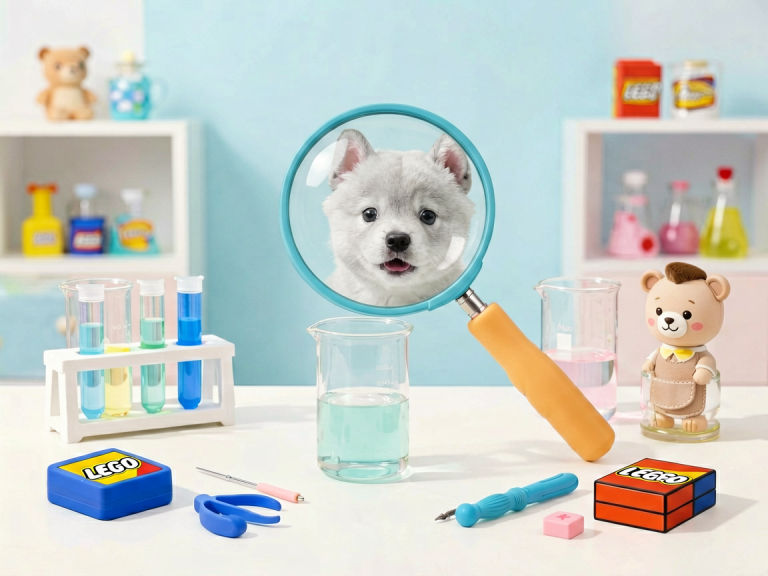
Creating a dedicated space for unplugged scientific exploration does not require a large budget or a separate room. A small corner of the kitchen or a low shelf in the living room can become a “Discovery Station.” Stock it with basic, reusable materials: measuring cups, a plastic dropper, a magnet set, a magnifying glass, a small scale, a notebook, colored pencils, and a collection of “found objects” (pinecones, rocks, bottle caps, string). Keep a basket of safe, non-toxic supplies like baking soda, vinegar, food coloring, cornstarch, and salt. The key is to make these materials accessible without needing a screen to access instructions. Instead, place a single laminated card with open-ended prompts: “What happens if you mix cornstarch and water?” or “Can you make a paperclip float?” This invites spontaneous play.
It is also helpful to establish a few simple rules: wash hands before and after, clean up spills immediately, and never taste or smell unknown substances (unless it is explicitly food-grade and approved). Having a small tray or plastic tablecloth makes cleanup easy, and a “science apron” (an old oversized t-shirt) adds to the ritual. The goal is to foster independence and responsibility. Over time, children will learn to set up their own experiments, record their observations, and even come to you with their own questions: “Mom, I think the salt is making the ice melt faster. Can I test it with different amounts?” That kind of self-driven inquiry is the hallmark of a true scientific mind.
—
Practical Tips for Adults: How to Encourage Without Taking Over
Adults play a crucial role in screen-free science play, but the temptation to direct or correct can undermine the child’s ownership. Instead of saying “That’s not going to work,” ask “What do you think will happen?” and then let them try. Even a failed experiment is a success if it leads to a new question. For example, if a child tries to mix oil and water and becomes frustrated that they won’t blend, you can guide them to add a drop of dish soap and watch the “magic” of emulsification. But let them discover this after their own attempts.
Another effective strategy is to model curiosity. When you are cooking, wonder aloud: “I wonder why bread rises?” Then, after the meal, you and your child can set up a tiny experiment with yeast, sugar, and warm water in a bottle, and observe the balloon inflate on top. This shows that science is not a separate subject but woven into daily life. Avoid using digital rewards or “screen time” as a prize for doing science; instead, celebrate the process itself. Keep a “Discovery Wall” where children can pin their drawings, notes, and even a dried leaf or a crystal they grew. This physical gallery reinforces the value of their work without any digital intermediary.
It is also important to respect different learning paces. Some children will want to repeat the same experiment ten times; others will quickly move on. Both approaches are valid. Repetition builds mastery and confidence, while quick exploration reveals breadth of interest. The adult’s role is to provide materials, ask thoughtful questions, and protect the time for unstructured play. In a world that constantly pushes for efficiency and measurable outcomes, unfettered scientific play is a sanctuary.
—
Conclusion: The Future of Learning Is Analog
Screen-free science play is not a rejection of technology—it is a reaffirmation of the fundamental human need to touch, build, fail, and wonder. The smartphone can show a child a video of a rocket launch, but only a homemade balloon rocket on a string can teach them about thrust and air pressure through a shared giggle. As we prepare children for a future that may be filled with artificial intelligence and virtual reality, we must not forget that the roots of innovation lie in physical curiosity. The greatest scientists—from Marie Curie to Richard Feynman—often recalled that their first experiments were messy, joyful, and utterly screen-free. By giving our children the same gift, we are not just teaching science; we are nurturing the endless, unplugged wonder that makes a life of discovery possible.
So put down the tablet, open the kitchen cupboard, and let the fizzing, splashing, building, and questioning begin. The best screen is the one that is off, and the best science play is the one that leaves your hands sticky and your mind buzzing with new questions.