Building Blocks of Connection: The Best Toys for Social Skills Development in 3-Year-Olds
At the age of three, children cross a remarkable developmental threshold. Their language blossoms, their imagination ignites, and—most importantly—they begin to crave interaction with peers. While solitary play still holds value, the preschool years are primarily about learning to share, take turns, negotiate, empathize, and collaborate. The right toys can serve as catalysts for these complex social behaviors, providing a safe and enjoyable context for practice. Choosing toys that encourage cooperative play rather than isolated competition is key. Below, we explore the most effective categories and specific examples of toys that naturally foster social <a href="https://www.playlearningguide.com/category/<a href="https://www.playlearningguide.com/category/skills/”>skills/”>skills in three-year-olds, along with explanations of how each type of play contributes to social-emotional growth.
1. Cooperative Board Games: First Lessons in Turn-Taking and Teamwork
Traditional board games often involve winners and losers, which can be frustrating for a three-year-old’s developing ego. Instead, look for cooperative board games where everyone works together toward a common goal. Games such as *Hoot Owl Hoot!* or *The Sneaky, Snacky Squirrel Game* (in its cooperative version) require players to take turns, follow simple rules, and help one another. In *Hoot Owl Hoot!*, for example, children collaborate to move owls back to their nest before the sun rises. There is no single winner—everyone wins or loses together.
Why this works for social skills: These games naturally teach patience and turn-taking in a low-pressure environment. When a child has to wait for their turn, they practice impulse control—a foundational social skill. Moreover, because the outcome depends on group effort, children learn to cheer for each other’s successes and offer encouragement when someone makes a mistake. The simple act of saying “Good job, Lily!” or “We can do it together!” builds empathy and cooperative language. Adult facilitation can further reinforce these skills by modeling phrases like “Your turn, then mine” or “Let’s think of a plan together.”
2. Pretend Play Sets: The Ultimate Stage for Role-Playing and Perspective-Taking
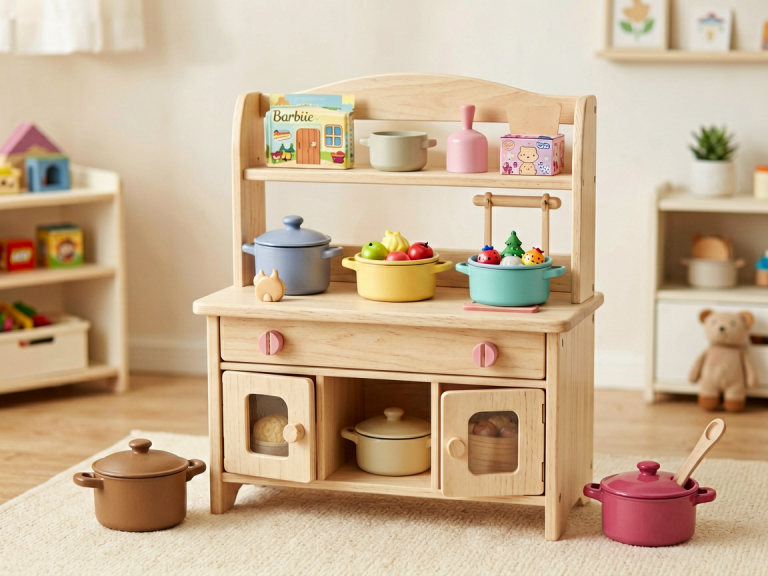
Three-year-olds are masters of make-believe, and toys that support pretend play are arguably the most powerful tools for social development. Play kitchens, doctor’s kits, tool benches, dress-up costumes, and puppet theaters invite children to step into different roles and interact with others in those roles. When two or three children play “restaurant” together, they must negotiate who is the chef, who is the customer, and what the menu includes. This requires verbal exchange, compromise, and the ability to see a situation from another’s point of view.
For instance, a simple set of plastic fruits and vegetables, a toy cash register, and some play money can spark an entire grocery store scenario. One child might say, “I want apples,” and another might respond, “That’s one dollar.” If a disagreement erupts over who gets to scan the items, an adult can guide them to find a solution: “Maybe you can take turns being the cashier. First you, then Sam.” Through such interactions, children internalize the rhythm of conversation, the concept of reciprocity, and the fact that other people have wants and needs different from their own. Puppets, in particular, allow shy children to express feelings indirectly, making them a gentle bridge to social interaction.
3. Building and Construction Sets: Engineering Collaboration and Communication
Blocks, magnetic tiles, and large interlocking bricks like Mega Bloks or Duplo are often thought of as solitary toys, but they are actually superb for group play when introduced in a shared space. A communal bin of wooden unit blocks or magnetic tiles encourages children to build together, whether by constructing a tall tower, a castle, or a “rocket ship to the moon.” The key is that the project is too big (or too fun) for one child to handle alone. Before the building begins, children must discuss their plan: “Let’s make a garage for the cars!” “No, let’s make a zoo!” This negotiation is a rich social exercise.
During construction, children naturally encounter problems that require cooperation. Perhaps the tower starts to wobble. One child might say, “We need a bigger block here,” and another might run to find one. They also learn to share limited resources—there may be only four red arches, so they must decide who uses them or whether to use a different shape instead. When the structure inevitably collapses, they laugh, pick up the pieces, and start again, building resilience and the ability to manage disappointment together. Socially, block play also involves spatial language (“under,” “next to,” “on top”) and words of affirmation (“That looks cool!”), which strengthen the social bonds of the play group.
4. Musical Instruments and Rhythm Sets: Synchronizing Bodies and Emotions
Making music together is a deeply social and even primal experience. Simple percussion instruments—shakers, tambourines, drums, xylophones, and bells— invite children to create sounds in unison. When a small group of three-year-olds sits in a circle with a drum each, they can be guided to play together, stop together, and follow a simple beat. An adult can lead a game of “copy the rhythm,” where one child taps a pattern and the others try to replicate it. This requires focused listening, turn-taking, and joint attention—all core social skills.
Moreover, music has a unique ability to regulate emotions. A child who is feeling anxious or overwhelmed can find calm through a steady drumming pattern with a friend. Group singing (even of nonsense songs) promotes a sense of belonging. Toys like a set of handbells or a small “music-making station” allow children to experiment with sounds while staying aware of their playmates’ actions. The emphasis is on harmony, both literal and figurative: children learn to adjust their volume, tempo, and actions to fit with the group. This early experience of synchronous activity is linked to later prosocial behaviors like helping and cooperating.
5. Vehicles and Playscapes: Navigating Shared Spaces and Stories
Toy cars, trains, and playsets (such as a wooden train track or a farm set) are classic tools for social play. A large train set with multiple tracks and trains naturally draws two or three children into a shared narrative. They must decide where the trains will go, who drives which engine, and what to do if the tracks cross. “My train is going to the station. Stop! Red light!” one child might shout, and another must respond by stopping their own train. This back-and-forth is essentially a conversation conducted through play.
Similarly, a farm set with animals, fences, and a barn becomes a stage for cooperative storytelling. One child might place a cow in the field while the other put the sheep inside the barn. If they disagree, they negotiate: “Let’s put all the animals in the barn because it’s raining.” Such scenarios teach children to integrate their ideas into a single, coherent play narrative. Importantly, vehicles and playscapes also offer opportunities for parallel play to gradually merge into associative and cooperative play, which is exactly the social progression a three-year-old is working through.
6. Art and Craft Supplies: Creating a Shared Masterpiece
While art is often seen as an individual activity, large collaborative art projects can be highly social. A giant sheet of butcher paper spread on the floor with chunky crayons, washable markers, and stampers invites multiple children to draw together. They might decide to draw a “rainbow river” or a “monster party.” Because the paper is huge, children naturally negotiate for space: “You draw over there; I’ll draw here. Let’s make the colors touch!” The act of sharing materials—the same red crayon, the same blue stamper—teaches patience and turn-taking in a low-stakes context.
Additionally, finished projects can spark conversation. A child might point to their drawing and say, “This is my house,” and a friend might respond, “I have a house too. Let’s make a road between them!” This kind of dialogue builds narrative and perspective-taking. An adult can further encourage social skills by prompting children to compliment each other’s work (“Tell Chloe what you like about her rainbow”) or to ask for help (“Can you help me glue this button on?”). Art thus becomes a vehicle for connecting, sharing ideas, and recognizing the contributions of others.
Conclusion: The Adult’s Role in Cultivating Social Play
No toy, no matter how perfectly designed, can teach social skills in isolation. The best toys for social development are those that create a context for interaction, but the adult’s guidance remains crucial. When introducing any of the toys discussed above, caregivers and educators should model cooperative language, mediate conflicts calmly, and celebrate collaborative successes. For a three-year-old, learning to say “Can I have that?” or “Let’s build together” is a milestone as significant as any academic achievement. By choosing toys that require sharing, negotiation, and joint imagination, we give children the tools not just to play, but to connect—laying a foundation for empathy, friendship, and social confidence that will last a lifetime.
*(Word count: approximately 1,080 words)*
Start with the complete guide: The Best Toys for Social Play: Building Connection, Cooperation, and Communication Through Play.