Unlocking Communication: The Best Language Toys Under $50 for Growing Minds
Introduction
In a world where communication skills are the bedrock of personal and academic success, parents and educators are constantly seeking tools that make language learning engaging and effective. While high-tech gadgets often dominate the conversation, many of the most powerful language development aids are surprisingly affordable. Language toys priced under $50 offer an accessible entry point for families to nurture vocabulary, grammar, reading, and storytelling abilities in children from toddlerhood through elementary school. These toys are not just about entertainment; they are carefully designed to stimulate neural pathways linked to linguistic processing, phonemic awareness, and social communication. This article explores a curated selection of language toys available for under $50, categorized by their primary skill focus. Each section will examine how these toys work, why they are effective, and what makes them a smart investment for budget-conscious families. From classic board games to modern electronic readers, the options are diverse, interactive, and proven to foster a love of words.
—
Building Blocks of Vocabulary: Puzzles, Cards, and Magnetic Sets
One of the most fundamental aspects of language acquisition is vocabulary expansion. For young children, hands-on manipulative toys that combine visual recognition with word association are particularly effective. Products like Melissa & Doug’s See & Spell Wooden Puzzle (typically $15–$25) allow preschoolers to match letter tiles with pictures, reinforcing spelling and object identification. Each puzzle piece features a colorful image and a corresponding word, encouraging children to sound out letters and recognize common patterns. The tactile experience of picking up and placing wooden tiles also supports fine motor development, which is closely linked to cognitive growth.
Another excellent option is The Learning Journey Match It! Spelling Puzzle (around $12–$18), which offers self-correcting puzzle pieces. Children must find the correct letter combinations to complete the spelling of a word shown in a picture. This trial-and-error process builds persistence and problem-solving skills while expanding their lexicon. For families on the tightest budgets, simple alphabet flashcards (such as those from School Zone, priced under $10) can be turned into games like “I Spy” or “Memory Match.” The key is repetition and positive reinforcement, which these toys naturally encourage.
Magnetic letters and boards are another classic under-$50 staple. The Magna-Tiles Alphabet Set ($35–$45) adds a dimensional twist—children can form letters with magnetic tiles, then attach them to a whiteboard to spell words. This open-ended toy grows with the child: from letter recognition in toddlerhood to simple word building in kindergarten. Research shows that multisensory learning—combining sight, touch, and sound—significantly improves retention. By underlining every purchase with a clear price cap, parents can build a small library of vocabulary-building toys without guilt.
—
Phonics and Reading Readiness: Electronic and Interactive Tools
For children who are ready to move from letter recognition to decoding sounds, electronic learning toys that incorporate phonics instruction are invaluable. The LeapFrog Phonics Reading System (often available for $30–$45) uses a stylus and interactive books to teach letter sounds, blending, and simple words. Children touch the pages, and the device responds with clear audio, modeling correct pronunciation. This immediate feedback loop is crucial because it helps children self-correct without frustration. Many versions of this system come with several books, so the initial investment stretches over months of learning.
Another standout is the VTech Touch & Learn Activity Desk Deluxe (priced around $40–$50, depending on sales). While it is more than just a language toy, its expansion packs include phonics, vocabulary, and spelling activities. The desk features a touch-sensitive surface, an interactive LED screen, and a variety of games that adapt to different skill levels. For example, a child might tap on a picture of a cat and hear the word spoken, then trace the letters to spell it. The desk also includes a music player feature that reinforces rhythm and rhyme—both critical for phonemic awareness.
For families who prefer screen-free alternatives, Phonics Flipbooks (available for under $20) are simple but effective. These spiral-bound books allow children to flip through pages to form different words by changing initial consonants or vowel sounds. They are portable, durable, and can be used independently or with a parent. The key is that they encourage active participation: every flip of the page is a mini lesson in sound manipulation. When paired with a set of word family cards (like those from Junior Learning, around $15), children can build dozens of words from a single root. These toys prove that technology is not a prerequisite for high-quality phonics practice.
—
Grammar, Storytelling, and Social Language: Board Games That Teach
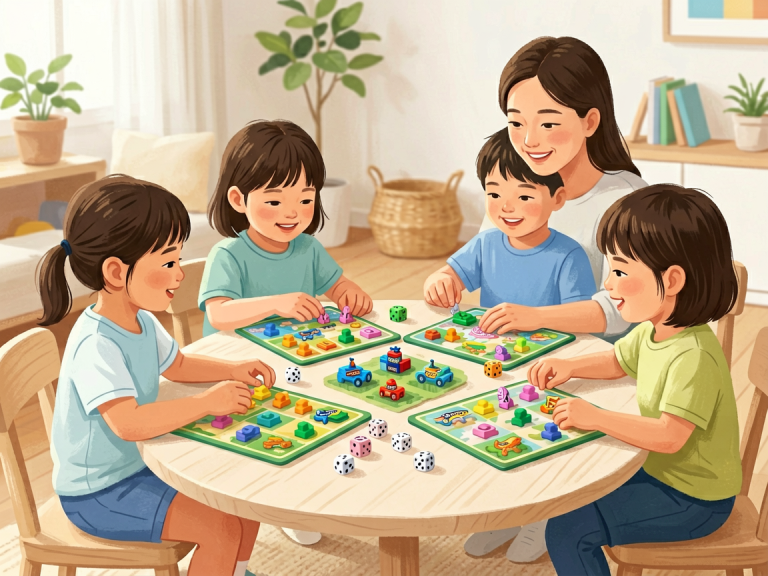
As children grow, language becomes a tool not just for labeling, but for expressing ideas, telling stories, and understanding grammar. Board games are particularly effective for this stage because they combine structured rules with spontaneous conversation. Scrabble Junior ($20–$30) is a perennial favorite. It simplifies the classic word game by using a double-sided board: one side features pre-printed words for young players, while the other offers a traditional crossword format for older children. Players learn spelling, word recognition, and strategic thinking—all while practicing turn-taking and sportsmanship.
Boggle Junior (around $15–$20) takes a different approach. Instead of forming words from tiles, children match letter cubes to picture cards. The game includes three levels of difficulty, allowing it to grow with the child. For more advanced grammar practice, The Sentence Game from Educational Insights (approximately $25) challenges players to build grammatically correct sentences using colored cards that represent parts of speech (nouns, verbs, adjectives, etc.). This teaches not only vocabulary but also sentence structure and word order.
Storytelling games deserve special mention. Rory’s Story Cubes ($10–$15) consist of nine dice with different images on each face. Players roll the dice and create a story based on the pictures that appear. This open-ended activity hones narrative skills, creativity, and sequencing. It is also highly social—children can take turns adding to a group story, developing listening and collaborative skills. Another similar product is The Storytelling Game by eeBoo (around $20), which uses illustrated cards to prompt story creation. These games are lightweight, portable, and can be played anywhere, making them excellent for road trips or quiet evenings at home.
—
Budget-Friendly Language Toys for Every Age: Making the Most of Under $50
One of the greatest advantages of the under-$50 market is its inclusivity across age groups. For infants and toddlers, soft fabric books with crinkle pages and high-contrast pictures (like those from Lamaze, around $10–$15) introduce the concept of print and narrative even before a child can speak. Pointing to pictures and naming objects while reading these books lays the groundwork for vocabulary. For preschoolers, puppets (such as the Folkmanis Little Red Riding Hood finger puppet set, about $12) encourage dialogue and role-playing, which naturally expands language use.
Elementary-aged children benefit from word search books or crossword puzzle pads (under $10 each), which reinforce spelling and pattern recognition in a low-pressure format. Many bookstores and online retailers offer bundles of activity books designed for specific grade levels. Alternatively, a set of dry-erase sentence building boards (like those from Learning Resources, around $20) allows children to write and wipe sentences repeatedly, practicing grammar and punctuation.
Finally, do not overlook the power of audiobooks and story CDs (many under $15). While not a physical toy in the traditional sense, audio stories expose children to rich vocabulary, varied sentence structures, and diverse accents. Paired with a play-along figurine set (e.g., from Schleich or Safari Ltd., $10–$20), a child can act out the story, blending listening comprehension with imaginative play. The key is to choose toys that offer multiple modes of engagement—visual, auditory, and kinesthetic—to suit different learning styles.
—
Conclusion
Language development need not be an expensive endeavor. The wide array of toys available for under $50 proves that thoughtful design often trumps high price tags. From wooden puzzles that teach spelling to electronic systems that promote phonics, and from board games that encourage grammar to dice that fuel storytelling, these tools empower children to explore language in ways that are natural, joyful, and effective. Parents who carefully select toys that align with their child’s current stage of development can build a rich learning environment without financial strain. Moreover, many of these toys have lasting value—they can be passed down to younger siblings or shared among playgroups. The real investment is not in the price, but in the time spent playing together, talking about words, and celebrating each new phrase or sentence. In an era of digital overload, simple, affordable language toys remind us that the best communication tools are the ones that invite conversation, curiosity, and connection. Whether you are a parent, teacher, or caregiver, you can unlock a world of words for your little learner—without breaking the bank.