Beyond Numbers: How Math Toys for Kids Build a Lifetime of Problem-Solving Skills
—
Introduction: Why Math Toys Matter More Than You Think
Walk into any toy store today, and you will find shelves lined with flashy electronic gadgets, robotic kits, and colorful puzzles. Among them, a special category quietly stands out: math toys for kids. These are not simply textbooks disguised as playthings; they are carefully designed tools that transform abstract mathematical concepts into tangible, hands-on experiences. In an era where STEM education is hailed as the cornerstone of future careers, the role of math toys has never been more critical. Yet, many parents and educators still view them as mere entertainment. This article explores why math toys are indispensable for children’s cognitive development, how they nurture a growth mindset, and what types of toys best support learning at different ages. By understanding the depth of these simple objects, we can help children unlock a world of logical reasoning, creativity, and confidence—all while having fun.
—
The Cognitive Foundation: How Math Toys Wire the Young Brain
From Concrete to Abstract: The Piagetian Perspective
Jean Piaget, the renowned developmental psychologist, taught us that children learn best when they move from concrete experiences to abstract reasoning. Math toys, by their very nature, embody this principle. A set of wooden blocks, for instance, allows a toddler to stack, count, and compare sizes long before they can recite multiplication tables. Through these physical manipulations, the brain forms neural connections that anchor later symbolic understanding. When a child picks up a unit cube and places it next to a ten-rod, they are not just playing—they are internalizing the base‑ten system. Research in cognitive neuroscience confirms that such hands‑on activities activate the parietal lobe, the region responsible for number sense and spatial reasoning. Math toys provide the scaffolding that transforms a child’s natural curiosity into structured mathematical thinking.
Developing Number Sense and Spatial Intelligence
Number sense—the ability to understand quantities, relationships, and operations—is a predictor of later math achievement. Traditional worksheets often fail to cultivate this sense because they skip the tactile stage. In contrast, math toys like counting bears, abacuses, and number lines engage multiple senses simultaneously. A child who sorts colored bears into groups of five learns addition and subtraction not as rote facts, but as a physical arrangement that can be rearranged. Similarly, spatial intelligence is honed by geometric puzzles, tangrams, and pattern blocks. These toys teach children to rotate, flip, and combine shapes in their minds—skills that directly correlate with success in geometry, engineering, and even reading maps. The beauty of math toys lies in their ability to embed these foundational skills into joyful, self‑directed play.
—
Types of Math Toys and Their Unique Benefits
Counting and Number Recognition Toys (Ages 2–5)
For the youngest learners, the goal is simple: make numbers visible and touchable. Counting bears (small plastic bears in different colors and sizes) allow children to practice one‑to‑one correspondence by placing one bear in each cup. Number puzzles with chunky wooden pieces help children match numerals to quantities. Abacuses with sliding beads provide a visual and tactile representation of counting and simple addition. These toys also introduce vocabulary—words like “more,” “less,” “equal,” and “how many?”—in a natural conversational context. Importantly, they build the concept of cardinality: the understanding that the last number counted represents the total quantity. Without this foundation, later arithmetic becomes a meaningless sequence of digits.
Pattern, Sorting, and Classification Toys (Ages 3–6)
Pattern recognition is at the heart of mathematical thinking. Toys such as lacing beads in geometric shapes, pattern blocks (plastic or wooden tiles in standard shapes), and sorting trays with colored objects encourage children to identify, extend, and create patterns. A three‑year‑old might simply sort buttons by color; a five‑year‑old can replicate an ABB pattern or design a symmetrical mosaic. These activities strengthen executive function—the brain’s ability to plan, focus, and switch tasks. Moreover, classification toys teach set theory informally. When children sort a collection of objects into groups (e.g., all red circles versus all blue squares), they are learning about attributes and categories, which underpin algebra and data analysis. The best part? They do not realize they are learning math at all.
Arithmetic and Operation Toys (Ages 5–8)
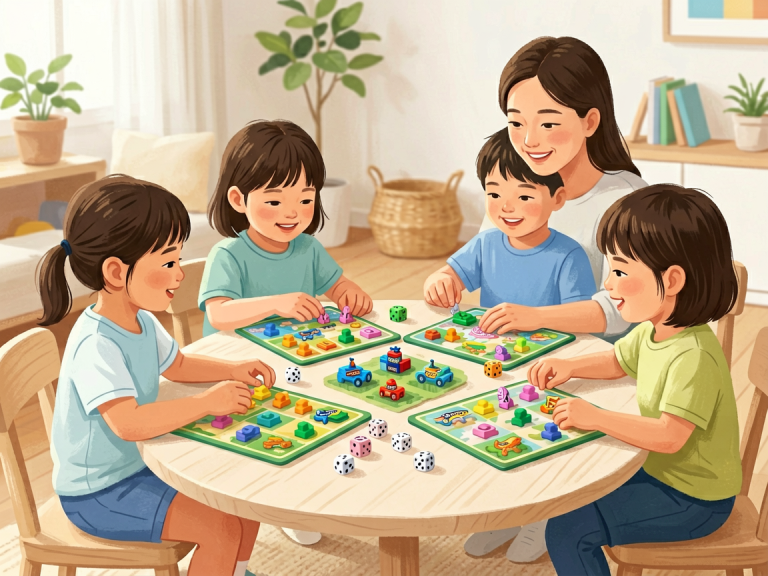
Once children have a solid sense of numbers and patterns, they are ready to explore operations. Number rods (like Cuisenaire rods) allow children to physically combine lengths to see that 3+4=7. Balance scales with numbered weights introduce equality and inequality in a literal, see‑saw manner. Dominoes and dice games turn addition and subtraction into quick, repetitive practice that builds fluency without drills. Math board games such as *Sum Swamp* or *Monopoly Junior* incorporate money handling, counting spaces, and simple probability. These toys help children move from counting on fingers to mental arithmetic by providing a visual anchor. They also teach perseverance—when a child loses a game because they miscalculated, they are motivated to try again. Importantly, these toys normalize mistakes as part of the learning process, reducing math anxiety before it even begins.
Geometry, Measurement, and Logic Toys (Ages 6–10)
As children enter elementary school, math toys can delve deeper into geometry and measurement. Geoboards with rubber bands allow kids to create polygons, understand perimeter and area, and explore symmetry. Measuring tapes, kitchen scales, and liquid measuring cups bring units of measurement to life during baking or science play. Tangrams and Pentomino puzzles challenge spatial reasoning and problem‑solving. Logic toys such as *Rush Hour* or *Gravity Maze* introduce sequential reasoning and conditional thinking, which are essential for coding and higher‑level math. For example, a child trying to solve a *Gravity Maze* puzzle must plan a path for a marble using blocks of different heights. This process involves trial and error, hypothesis testing, and revision—exactly the scientific method applied to a spatial problem. These toys demonstrate that math is not just about numbers; it is about patterns, relationships, and elegant solutions.
Advanced Math Toys for Older Kids (Ages 10+)
For tweens and teenagers, math toys can bridge the gap between concrete play and abstract theory. Fraction cubes and decimal tiles make rational numbers tactile. Geometric construction sets (like *K’NEX* or *Zometool*) allow students to build 3D models of polyhedra, exploring Euler’s formula or the properties of platonic solids. Coding toys such as *Sphero* or *Micro:bit* integrate mathematical logic with programming—children must use coordinates, angles, and variables to command a robot. Math puzzle books with mechanical puzzles like *Rubik’s Cube* or *Hanoi Tower* train memory, pattern recognition, and algorithmic thinking. Even board games like *Settlers of Catan* involve resource management, probability estimation, and strategic planning. At this stage, math toys reinforce school curriculum by providing a playful laboratory where formulas become tools rather than commands.
—
Selecting the Right Math Toys: A Practical Guide for Parents and Educators
Age Appropriateness and Developmental Readiness
Not all math toys are suitable for every age. A complex logic puzzle might frustrate a four‑year‑old, while a simple counting bear set may bore a ten‑year‑old. The key is to match the toy to the child’s current zone of proximal development—challenging enough to stretch their abilities, but not so hard that they give up. For preschoolers, look for toys that emphasize fine motor skills, color recognition, and basic counting. For early elementary, prioritize toys that encourage open‑ended exploration of arithmetic and geometry. For older children, choose toys that require planning, strategic thinking, and multiple steps. Observe your child: if they are repeatedly making the same mistake, the toy may be too difficult; if they lose interest quickly, it may be too easy. The best math toys grow with the child, offering multiple levels of play.
Quality Over Quantity: The Value of Open‑Ended Design
A common mistake is buying dozens of specialized toys. Instead, invest in a few high‑quality, open‑ended sets. Wooden unit blocks, for example, can be used from age two to age twelve—for counting, building, measuring area, and even exploring fractions. Pattern blocks are another classic: a single set can teach symmetry, tessellation, fractions, angles, and ratios. Number rods (Cuisenaire rods) are perhaps the most versatile math manipulative ever created; they illustrate addition, subtraction, multiplication, division, fractions, ratios, and even early algebra. Open‑ended toys encourage creativity and divergent thinking. They allow children to pose their own problems rather than simply solving pre‑made ones. In contrast, electronic math toys that provide immediate audio‑visual feedback can be addictive but often limit the depth of exploration. The best math toys are simple, durable, and invite endless experimentation.
Integrating Math Toys into Daily Life
Math toys do not need to be confined to a “math lesson.” Incorporate them into everyday routines. Have your child count the number of apples while grocery shopping, using a small abacus. Build a tower with blocks and ask, “How many blocks tall is it?” while measuring with a ruler. Play a board game that requires adding numbers on dice. Bake cookies and let your child measure flour and sugar, then double the recipe to practice multiplication. Use a geoboard during a road trip to create shapes and discuss symmetry. The goal is to normalize mathematical thinking so that it becomes as natural as storytelling or drawing. When children see math all around them, they develop a positive identity as a “math person.” Research shows that children who engage in frequent, playful math activities at home perform significantly better in school, regardless of their parents’ own math abilities.
—
The Long‑Term Impact: Beyond School Grades
Building Resilience and a Growth Mindset
One of the most profound benefits of math toys is their ability to cultivate a growth mindset. When a child builds a tower that falls, or tries a puzzle that seems impossible, they learn that failure is not a verdict but a step toward success. Math toys, by their very nature, provide immediate, non‑judgmental feedback: the blocks will not fit if the measurements are wrong; the puzzle piece will not snap in unless it is correctly oriented. This feedback teaches children to self‑correct, to try different strategies, and to persist. Over time, they internalize the belief that mathematical ability is not fixed but can be developed through effort. This mindset is the single strongest predictor of academic success, even more than raw IQ. In an age of high‑stakes testing and math anxiety, toys offer a safe space to embrace challenge.
Preparing for a Quantitative World
Beyond school, mathematics permeates everyday life—from budgeting and cooking to understanding statistics in news articles, to evaluating risks in decision‑making. Adults who struggle with numeracy often trace their difficulty back to negative early experiences with math. Math toys provide a joyful entry point that prevents that cycle. Children who grow up playing with math toys are comfortable with numbers, patterns, and logic. They are less likely to say “I’m just not a math person.” They are also better equipped for careers in STEM fields, which are growing exponentially. But even for those who pursue the arts or humanities, a strong mathematical foundation enhances critical thinking and enables informed citizenship. The cost of neglecting early math play is high; the payoff of investing in it is immeasurable.
—
Conclusion: Play Is the Highest Form of Research
Albert Einstein once said, “Play is the highest form of research.” Math toys for kids epitomize this principle. They transform abstract symbols into tangible, joyful experiences. They build neural pathways, foster resilience, and ignite a lifelong love of learning. In a world that often pressures children to perform on tests, math toys remind us that the deepest learning happens when a child is free to explore, to fail, and to try again. Whether it is a toddler stacking blocks or a tween solving a logic puzzle, every moment of play with math toys is an investment in a smarter, more confident future. So next time you see a set of colorful blocks or a balance scale, do not dismiss it as a simple toy. Recognize it for what it is: a powerful tool that can shape a child’s mind and open doors to a universe of possibilities. Let the play begin.
Start with the complete guide: Beyond Counting: The Best Early Math Toys That Build a Foundation for Lifelong Numeracy.