From Blocks to Dreams: How Educational Toys for Babies Build Imagination
Introduction
In the quiet corner of a nursery, a baby grasps a soft wooden block, turns it over in tiny fingers, and then—with a look of profound concentration—presses it against her ear as if listening for a secret. That block is not merely a block. In her imagination, it might be a telephone, a drum, or a spaceship about to launch. This moment captures the essence of early childhood development: the raw, untamed power of imagination. For parents and caregivers, the question is not whether babies should engage in imaginative play, but how to nurture that spark. The answer lies in carefully selected educational toys. Unlike passive entertainment or rigidly structured gadgets, educational toys designed for babies serve as open-ended invitations to explore, create, and wonder. They are the tools that transform a simple “bang” into a story, a shape into a character, and a rattle into a symphony. This article explores the profound role these toys play in building imagination, offers guidance on choosing the right ones, and provides practical strategies for integrating them into daily life.
The Importance of Imagination in Early Development
Imagination is far more than daydreaming or make-believe. For a baby, it is a fundamental cognitive process that lays the groundwork for problem-solving, emotional regulation, language acquisition, and social understanding. When a baby imagines that a cardboard box is a cozy cave, she is learning to represent one thing with another—a skill that underpins symbolic thinking, which later enables reading and mathematics. Imagination also fuels curiosity. The baby who imagines what happens when she drops a ball from her high chair is conducting a tiny experiment, testing cause and effect. Moreover, imaginative play helps babies process emotions. A soft teddy bear can become a friend who feels sad or happy, allowing the baby to explore feelings in a safe, controlled way. Research in developmental psychology consistently shows that children who engage in rich, imaginative play develop stronger executive functions, including self-control, flexibility, and working memory. Therefore, encouraging imagination from infancy is not a luxury; it is an essential investment in a child’s future learning and well-being.
Characteristics of Educational Toys That Build Imagination
Not all toys are created equal when it comes to sparking imagination. The most effective educational toys for babies share several key characteristics. First, they are open-ended. Unlike a electronic toy that only plays a single song or flashes a specific pattern, an open-ended toy can be used in countless ways. A set of colorful stacking cups, for example, can be towers, nesting dolls, drums, scoops in the bath, or hats for teddy bears. Second, they are sensory-rich. Babies learn through their senses—touch, sight, sound, and even taste. Toys with varied textures, contrasting colors, gentle sounds, and pleasing weights engage multiple senses simultaneously, encouraging exploration and creative connections. Third, they are age-appropriate but not overly prescriptive. A rattle that a three-month-old can grasp is educational; a rattle that plays a pre-recorded jingle and only lights up in one sequence may actually limit imagination by dictating how the toy should be used. Finally, the best toys allow for repetition and variation. Babies thrive on doing the same action over and over, each time discovering something new. A simple set of wooden rings on a dowel can be stacked in different orders, knocked down, and rebuilt, reinforcing the idea that creation and destruction are part of the same playful cycle.
Types of Educational Toys That Nurture the Imagination
Building and Construction Sets
Blocks are the quintessential imagination builders. Whether made of soft foam, wood, or plastic, blocks offer infinite possibilities. A six-month-old might simply enjoy the weight and texture of a single block, while a one-year-old begins to stack two or three, experimenting with balance. As babies grow, they learn to combine blocks to create towers, bridges, and enclosures. This process involves spatial reasoning, planning, and storytelling—each tower becomes a castle, a skyscraper, or a fortress. Magnetic tiles, with their translucent colors and simple connections, add another dimension, allowing babies to create three-dimensional shapes that mimic real-world structures or fantastical creatures.
Shape Sorters and Puzzle-Like Toys
Classic shape sorters might seem like simple matching games, but they are also powerful imagination tools. When a baby picks up a star-shaped block and tries to fit it into the square hole, she is not only learning geometry—she is practicing persistence, trial-and-error, and the joy of breakthrough. More importantly, shape sorters often become characters in a baby’s narrative: the circle is a wheel for a make-believe car, the triangle is a hat for a doll. The very act of sorting, grouping, and categorizing builds cognitive flexibility, allowing the baby to see patterns and invent new uses for objects.
Sensory and Textured Toys
Sensory toys such as fabric balls with tags, crinkly cloth books, and textured teethers do more than soothe gums. They invite the baby to explore the world through touch and sound. A crinkly page in a cloth book might be “leaves rustling in the wind” to a baby who hears it for the first time. A squishy, bumpy ball can become a moon with craters or a mountain with caves. These toys stimulate the brain’s associative networks, helping babies connect tactile sensations with mental images. High-contrast black-and-white toys also support visual development and encourage focused attention, which is the foundation of imaginative concentration.
Role-Play and Miniature Animals
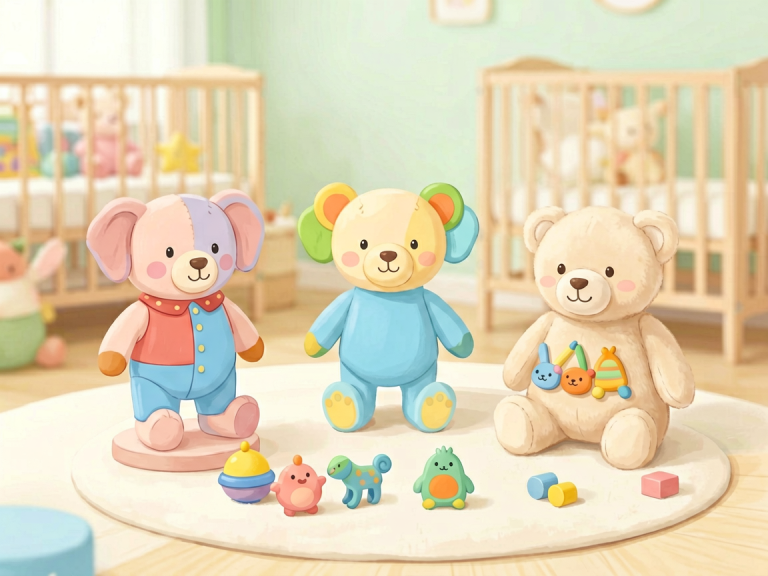
Even before a baby can speak, they can engage in rudimentary role-play. Soft stuffed animals, small wooden dolls, or plastic farm animals become companions in a baby’s world. By holding a teddy bear and pretending to feed it, the baby is practicing empathy and narrative thinking. Toy telephones, play kitchens, and tiny cars allow babies to imitate adult actions while adding their own creative twists. A one-year-old might pick up a toy phone, say “hello,” and then listen intently as if having a conversation—a magical moment where reality and make-believe merge. These toys support language development because the baby begins to assign words to actions, and parents can join in, expanding the story.
Musical and Sound-Making Toys
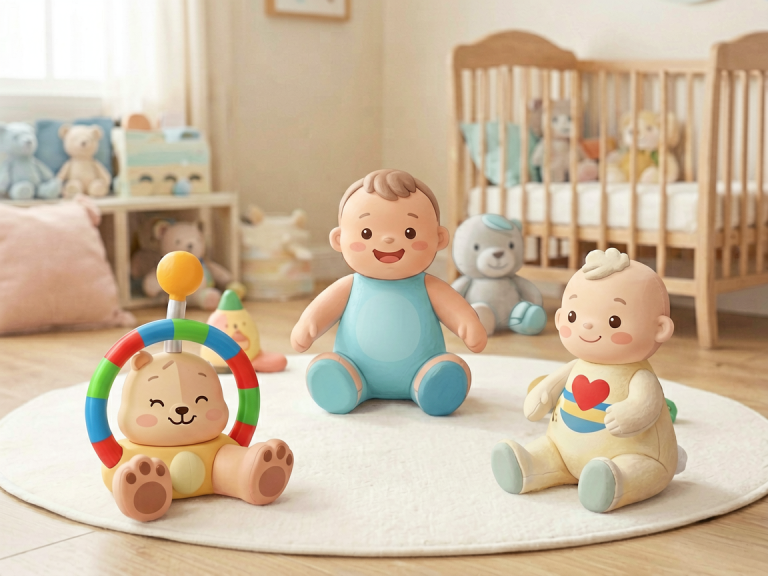
Music is a universal language of imagination. Simple instruments like rattles, shakers, drums, and xylophones let babies discover rhythm and cause and effect. When a baby strikes a drum and hears a boom, she may imagine a giant’s footsteps or a thunderstorm. The lack of a fixed melody means each bang or jingle is unique, inviting the baby to create her own symphony. Even a set of bells on a wristband can become a character’s voice—a jingle for a dancing bird, a ring for a playful cat. Musical toys also enhance auditory discrimination and promote emotional expression.
How to Choose the Right Educational Toys for Your Baby
With so many options on the market, selecting toys that genuinely build imagination requires thoughtful consideration. First, prioritize quality over quantity. A few well-chosen, durable toys are better than a mountain of cheap, electronic gadgets that dictate play. Look for toys made from natural materials like wood, cotton, and non-toxic paints—they are safer, more pleasant to touch, and often more open-ended. Second, consider your baby’s current developmental stage. A three-month-old needs toys that are easy to grasp and safe to mouth; a nine-month-old might enjoy toys that cause a reaction, like a ball that rolls when pushed; a twelve-month-old will love toys that require simple problem-solving, like stacking rings. Yet even within each stage, choose toys that allow for multiple uses. Avoid toys with only one function, such as a plastic button that plays a single song and nothing else. Third, think about versatility. Can the toy be used in different settings—on the floor, during tummy time, in the bath, or outdoors? Can it be combined with other toys to create new play scenarios? Finally, trust your baby’s interests. If she is fascinated by the sound of crinkling paper, give her a crinkle fabric book rather than a brightly colored plastic toy. The best toy is the one that captures her attention and invites her to explore freely.
Practical Tips for Parents to Maximize Imaginative Play
Having the right toys is only half the equation. How you engage with your baby during play profoundly influences her imagination. Here are some actionable strategies:
- Observe before intervening. Let your baby lead the play. If she is tapping a block against the table, refrain from immediately showing her how to stack it. She may be imagining the block as a drum or a door knocker. Your job is to follow her cues and support her narrative.
- Narrate without directing. Use simple language to describe what your baby is doing, but avoid telling her what to do. Instead of “Put the circle in the hole,” try “You found the circle! It’s going for a ride.” This validates her exploration and invites her to expand the story.
- Play alongside, not over. Engage in parallel play with your own toys. Build a small tower next to your baby’s blocks, or pretend to feed your own toy elephant. Babies learn by imitation, and seeing you engaged in imaginative play encourages them to do the same.
- Rotate toys regularly. Babies can become bored with even the best toys if they see them every day. Keep a small selection out and store others away. Every few weeks, swap them. The “new” toys will seem fresh and exciting, reigniting imagination.
- Incorporate everyday objects. Not every toy needs to come from a store. A wooden spoon becomes a drumstick, a cardboard box becomes a rocket, a scarf becomes a superhero cape. These objects have no predefined purpose, making them ideal for building imagination. Always ensure safety—no small parts that could cause choking, and no sharp edges.
- Create a safe, stimulating environment. Designate a play space where your baby can move freely and access toys independently. A soft mat, low shelves with baskets of toys, and plenty of floor space encourage spontaneous exploration. Natural light and a few plants or nature objects (like pinecones or smooth stones) can also inspire creative play.
- Limit screen time. Screens, especially passive video content, train babies to be consumers rather than creators of play. The American Academy of Pediatrics recommends avoiding screen time for children under 18 months (except for video chatting). When imagination is the goal, real-world, hands-on experiences are irreplaceable.
Conclusion
The journey of imagination begins long before a child can speak in full sentences. It starts the moment a baby gazes at a mobile, reaches for a rattle, or turns a block into a telephone. Educational toys are the seeds from which these imaginative worlds grow—not because they provide instructions or answers, but because they ask questions. What can I do with this? What if I try it another way? Who will I be today? By choosing open-ended, sensory-rich, and developmentally appropriate toys, and by engaging with our babies in thoughtful, responsive ways, we nurture not just their imagination but their very capacity to think, feel, and dream. In a world that often pushes children toward early academics and structured outcomes, we must remember that the most profound learning happens in the messy, joyful, and unpredictable moments of make-believe. So let the blocks scatter, let the stuffed animals hold conversations, and let the rattle become a star. That is where imagination—and a lifetime of creativity—truly begins.