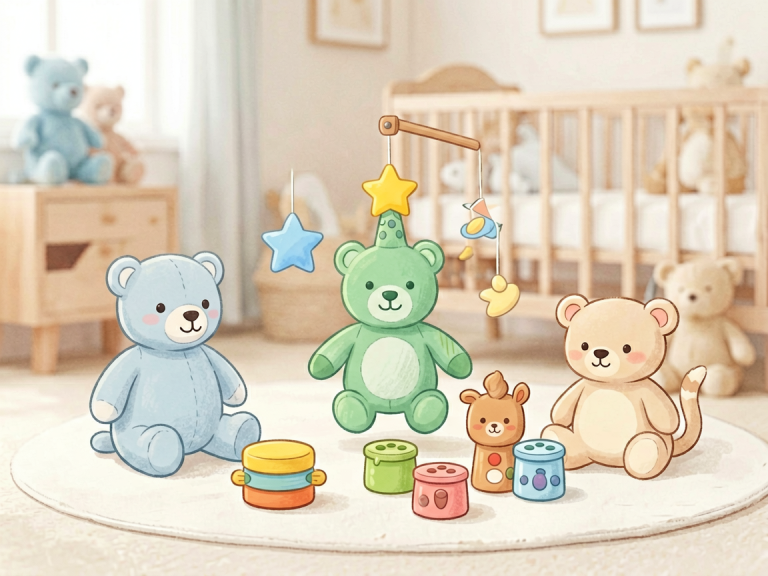
The Forgotten Joy: Why Screen-Free Play Is the Ultimate Replacement for Tablet Time in 4-Year-Olds
It starts innocently enough. A fussy toddler on a long car ride, a parent desperate for five minutes of quiet, or a rainy afternoon that stretches endlessly. The tablet appears, glowing and humming, and suddenly the world goes still. For a four-year-old, that screen is a universe of bright colors, catchy songs, and instant rewards. For the parent, it is a lifeline. But what if that lifeline is actually a chain? What if the very tool we use to pacify, entertain, and educate our children is quietly stealing something irreplaceable from their early years?
The answer is not guilt. It is not about throwing away every device and retreating to a cabin in the woods. The answer is simpler, more ancient, and infinitely more rewarding: screen-free play. For a four-year-old, replacing tablet time with intentional, unstructured, and imaginative play is not a deprivation—it is a gift. This article explores why this shift matters, how to make it happen, and the profound benefits that await both child and parent.
The Hidden Cost of Tablet Time at Age Four
Before we can embrace a new habit, we must understand what we are leaving behind. Children aged four are in a critical window of brain development. Their neural pathways are being forged at an astonishing rate, shaped by every touch, sound, conversation, and movement. When a tablet occupies that window, it does not simply fill time—it occupies space that could otherwise be filled with real-world experience.
Research from the American Academy of Pediatrics suggests that excessive screen time in early childhood is linked to delays in language development, reduced attention span, and poorer executive function. For a four-year-old, the problem is not the content of a well-designed educational app; it is the medium itself. A screen is a two-dimensional, passive experience that overrides the child’s natural drive to explore, touch, and manipulate the physical world. When a child swipes a finger to move a digital block, they miss the sensory feedback of a wooden block’s weight, texture, and resistance. They miss the problem-solving required to balance an actual tower, the frustration of a real collapse, and the triumph of rebuilding.
Moreover, tablet time often replaces social interaction. A four-year-old who spends an hour with a screen is an hour not spent negotiating with a sibling, reading a parent’s facial expressions, or practicing turn-taking in a game of pretend. These are the subtle, cumulative lessons that build emotional intelligence and self-regulation. The tablet is a shortcut to calm, but it is a shortcut that bypasses the very skills children need to manage their own emotions without external stimulation.
Why Screen-Free Play Is the Superior Alternative
Screen-free play is not merely the absence of screens—it is a rich, active, and deeply developmental experience. For a four-year-old, play is the work of childhood. Through play, they learn physics (how high can I stack these blocks?), social dynamics (who gets to be the mommy in our game?), language (negotiating roles and rules), and creativity (this cardboard box is a rocket ship). None of this can be replicated by a screen, because a screen tells a child what to do; play invites a child to decide.
Consider the difference between a tablet game that teaches letter recognition and a simple set of magnetic letters on a refrigerator. The tablet game rewards correct answers with lights and sounds, training the child to respond to external cues. The magnetic letters, on the other hand, require the child to pick them up, feel their weight, arrange them, and discover that some letters stick while others fall. The child might spell their name, then accidentally knock the letters off, then start again. There is frustration, experimentation, and ultimately a sense of ownership. The learning is woven into the experience, not pasted on top of it.
Screen-free play also supports what psychologists call “self-directed learning.” A four-year-old who is left to their own devices (pun intended) will gravitate toward activities that challenge them just beyond their current ability. They will repeat a task until they master it, then move on. This natural cycle of challenge and mastery builds persistence and grit—qualities that no app can teach because an app removes the friction. In the real world, a tower falls, a puzzle piece does not fit, a pretend cake burns in the oven. These small failures are the essence of resilience.
Practical Strategies to Transition from Tablet to Play
Letting go of the tablet does not happen overnight, and it does not require a dramatic announcement. Four-year-olds thrive on routine and predictability. The key is to replace the screen with something equally compelling—and to do it gradually.
1. Create a “Wonder Basket” for Spontaneous Play
A wonder basket is a simple container filled with open-ended, natural, and tactile objects. Think wooden rings, smooth stones, pinecones, fabric scraps, small boxes, ribbon, and seashells. Unlike a tablet, which offers a predetermined sequence of events, a wonder basket invites the child to invent their own. One afternoon, the stones might become a family of people; the next, they might be weighed on a kitchen scale. Place the basket in a visible, accessible spot. When the child reaches for the tablet (and they will), redirect them to the basket. Say, “Let’s see what you can create today.” The novelty of the objects, combined with the freedom to choose, often proves more engaging than a screen.
2. Redesign the Environment to Encourage Movement
A four-year-old’s body craves movement. Screen time is sedentary, which is one reason it is so calming—and so problematic. To replace tablet time, set up low-cost, high-reward physical play options. A small indoor slide, a balance beam made of painter’s tape on the floor, a pile of pillows for jumping, or a simple tunnel made from a cardboard box can occupy a child for thirty minutes or more. The goal is to make physical play the default, not the alternative. Keep a small bin of dress-up clothes nearby—a cape, a hat, a pair of old sunglasses. A child who puts on a cape becomes immediately powerful, and power is best exercised through action, not swipes.
3. Harness the Power of “Yes” Spaces
Screen time often fills a void because the child is bored or the environment is full of “no.” Instead of constantly limiting the child (“Don’t touch that,” “Stay off the couch,” “Put that down”), create zones where the answer is always yes. A corner of the living room with a washable mat, a few cups of water, and a brush can become a water-painting station. A low shelf with play dough, rolling pins, and cookie cutters invites endless molding. When a child knows they have a safe, permitted space to make a mess, they do not need a screen to occupy their mind. The mess is the point—and it is washable.
4. Establish a “No Tablet” Time of Day
Choose one block of the day that is permanently screen-free. Morning, before any device has been turned on, is ideal because the child is fresh and more willing to initiate play. Set a timer for thirty minutes (or start with fifteen) and announce, “This is our exploring time.” During this period, the adult should be present but not directing. Sit on the floor with a cup of tea and simply observe. The child will sense your calm attention and feel secure enough to dive deep into their own world. Over several weeks, this routine will become automatic; the child will begin to expect and even prefer this time.
The Long-Term Benefits: Beyond the Toddler Years
Replacing tablet time with screen-free play at age four does more than fill a few hours. It builds a foundation for lifelong learning and well-being. Children who grow up with ample unstructured play tend to have stronger problem-solving skills, higher creativity scores, and better emotional regulation. They learn to entertain themselves without external stimuli—a skill that becomes precious in the age of endless notifications.
There is also an unexpected gift for parents. When the tablet is put away, the child demands attention. This can feel exhausting at first, but it quickly transforms into connection. A four-year-old who builds a tower with you, who laughs with you over a silly story, who asks you to be the monster in their game, is forging a relationship that no app can mediate. You become the source of joy, not the gatekeeper of the screen. And that, ultimately, is the most profound replacement of all.
So, take a deep breath. Turn off the tablet. Place it in a drawer, out of sight. Then sit on the floor with a handful of cardboard tubes and a roll of tape. Watch what happens. The magic is already there, waiting to be uncovered.