Beyond the Glowing Screen: Embracing Screen-Free Play for 18-Month-Olds to Replace Tablet Time
Introduction
In the modern digital age, tablets have become a common tool for pacifying toddlers. A quick swipe, a colorful animation, and a nursery rhyme – and suddenly a fussy 18-month-old is quiet and absorbed. For many parents, this seems like a harmless solution, even a lifesaver during a busy day. However, a growing body of research from child development experts, pediatricians, and early childhood educators warns that tablet time for infants and toddlers can have lasting negative consequences on language development, attention span, motor skills, and social-emotional growth. The American Academy of Pediatrics recommends no screen time for children under 18 months (except for video chatting), and for those aged 18 to 24 months, only high-quality programming with a caregiver co-viewing. Yet, in reality, many 18-month-olds are handed a tablet for extended periods, often without adult interaction. This article explores why replacing that tablet time with intentional, screen-free play is not just beneficial but essential for your child's development. More importantly, it provides practical, evidence-based strategies and play ideas that respect your toddler's developmental stage, foster deep learning, and nurture a joyful, screen-free childhood.
—
Why Screen Time Is Harmful for 18-Month-Olds
Before diving into alternatives, it is crucial to understand exactly what happens in a developing brain when a tablet is the primary source of stimulation. At 18 months, a child's brain is undergoing an explosive period of neural connectivity. Every sensory experience – touching, tasting, hearing, moving, and interacting with real people – builds essential pathways. Screen time, by contrast, offers a two-dimensional, passive, and highly accelerated form of input that can actually disrupt this natural process.
Language Development Delays
Language acquisition at 18 months depends on contingent interaction – that is, back-and-forth communication where a caregiver responds to a toddler's babbling, gestures, or words with appropriate verbal and non-verbal feedback. A tablet cannot do this. When a child taps a screen and an app says “apple,” there is no eye contact, no exaggerated facial expression, and no turn-taking. Studies have shown that for every 30 minutes of screen time per day, toddlers say fewer words and have shorter sentences. A screen does not adapt to your child's unique sounds or interests; it simply repeats the same automated response. Over time, this can slow vocabulary growth and reduce the motivation to use language for genuine social connection.
Attention and Executive Function Damage
18-month-olds are naturally wired for short bursts of focus, but they also need practice sustaining attention on real-world tasks. Tablets deliver a constant stream of rapidly changing, highly salient stimuli – colors, sounds, animations – that overstimulate the developing reward system. This creates a “dopamine loop” that makes everyday, slower-paced activities (like stacking blocks or watching a leaf blow in the wind) seem boring by comparison. Researchers have found that early, heavy screen use is associated with lower executive function skills – such as impulse control, working memory, and cognitive flexibility – at age 5 and beyond. Your toddler’s brain is learning to expect instant gratification; when that expectation is not met, frustration and meltdowns often follow.
Missing Out on Sensorimotor Learning
Jean Piaget’s theory of cognitive development identifies the sensorimotor stage (birth to 2 years) as a period when children learn through direct physical interaction with their environment. An 18-month-old learns about gravity by dropping a spoon over and over; about cause and effect by banging a pot with a wooden spoon; about texture and temperature by squishing playdough or touching wet sand. A tablet eliminates this essential tactile feedback. While some “educational” apps claim to teach shapes or colors, they cannot replicate the neural wiring that occurs when a child picks up a real wooden shape, turns it in their hand, aligns it with a hole, and pushes it through with effort. This physical trial-and-error is the foundation of problem-solving, spatial awareness, and fine motor control.
Sleep Disruption and Emotional Regulation
The blue light emitted from screens suppresses melatonin production, making it harder for toddlers to fall asleep and stay asleep. Poor sleep cycles exacerbate irritability, impulsivity, and difficulty regulating emotions. Moreover, when a toddler uses a tablet as a primary soothing tool, they do not learn how to self-regulate without an external stimulus. Instead of learning to breathe through frustration or seek comfort from a caregiver, they learn to crave a glowing object. This can lead to intense withdrawal behaviors – crying, throwing the tablet, arching their back – when the screen is taken away.
—
The Benefits of Screen-Free Play for 18-Month-Olds
Replacing tablet time with high-quality, screen-free play offers profound developmental advantages. Understanding these benefits will give you the motivation to stay consistent, even on difficult days.
Deeper Language and Social Interaction
When you sit on the floor with your child and engage in screen-free play, you naturally talk about what you are doing. You might say, “Oh, you stacked the red block on top of the blue one! Look, it wobbles.” You follow your child’s lead, imitating their sounds, labeling objects, and expanding their utterances. This is the gold standard for language learning – “parentese” with live contingent feedback. Your child also learns the art of joint attention, where both of you look at the same toy, exchange a smile, and share a moment of discovery. These moments build not only vocabulary but also the neural circuits for empathy and social bonding.
Enhanced Motor Coordination and Body Awareness
Screen-free play requires movement: reaching, grasping, pulling, pushing, climbing, balancing, and manipulating objects. When an 18-month-old picks up a chunky crayon and makes random marks on paper, they are strengthening the small muscles in their fingers and hands that will later be used for writing. When they crawl through a tunnel made of sofa cushions, they are developing proprioception – an internal sense of where their body is in space. This body awareness is crucial for later skills like catching a ball, riding a tricycle, or even sitting still in a classroom. No tablet can teach a toddler how to coordinate their eyes, hands, and core muscles simultaneously.
Improved Attention Span and Frustration Tolerance
Real-world play is naturally slower and more unpredictable. A wooden train might tip over; a puzzle piece might not fit; a ball might roll under the couch. Each of these small “failures” is an opportunity for your toddler to practice persistence. With a patient caregiver nearby to offer a gentle “uh-oh, try again!” or to model problem-solving, the child learns that difficulty is not a signal to quit but a cue to try a different approach. Over time, this builds a tolerance for frustration and a longer attention span. Unlike the instant reset of a tablet game, real play requires the child to engage their own cognitive resources – and that is where true learning happens.
Creativity, Imagination, and Open-Ended Exploration
A tablet app is designed with a fixed outcome: tap here, hear a sound, finish a level. Open-ended play has no predefined path. A cardboard box can become a spaceship, a train, a house for a stuffed bear, or a drum. An 18-month-old who has never been exposed to a tablet will happily spend 20 minutes filling a bucket with sand, dumping it out, and repeating. This type of repetitive, self-directed exploration is the bedrock of creativity and scientific thinking. The child is constructing their own understanding of the world, rather than passively receiving information from a screen.
Stronger Parent-Child Bond
Perhaps the most overlooked benefit is the relationship itself. When you put away your own phone, sit on the floor, and share screen-free play with your toddler, you are sending a powerful message: “You are more interesting than any device. I want to be with you.” This builds secure attachment, which is the foundation of all future emotional health. Your child learns that they are valued, that their play matters, and that you are a reliable source of joy and comfort. This bond cannot be replicated by a tablet – not even by the most famous “educational” app.
—
Practical Screen-Free Play Ideas for 18-Month-Olds
Now that you are convinced of the “why,” here is the “how.” These activities are specifically chosen for an 18-month-old’s developmental stage: they are sensory-rich, involve gross and fine motor skills, encourage language, and require minimal materials (many use things you already have at home).
1. Sensory Bins with Natural Materials
Fill a shallow plastic bin with dry rice, oatmeal, or cooked (cooled) pasta. Add scoops, small cups, and a few safe toys like a rubber duck or a wooden spoon. Let your child sit in the bin or beside it – expect a mess, but that is part of learning. The texture, sound, and movement of the grains engage multiple senses. *What to say:* “Feel the rice! It’s falling through your fingers. Can you scoop it into the cup?” This is also excellent for language: you can introduce words like “pour,” “full,” “empty,” and “grain.”
2. Water Play at the Sink or in a Tub
Place a towel on the floor and give your child a shallow basin of warm water (adult-supervised at all times). Add plastic cups, a small funnel, a sponge, and a few floating bath toys. Water play develops hand-eye coordination as they pour, squeeze, and splash. *Why it works:* It naturally calms many children and teaches cause and effect. *Extension:* Add a few drops of food coloring for a science lesson – “Look, the water turned blue!”
3. Push-and-Pull Toys
18-month-olds love to move. A wooden wagon, a toy lawnmower, or even a simple cardboard box with a string attached can provide hours of walking practice. Pushing a toy encourages balance and upright locomotion; pulling it teaches coordination and planning. *Tip:* Go outside if weather permits – a simple walk with a push toy on a sidewalk offers visual variety, fresh air, and gross motor development.
4. Block Stacking and Knocking Down
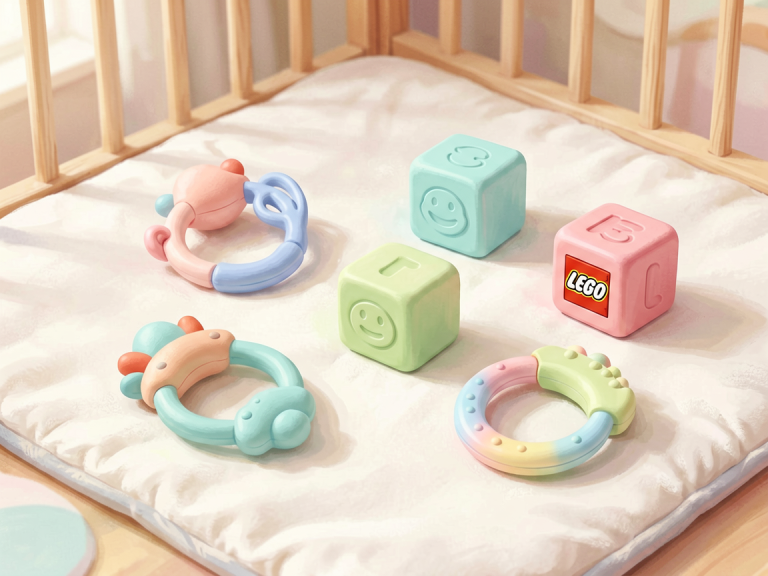
A set of soft foam blocks or lightweight wooden blocks is a classic for a reason. Your toddler will likely enjoy knocking down your towers more than building their own – and that’s fine. Each time they knock a tower, they are learning about gravity, height, and the social joy of “crash!” *What to say:* “Uh oh, it fell! Can you help me build it again? Let’s put the red one on top.” This builds resilience and turn-taking.
5. Art with Non-Toxic Materials
Avoid small crayons that can break into choking hazards. Instead, use chunky, egg-shaped crayons or washable finger paints. Tape a large sheet of paper to the highchair tray or a low table. Let your child scribble freely. *Development focus:* The circular scribbles at this age are pre-writing strokes. Do not expect any recognizable drawing – just enjoy the process. *Cleanup tip:* Use a plastic bib and have wipes handy. The mess is temporary; the neural connections last a lifetime.
6. Music and Movement
Put on simple, repetitive music (not from a tablet, but from a speaker). Give your toddler a small shaker, a drum, or just sing and clap your hands. Dance together – pick them up, spin slowly, or bounce to the rhythm. This develops vestibular sense (balance) and auditory processing. *Why it matters:* 18-month-olds learn rhythm long before they learn language, and moving to music builds cross-hemispheric coordination in the brain.
7. Peek-a-Boo and Hide-and-Seek (Simplified)
Hide a toy under a blanket and encourage your child to find it. Then hide yourself behind a door and call “Where’s Mama?” This classic game teaches object permanence – the understanding that things still exist even when out of sight – which is a major cognitive milestone at this age. It also sparks laughter and social connection.
8. Climbing and Tunneling
If you have a soft play structure, use it. If not, create a low fort using couch cushions and a blanket. Your toddler will enjoy crawling through, over, and under. This builds strength, coordination, and problem-solving. Always supervise climbing to ensure safety.
—
How to Transition from Tablet to Active Play
Moving from a habit of daily tablet time to a completely screen-free routine is not always easy – especially if your child has already come to expect the screen as a comfort or entertainment source. Here is a step-by-step approach that minimizes tears and maximizes success.
Step 1: Set a Firm Limit, Then Phase It Out Gradually
If your child is used to 30 minutes of tablet time a day, do not go cold turkey overnight (unless you feel strong enough). Instead, reduce it to 15 minutes for a few days, then 10, then 5, then zero. Use a kitchen timer so the child can see and hear the countdown. When the timer rings, say cheerfully, “Bye-bye tablet!” and immediately hand them a highly engaging alternative – like a new sensory bin or a set of blocks they haven’t seen in a while. The key is to replace, not just remove.
Step 2: Prepare Your Environment for Easy Access to Play
Designate a small area in your living room or kitchen with a low shelf or basket containing 4–6 carefully chosen, open-ended toys. Rotate these toys every few days to keep novelty alive. When you see your child reaching for the tablet, redirect them to the shelf. *Pro tip:* Keep the tablet itself out of sight – in a drawer or high cabinet. Visual cues are powerful triggers for toddlers.
Step 3: Be Present and Engaged at First
During the transition, your child may be grumpy or resistant. They need your active participation to discover that play is more rewarding than the screen. Set aside even 10 minutes of uninterrupted, fully engaged playtime – no phone, no chores. Get down on their level, mirror their actions, and show genuine excitement. Once they are absorbed, you can gradually ease back and let them play independently for short periods.
Step 4: Manage Your Own Screen Habits
Children learn more from what you do than what you say. If you are constantly checking your phone during playtime, your child will understandably want to imitate you. Designate your own screen-free times – at least during the first 30 minutes after you get home or during meals and bath time. Let your child see you reading a book, folding laundry, or playing with a puzzle. Your modeling is the most powerful teaching tool.
Step 5: Plan Ahead for High-Risk Moments
Certain times of day are especially tempting for tablet use: the “witching hour” before dinner, while waiting at the doctor’s office, or during a long car ride. For these moments, have a bag of screen-free tricks ready: a new board book, a few Matchbox cars, a small toy that attaches to the stroller, or a pack of fruit pouches with a built-in game (like pulling the tab). Even a few minutes of distraction with a real object can diffuse a meltdown.
Step 6: Embrace Boredom
It is natural to feel anxious when your 18-month-old appears “bored.” But boredom is not a problem to be solved with a screen; it is a gateway to creativity. When a toddler is allowed to feel bored, they eventually start exploring, experimenting, and inventing their own games. Resist the urge to jump in with an activity every time they stop moving. Let them sit and stare at a sunbeam, or play with their own toes. That quiet moment is their brain consolidating, processing, and preparing for the next burst of learning.
—
Conclusion: A Gift That Lasts a Lifetime
Replacing tablet time with screen-free play for your 18-month-old is not about depriving them of modern technology. It is about giving them something far more valuable: the opportunity to learn through their own hands, their own bodies, and their own relationships. The first two years of life are a once-in-a-lifetime window of rapid neural development. Every sand grain they pour, every block they stack, every smile they share with you – these experiences literally shape the architecture of their brain.
It will not always be easy. There will be days when the tablet seems like the only way to get dinner on the table. On those days, lower your expectations for play – let your child bang pots and pans, sit in a pile of laundry, or “read” a board book on the kitchen floor. The mess and chaos are temporary; the cognitive and emotional benefits are permanent. You are not just reducing screen time; you are cultivating a childhood filled with curiosity, resilience, and deep connection.
Start today. Turn off the tablet, open the toy bin, and sit beside your child. Watch them explore, struggle, and triumph. In that moment, you are giving them the greatest gift: a childhood that is real, vibrant, and entirely their own.