Introduction: Why Play-Based Learning Matters at Age Two
The Ultimate Guide to the Best Play-Based Learning Toys for 2-Year-Olds: Nurturing Curiosity, Creativity, and Cognitive Development Through Purposeful Play
The age of two is a magical window of rapid brain development, language explosion, and emerging independence. At this stage, children are naturally driven to explore, manipulate, and make sense of their world through play. Play-based learning is not merely a trendy educational buzzword; it is a scientifically supported approach that harnesses a toddler’s innate curiosity to build foundational skills in cognition, motor coordination, social-emotional regulation, and language. Unlike passive entertainment or rigid academic drills, the best play-based learning toys for 2-year-olds are tools that invite open-ended discovery, problem-solving, and imaginative engagement. This article explores the most effective categories of such toys, each carefully selected to align with developmental milestones while keeping joy at the center of the experience.
When selecting toys for a two-year-old, parents and caregivers must look beyond flashy lights or electronic noises. The most powerful learning toys are often simple, durable, and designed to be used in multiple ways. They encourage repetition, trial-and-error, and the kind of deep focus that builds neural connections. From stacking blocks to pretend play sets, the right toys transform playtime into a rich landscape of learning. Below, I break down the best play-based learning toys by developmental domain, providing specific recommendations and explaining why each category matters.
1. Building and Stacking Toys: The Foundation of Spatial Reasoning and Fine Motor Skills
Why They Are Essential for 2-Year-Olds
At age two, children are beginning to understand concepts like size, shape, balance, and cause and effect. Building and stacking toys are arguably the most versatile play-based learning tools because they simultaneously engage multiple cognitive and physical systems. When a toddler stacks a block on top of another, she is practicing hand-eye coordination, grip strength, and spatial awareness. When the tower inevitably falls, she learns about gravity and resilience—the emotional skill of trying again.
Top Recommendations
Wooden unit blocks are the gold standard. Unlike plastic sets, wooden blocks have weight, texture, and a satisfying sound when they clatter. A set of basic rectangular, square, and triangular blocks allows for endless configurations. For a two-year-old, start with a set of about 20 to 30 blocks in primary colors or natural wood. Brands like Melissa & Doug or Guidecraft offer non-toxic, smooth-edged blocks that are safe for little hands.
Magnetic tiles are another outstanding option. Sets such as Magna-Tiles or PicassoTiles let children attach squares and triangles along magnetic edges, creating 3D structures that defy gravity. The translucent colors captivate toddlers, and the satisfying click of magnets connecting reinforces cause-effect learning. These tiles also introduce early geometry concepts—a triangle becomes a roof, a square becomes a wall.
Stacking rings and nesting cups remain classics for a reason. The classic wooden stacking ring toy with a central peg helps children practice size discrimination (big to small) and sequencing. Nesting cups, which can be stacked inside each other or built into towers, teach volume and relative size. They also double as bath toys, sand toys, or pretend kitchen bowls, extending their play value.
Play-Based Learning in Action
A two-year-old using building toys is not just playing; she is engaging in early engineering. She experiments with stability: “If I put the big block on top of the small one, it wobbles.” She learns vocabulary: “tall,” “short,” “on top,” “underneath.” She practices persistence when a structure collapses. By providing blocks without a prescriptive outcome, we allow the child to lead the learning. This is the essence of play-based education—child-directed exploration with adult support nearby.
2. Cause-and-Effect and Problem-Solving Toys: Cultivating Logical Thinking
Why They Matter for Cognitive Development
The two-year-old brain is a pattern-seeking machine. Toys that require a sequence of actions to produce a result—pushing a button to make a pop-up appear, turning a knob to release a ball—teach critical thinking and anticipation. These toys are essentially puzzles without words, encouraging children to ask, “What happens if I do this?” This question is the seed of scientific reasoning.
Top Recommendations
Shape sorters are a non-negotiable milestone toy. Look for a wooden or sturdy plastic sorter with a variety of geometric shapes and corresponding holes. The classic shape sorter box requires the child to rotate the shape, align it with the hole, and push it through. This task involves visual discrimination (matching shapes), fine motor control (grasping and turning), and problem-solving (figuring out which shape goes where). Advanced versions include color matching or multiple sides.
Peg puzzles with large knobs are perfect for this age. Each piece has a peg that a toddler can easily grasp, and the puzzle board has a matching silhouette. Unlike jigsaw puzzles with interlocking pieces, peg puzzles are more accessible. They teach one-to-one correspondence (one piece per space) and spatial relationships. Themes like animals, vehicles, or shapes also build vocabulary.
Ball drop ramps or marble runs designed for small hands offer mesmerizing cause-and-effect learning. The child places a ball at the top of a ramp, watches it roll down a series of tracks, and hears it land in a cup or basket. This introduces concepts like incline, speed, and trajectory. Many sets allow the child to rearrange the tracks, adding a layer of planning and prediction.
Developmental Insights
When a two-year-old struggles to fit a shape into a sorter and then succeeds, the brain releases dopamine—a neurotransmitter associated with reward and motivation. This positive feedback loop encourages the child to seek out increasingly challenging problems. It is crucial to choose toys that are just difficult enough to be engaging but not so hard that they cause frustration. The golden rule is the “Goldilocks principle”: not too easy, not too hard. A shape sorter with four basic shapes (circle, square, triangle, star) is ideal; a 12-shape sorter may overwhelm.
3. Imaginative and Pretend Play Toys: Building Social Skills, Language, and Emotional Understanding
The Power of “Let’s Pretend”
At age two, children begin to engage in symbolic play—the ability to use one object to represent another, such as a block becoming a phone or a stick becoming a spoon. This is a massive cognitive leap. Pretend play is how toddlers make sense of adult behaviors, practice social roles, and process emotions. The best play-based learning toys for this domain are open-ended props that encourage story creation.
Top Recommendations
Play kitchens and food sets are perennial favorites. A simple wooden or plastic kitchen with a stove, sink, and oven invites endless scenarios. Add a set of play fruits and vegetables that can be “cut” with a wooden knife (velcro attachments allow slicing). This play involves sequencing (first cut, then cook, then serve), language (naming foods, describing actions), and social interaction (sharing a meal with a stuffed animal). Look for sets that are realistic enough to spark imagination but not so detailed that they dictate every move.
Dolls, stuffed animals, and doll accessories are essential for emotional development. A soft baby doll with a blanket, bottle, and small cradle lets a toddler practice nurturing behaviors. This is how children learn empathy, caregiving, and comfort. They may mimic routines like feeding, bathing, and putting to sleep, which helps them process their own daily experiences. Similarly, a set of animal figurines (farm animals, zoo animals, dinosaurs) allows for classification, storytelling, and vocalizations (moo, roar, quack).
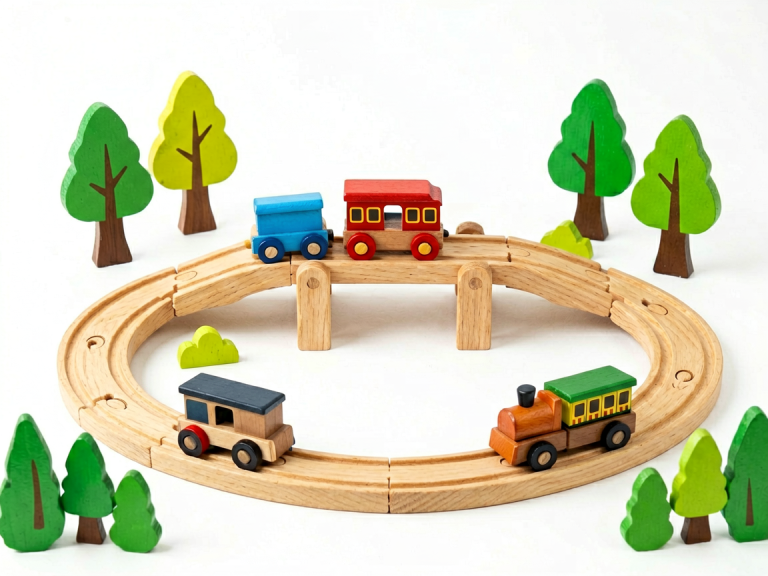
Vehicle sets—trucks, cars, trains, and a simple track—offer rich pretend play. A two-year-old can push a truck across the floor, make engine sounds, and imagine it carrying cargo. A wooden train set with a few tracks and a magnetically connected train introduces the concept of sequences (cars behind each other) and spatial arrangement (track loops). These toys also encourage gross motor movement as children crawl or walk while pushing their vehicles.
Language Blossoming Through Dialogue
During pretend play, talk naturally flourishes. A child might say, “Baby hungry. Need milk.” Or, “Truck go fast, vroom vroom.” This self-directed speech is crucial for language development. Children who engage in frequent pretend play tend to have larger vocabularies and better narrative skills. As a caregiver, you can enrich this play by asking open-ended questions: “What is the baby’s name?” “Where is the truck going?” But the key is to follow the child’s lead—let them direct the story.
4. Sensory and Fine Motor Manipulatives: Strengthening Hands and Calming Minds
Why Sensory Play Is Learning
Two-year-olds are sensory learners. They learn through touching, tasting, smelling, seeing, and hearing. Sensory play helps regulate the nervous system, improves focus, and lays the groundwork for later writing skills by strengthening the small muscles of the hand. The best sensory toys for this age are safe, non-toxic, and designed for exploration without frustration.
Top Recommendations
Play dough is a sensory powerhouse. Choose a non-toxic, soft (but not sticky) play dough in a few colors. Provide simple tools like a plastic rolling pin, cookie cutters, a plastic knife, and small stamps. Squeezing, rolling, pinching, and cutting play dough builds hand strength and bilateral coordination (using both hands together). It also offers a calming activity; the repetitive motion of kneading can soothe an overtired toddler.
Scoop-and-pour sets for water, sand, or rice play are outstanding. A set with a large bin, scoops, cups, funnels, and a small watering can lets children practice transferring materials. This develops hand-eye coordination and the concept of volume (“full,” “empty,” “more,” “less”). You can create a sensory bin with dry rice or beans (supervised to avoid ingestion) and hide small toys for a treasure hunt. This is a low-cost, high-engagement activity.
Lacing beads or large wooden beads with a thick string or lace. Lacing beads require the child to hold the bead in one hand, thread the string through the hole, and pull it out the other side. This is an advanced fine motor task that prepares the hand for later writing and buttoning. Choose beads with large holes (at least ½ inch) and a stiff lace with a wooden tip for easier threading. The activity also introduces patterns if you encourage stringing beads of alternating colors.
Calming and Focusing
Many two-year-olds experience big emotions and short attention spans. Sensory toys can act as an anchor. A child who is upset may find comfort in squeezing play dough or scooping rice. These activities are also “low pressure”—there is no right or wrong way to play. This freedom reduces anxiety and builds confidence. Always supervise sensory play with small items to prevent choking hazards.
5. Music and Movement Toys: Igniting Rhythm, Coordination, and Joy
The Link Between Music and Brain Development
Musical play is often overlooked in toy lists, but it is deeply developmental. Rhythmic activities stimulate the auditory cortex, improve memory, and support motor coordination. For a two-year-old, music is about feeling the beat, not performing correctly. The best musical toys are simple, durable, and produce pleasant (not shrieking) sounds.
Top Recommendations
Hand percussion instruments are ideal. A small wooden shaker (egg shaker or maraca), a tambourine, a pair of rhythm sticks, and a small drum (like a bongo or djembe) provide a rich palette of sounds. Let the child explore freely—shaking, tapping, banging. This develops a sense of tempo and dynamics (loud/soft). You can play a simple song and encourage the child to follow along, but the primary goal is exploration.
Push or pull toys with sound—like a wooden duck that quacks when pulled, or a mini shopping cart with wheels that rattle—combine gross motor movement with auditory feedback. A child pushing a cart develops balance and leg strength while hearing a consistent sound pattern. These toys also encourage walking practice, which is still being refined at age two.
Simple xylophones or glockenspiels with large, colorful keys. A child can strike the keys with a mallet and immediately hear the pitch change. This introduces the concept of high and low notes. Some sets have color-coded keys that match a songbook, but for a two-year-old, just banging the keys is enough. The cause and effect of hitting a key to produce a sound is incredibly satisfying.
Dance and Movement
Beyond toys, encourage movement to music. A toy with a built-in speaker that plays simple songs (like a music player with buttons) allows the child to choose a song and dance. Dancing improves gross motor skills, spatial awareness, and emotional expression. Clapping along to a beat also teaches rhythm—a skill linked to reading fluency later on.
Conclusion: Choosing Quality Over Quantity, Process Over Product
Selecting the best play-based learning toys for a two-year-old is less about buying the trendiest brand and more about understanding the child’s developmental needs. The toys that last—both in durability and in engagement—are those that allow for multiple uses, encourage active manipulation, and spark the child’s own ideas. A cardboard box can be a cave, a spaceship, or a castle; a set of simple blocks can become a tower, a road, or a fence. The best toy is the one that invites the child to say, “What if I…?”
Remember that the adult’s role is not to teach but to provide an environment rich in possibilities. Rotate toys to keep interest alive, and always prioritize safety: avoid small parts that can be choking hazards, check for lead-free paint, and supervise play with any toy that has strings or magnets. Above all, let the child lead. When a two-year-old is deeply engaged in play, she is learning more effectively than any worksheet or app could ever teach. Play is the work of childhood, and these toys are her finest tools.