A Parent’s Guide to Choosing Age‑Appropriate Toys for Babies: From Newborn to First Steps
—
Introduction
Selecting toys for a baby can feel overwhelming. Shelves overflow with bright plastic gadgets, soft plush animals, and musical contraptions, each promising to boost development. Yet the most important criteria for choosing toys are not their price or how many bells they have, but whether they match the baby’s current physical, cognitive, and emotional abilities. An age‑appropriate toy is safe, stimulating without being overstimulating, and supportive of the baby’s natural developmental milestones. This guide will walk parents through each stage of infancy, from the first weeks of life to the toddler‑on‑the‑move phase, offering practical advice on what to look for and what to avoid.
—
Why Age Matters: The Science of Developmental Windows
Babies grow at an astonishing rate. In the first year alone, they progress from a helpless newborn who can barely focus their eyes to a curious toddler who can crawl, pull up to stand, and even say a few words. Each developmental window builds on the previous one. A toy that is perfect for a six‑month‑old may frustrate a three‑month‑old or bore a ten‑month‑old. Choosing a toy that is too advanced can cause frustration; one that is too simple can lead to disinterest. More importantly, an inappropriate toy can pose safety hazards—small parts, sharp edges, or long cords become dangerous when a baby’s motor skills change.
Thus, understanding what your baby can do at each stage is the foundation of smart toy selection.
—
Stage 1: Newborn to 2 Months – Sensory Awakening
What Your Baby is Doing
Newborns are just waking up to the world. Their vision is blurry (they see best at about 8–12 inches), their hearing is sharp but they startle easily, and their movements are mostly reflexive. They cannot grasp, roll over, or sit up. Their primary needs are comfort, bonding, and gentle stimulation of the senses.
Recommended Toys
- High‑contrast black‑and‑white cards or mobiles – Newborns’ eyes are drawn to strong patterns. Hang these above the crib or changing table at the correct distance.
- Soft, textured rattles – Not for active grasping, but for you to shake gently. The sound encourages head turning and auditory tracking.
- Unbreakable mirror – Babies love faces, even their own. Place it low in the crib so they can catch a glimpse during tummy time.
- Musical crib toys – Choose ones that play lullabies at low volume. Avoid flashing lights or loud, jarring sounds.
Safety Tips
- No small parts (anything that can fit into a toilet paper tube is a choking hazard).
- Avoid toys with strings or ribbons longer than 12 inches.
- Ensure all materials are BPA‑free and non‑toxic, as babies will eventually mouth everything.
—
Stage 2: 2 to 4 Months – Grasping and Discovery
What Your Baby is Doing
Around this time, babies begin to intentionally bat at objects, swipe at dangling toys, and bring their hands to their mouth. They start to hold a rattle briefly and enjoy kicking. Their vision improves, and they start tracking moving objects with their eyes.
Recommended Toys
- Soft gym and play mats – Overhead arches with dangling toys encourage reaching and batting. Look for toys with different textures and sounds (crinkle, squeak, bell).
- Easy‑to‑grasp rings or rattles – Wide, ring‑shaped handles are easiest for tiny fists. Some have beads that slide and make noise.
- Teething rings – Even before teeth arrive, babies love to chew. Choose silicone rings that are easy to hold and free of phthalates.
- Foot‑finders and socks with bells – These attach to feet and reward kicking with sound, helping babies discover their own body.
Safety Tips
- Check that all toys are securely fastened to the play mat or gym. No small pieces that can detach.
- Clean toys regularly—babies dribble and drool constantly.
—
Stage 3: 4 to 6 Months – Mouthing and Purposeful Play
What Your Baby is Doing
Now babies are masters of mouthing. Everything goes straight to the mouth—it’s their primary way of exploring texture, temperature, and taste. They begin to transfer objects from one hand to the other. They may start rolling over and sitting with support.
Recommended Toys
- Soft cloth books – Look for fabrics with crinkly pages, a sewn‑in teether, and bright colors. The baby will grasp, chew, and “read” them.
- Simple cause‑and‑effect toys – Press a button, hear a gentle sound. Pop‑up toys or those that make noise when squeezed are perfect.
- Infant stacking cups – These can be nested, knocked over, or chewed. They introduce size and order.
- Activity boards with flaps and zippers – Choose ones that are soft and have different textures for tactile exploration.
Safety Tips
- Only use toys that are dishwasher safe or easy to sanitize—many end up coated in saliva.
- Avoid any toy that has a battery compartment that can be pried open. Secure screws are a must.
—
Stage 4: 6 to 9 Months – Sitting, Shaking, and Banging
What Your Baby is Doing
This is a leap in motor development. Most babies sit unsupported, reach for toys with accuracy, and begin to crawl (commando style at first, then on all fours). They love to bang, shake, and throw objects. Object permanence starts to emerge—they realize a hidden toy still exists.
Recommended Toys
- Activity cubes or busy boxes – These have spinning gears, beads on wires, sliding doors, and buttons. They strengthen fine motor skills while teaching cause and effect.
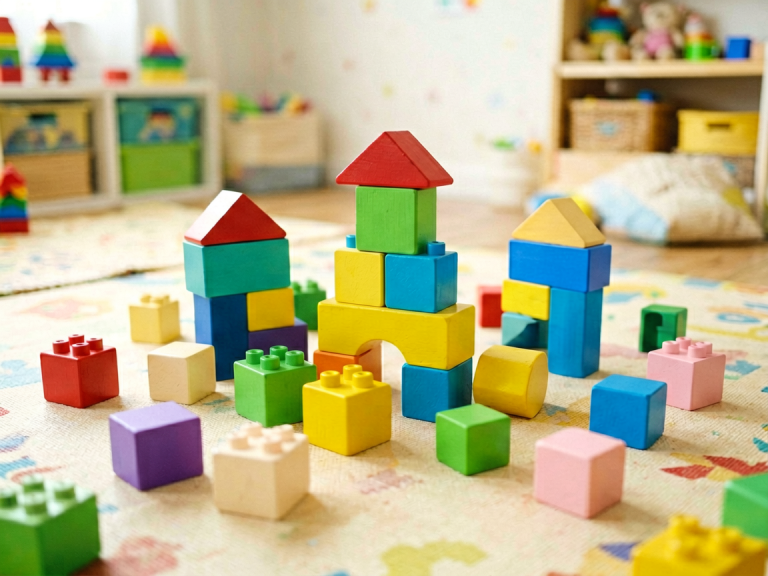
- Soft blocks – Lightweight, easy to grasp, and safe to throw. Stacking (even if baby knocks them down) builds spatial awareness.
- Rings on a ring stacker – The classic cone with graduated rings. Initially babies will just chew or hold them; later they learn to order them.
- Rolling toys – A soft ball that jingles or a wheeled toy that moves when pushed encourages crawling and chasing.
Safety Tips
- At this stage, babies start to pull up on furniture. Remove any toys that have sharp corners or could topple over.
- Balls should be at least 1.75 inches in diameter to prevent choking.
- Supervise play with toys that have small parts, even if they are marketed as “baby safe.”
—
Stage 5: 9 to 12 Months – Cruising, Poking, and Problem Solving
What Your Baby is Doing
Many babies crawl competently, pull up to stand, and “cruise” along furniture. Their pincer grip (thumb and forefinger) develops, allowing them to pick up tiny objects. They understand simple commands, imitate actions, and enjoy games like peek‑a‑boo.
Recommended Toys
- Shape sorters – The classic one with a cube and four large shapes. Initially babies will dump them out and try to fit them by trial and error. This teaches problem solving.
- Push‑toys (walkers) – Look for sturdy, stable walkers that babies can push while standing. Avoid seated baby walkers (they are dangerous and banned in many countries). Push toys help with balance.
- Simple puzzles – Knob puzzles with large, chunky pieces (each piece has a handle). Babies learn to match shapes to holes.
- Interactive cause‑and‑effect toys – Pop‑up boxes, musical instruments (like a baby xylophone or drum), and toys that react to button presses.
Safety Tips
- As babies pull up, ensure that any toy with strings or cords is removed (strangulation risk).
- Check for sharp edges or splinters on wooden toys.
- Batteries should be secured with screw‑down covers. Button batteries are extremely dangerous if swallowed.
—
Stage 6: 12 to 18 Months – Walking, Imitation, and Language Explosion
What Your Baby is Doing
Now your baby is a toddler! They may be walking independently, climbing onto low furniture, and using a few words. They imitate adult actions (talking on the phone, sweeping) and engage in simple pretend play. Their attention span is still short, but they love repetition.
Recommended Toys
- Pull‑toys – A wooden duck or car on a string that they can pull behind them. This strengthens coordination and balance.
- Simple dolls or stuffed animals – Babies can practice nurturing: feeding, rocking, covering. This fosters social‑emotional skills.
- Stacking and nesting cups – At this age, they can build towers of three or four.
- First musical instruments – Tambourines, maracas, and drums that they can shake or bang. Music supports rhythm and language.
- Large crayons and paper (supervised) – Scribbling is a pre‑ writing skill. Use only washable, non‑toxic crayons.
Safety Tips
- Now that your baby moves quickly, keep floors clear of clutter. Toys should be stored in low, open bins so they can access them independently.
- Avoid toys with small magnetic parts—if swallowed, magnets can cause serious internal injury.
- Continue inspecting toys for wear. Broken pieces should be thrown away immediately.
—
General Safety and Quality Guidelines for All Ages
Regardless of the age, every toy should pass these basic checks:
- No choking hazards. The toilet paper roll test is still the gold standard: if a toy or its smallest part can fit completely inside a cardboard toilet paper tube, it is too small for any baby under three years old.
- Non‑toxic materials. Look for labels like “BPA‑free,” “phthalate‑free,” “lead‑free,” and “ASTM certified.”
- Sturdy construction. No sharp edges, splinters, or parts that can break off easily.
- Age labeling. Follow the manufacturer’s recommended age range, but also use your own judgment based on your baby’s development.
- Cleaning ease. Babies drool, vomit, and transfer food to toys. Choose toys that can be wiped down or put in the dishwasher.
- Avoid screens. The American Academy of Pediatrics recommends no screen time (other than video chatting) for babies under 18 months. Interactive toys that light up are fine, but passive screens (like a tablet playing videos) offer no developmental benefit.
—
Conclusion: Follow Your Baby’s Lead
Every baby develops at their own pace. The best “toy” is still your face, your voice, and your attention. Age‑appropriate toys are tools that support, not replace, human interaction. When you choose a toy, ask yourself: *Will this invite my baby to explore, to problem‑solve, to move, and to connect?* If the answer is yes, and if it is safe, then you have made a wonderful choice.
Watch your baby’s cues. If they ignore a toy, put it away for a month and try again. If they seem frustrated, offer simpler options. The goal is not to accelerate development, but to meet your baby where they are and let them play—because play is the work of childhood.
Remember: A simple set of wooden blocks, a cardboard box, and a loving parent are more valuable than the most expensive electronic gadget. Your presence and your careful selection make all the difference.