The Thoughtful Parent’s Guide to Selecting Age-Appropriate Toys for 18-Month-Olds
Introduction: Understanding the 18-Month Milestone
At 18 months, a child is no longer a passive infant but an active explorer. This stage, often called the “toddler dawn,” is marked by rapid cognitive, physical, social, and emotional development. Toddlers begin to walk with confidence, climb onto furniture, understand simple instructions, and express their own desires (often with a firm “no!”). They are driven by curiosity and a growing sense of autonomy. Choosing the right toys during this period is not merely about entertainment—it is about supporting foundational skills such as problem-solving, language acquisition, fine and gross motor coordination, and emotional regulation. A well-chosen toy can turn a tantrum into a learning moment. This guide will walk you through the key developmental domains of an 18-month-old, the safety criteria every parent must consider, and practical categories of toys that strike the perfect balance between challenge and success.
Developmental Landscape at 18 Months: What Your Child Is Learning
Before diving into specific toy recommendations, it is essential to understand what an 18-month-old is capable of and what they are striving to master.
*Physical Development:* Gross motor skills are exploding. Most 18-month-olds can walk independently, run stiffly, climb stairs with help, squat to pick up an object, and push or pull toys. Fine motor skills are also advancing: they can build a tower of three or four blocks, scribble with a crayon, turn pages of a board book (sometimes several at once), and use a spoon with some accuracy.
*Cognitive Development:* Toddlers at this age are beginning to understand object permanence—that objects continue to exist even when out of sight. They engage in simple pretend play, such as pretending to talk on a phone or feed a doll. They can identify common objects by name and point to body parts when asked. Problem-solving is emerging: they will try to fit a shape into a hole or figure out how to open a container.
*Language Development:* Vocabulary expands rapidly. By 18 months, many toddlers say between 5 and 20 words, though comprehension far outpaces expression. They understand simple commands like “give me the ball” and enjoy being read to. They also use gestures like pointing, waving, and nodding to communicate.
*Social and Emotional Development:* This is the age of burgeoning independence mixed with separation anxiety. Toddlers may engage in parallel play (playing alongside others but not directly with them). They imitate adults and older children, show pride in accomplishments, and can experience frustration when they cannot do something. Empathy begins to appear in rudimentary forms, such as offering a toy to a crying peer.
Safety First: Non-Negotiable Criteria for Toy Selection
The American Academy of Pediatrics and global safety standards provide clear guidelines that are especially critical for 18-month-olds, who still put objects in their mouths frequently.
*Avoid Small Parts:* Any toy or component that can fit inside a toilet paper tube (about 1.25 inches in diameter) is a choking hazard. This includes buttons, eyes on stuffed animals, loose beads, and small batteries. Always check the manufacturer’s age recommendation, but also perform your own “choke test.”
*Material Safety:* Toys should be made of non-toxic materials. Look for labels like “BPA-free,” “phthalate-free,” and “lead-free.” Avoid painted wooden toys from unknown sources unless they certify safety. Soft plastic should be sturdy enough not to break into sharp fragments.
*Durability and Construction:* 18-month-olds are strong and enthusiastic. Toys that can be thrown, dropped, chewed, and stepped on need to hold up. Check for loose parts, weak seams, or sharp edges. For battery-operated toys, the battery compartment should be secured with a screw—toddlers can open standard snap covers.
*No Strangulation Hazards:* Avoid toys with long cords, strings, or ribbons longer than 12 inches. Remove any drawstrings from toys or clothing that could get caught on furniture.
*Age Appropriateness vs. “Advanced” Labels:* Resist the urge to buy toys labeled for older children because your child seems “smart.” The age recommendations on packaging are based on safety and developmental readiness, not intelligence. A puzzle for a 3-year-old may contain small pieces that are dangerous for an 18-month-old, even if the child could technically do it.
Top Toy Categories That Support Development at 18 Months
Now that safety and development are clear, here are specific types of toys that are not only age-appropriate but actively beneficial.
*1. Stacking, Nesting, and Sorting Toys*
*Why they work:* These toys build fine motor control, hand-eye coordination, spatial awareness, and early problem-solving. An 18-month-old can stack rings on a cone (maybe in the wrong order at first) or nest cups inside one another. Sorting toys with shapes or colors introduce categorization—a key cognitive skill.
*Examples:* Ring stackers, nesting cups, shape sorters with large, simple shapes (triangles, circles, squares), and stacking blocks that can also be knocked down (a favorite activity).
*Parent tip:* Let your child try independently, but model the correct action occasionally. Celebrate when they succeed, and don’t fuss when they knock things over—that’s also learning about cause and effect.
*2. Push and Pull Toys*
*Why they work:* As new walkers, 18-month-olds benefit from toys that encourage balance and coordination. Push toys (like a small lawn mower or shopping cart) provide support for unsteady walkers, while pull toys (a dog on wheels that waddles) teach backward motion and spatial planning.
*Examples:* Wooden or plastic push carts with blocks inside, pull-along animal toys, and ride-on toys that the child straddles and pushes with feet (not pedals).
*Parent tip:* Ensure the push toy is sturdy and tall enough that the child doesn’t have to stoop. Avoid pull toys with long strings—look for short, stiff handles instead.
*3. Simple Pretend Play Toys*
*Why they work:* Pretend play is the foundation of social, emotional, and cognitive growth. At 18 months, it is very concrete—children imitate routines they see daily. These toys help them make sense of their world, practice language, and develop empathy.
*Examples:* Toy telephones (rotary or press-button), plastic dishes and cups, a doll or soft animal with a blanket, a play kitchen with large, chunky accessories, and toy tools like a plastic hammer.
*Parent tip:* Join in the play. Pretend to take a phone call, or feed the doll. This interaction expands vocabulary and shows your child how to use the toy. Don’t over-script—let them lead.
*4. Cause-and-Effect Toys*
*Why they work:* Toddlers are fascinated by how their actions create results. These toys teach logical sequencing, persistence, and the concept of “if-then.” They are also highly engaging, which helps with attention span.
*Examples:* Pop-up toys where you push a button or slide a switch to make an animal jump out, ball ramps where a ball rolls down a track, musical instruments like a xylophone or drum (tapping produces sound), and activity cubes with doors, knobs, and levers.
*Parent tip:* Choose toys that require one or two steps to operate—too many steps will frustrate an 18-month-old. Demonstrate, then let them try repeatedly.
*5. Soft Building Blocks and Large Construction Sets*
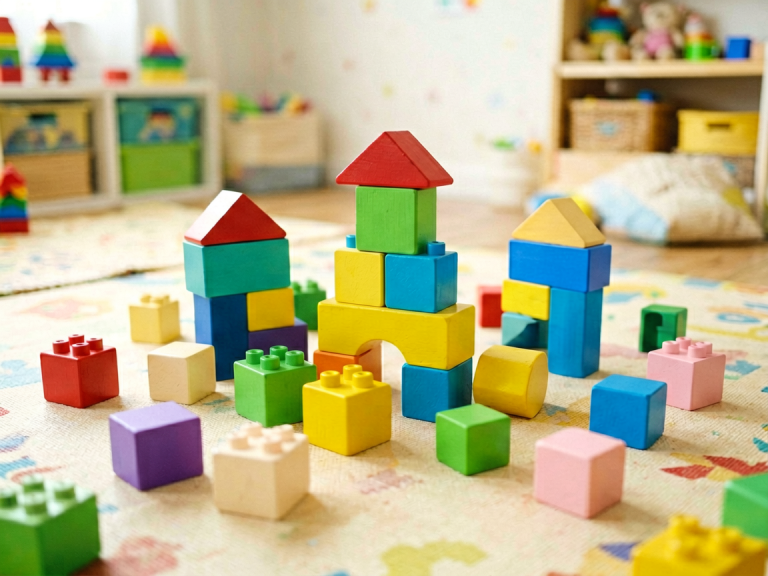
*Why they work:* Building is a fundamental learning activity. Soft blocks (fabric or foam) are safe for throwing and chewing while still allowing tower-building, which teaches balance, gravity, and spatial relationships. Large, interlocking bricks that are easy to pull apart are also appropriate.
*Examples:* Foam blocks in various shapes and colors, large Duplo-style blocks (not regular Lego, which are too small), and cardboard bricks that can be stacked and knocked down.
*Parent tip:* Build a simple tower and encourage your child to knock it down. Then try to build together. Talk about colors and sizes: “Let’s put the blue block on top.”
*6. Books and Language Toys*
*Why they work:* Language development is lightning fast at this age. Books with bright, realistic pictures, simple text, and interactive elements (flaps, textures) capture attention. Repeating words and pointing to images builds vocabulary and pre-reading skills.
*Examples:* Board books with photos of animals, babies, or everyday objects; touch-and-feel books; lift-the-flap books; and electronic toys that say a word when a button is pressed (use sparingly—real human interaction is better).
*Parent tip:* Read the same book multiple times—repetition is key for toddlers. Point to the picture and name it, then ask your child to point, too. Don’t worry about reading every word; describe what you see.
*7. Art and Sensory Materials (Supervised)*
*Why they work:* Sensory exploration is vital for brain development. While 18-month-olds cannot draw representational pictures, they can experience the texture of paint, the smell of dough, and the satisfaction of making marks.
*Examples:* Crayons that are chunky and egg-shaped for easy grip, finger paints (non-toxic), play dough (supervised to prevent eating), and large stampers with handles.
*Parent tip:* Always supervise art activities. Expect mess. Lay down a plastic tablecloth and dress your child in washable clothes. Focus on the process, not the product. Say “Look at the red line you made!” rather than “What is it?”
What to Avoid: Toys That Frustrate or Overstimulate
Not every toy on the market is suitable. Avoid toys that:
- Have too many flashing lights and sounds. Overstimulating electronic toys can overwhelm a toddler’s developing nervous system and reduce creative play. Simple is better.
- Require precise motor skills beyond their ability. Tiny puzzle pieces, thin markers, or complex construction sets will only cause frustration.
- Encourage passive entertainment. Toys that do the playing for the child (e.g., a plush toy that sings a whole song automatically) offer little developmental benefit. Instead, choose toys that require the child to act.
- Reinforce stereotypes or are overly commercialized. At 18 months, a plain wooden block is far more valuable than a licensed character toy that lights up and talks. Character toys often limit imaginative play because the child’s role is pre-scripted.
The Role of Parental Interaction: The Toy Is Only Half the Equation
No toy, no matter how perfectly chosen, can replace a parent’s engagement. An 18-month-old learns best when a caregiver is nearby—offering a word of encouragement, demonstrating a new action, or simply being a safe base to return to. When you play together with a shape sorter, you can name the shapes and colors, count the pieces, and praise the effort. This turns a simple activity into a rich language lesson. Similarly, reading a book together does more than any electronic “learning” tablet.
Set aside short, focused playtimes (10–15 minutes) without distractions like a phone. Follow your child’s interest—if they want to stack blocks for only two minutes and then chase a ball, that is fine. The goal is not to “teach” but to provide a responsive environment where the child feels safe to explore.
Conclusion: Let the Child Lead, with a Thoughtful Guide
Selecting age-appropriate toys for an 18-month-old does not require a library of research or a large budget. The best toys are often the simplest: blocks that stack, cups that nest, balls that roll, and books that invite conversation. What matters most is that the toy aligns with the child’s current abilities—challenging enough to engage, but easy enough to succeed with effort. A good toy respects the toddler’s drive for independence while offering the safety and support they still need. With this guide, you can walk into any store or scroll through any website with confidence, knowing that the right choice will light up your child’s eyes—and their developing brain.