Unlocking the Magic of Numbers: A Parent’s Guide to Math Toys
Introduction: Why Math Toys Belong in Every Playroom
Every parent wants their child to succeed in school, and math often tops the list of subjects that cause anxiety—for both kids and adults. Yet the secret to building a strong mathematical foundation isn’t found in flashcards or drill sheets. It lies in the playful, hands-on experiences that math toys provide. When children manipulate blocks, sort shapes, balance scales, or roll dice, they are not just playing—they are constructing the neural pathways that will later support algebra, geometry, and logical reasoning.
This guide is designed to help you navigate the world of math toys with confidence. Forget the pressure of early acceleration; instead, focus on fostering curiosity, persistence, and a genuine love for numbers. By the time you finish reading, you will understand which toys suit which ages, how to choose quality over gimmicks, and how to turn a simple play session into a rich learning moment.
Part One: The “Why” Behind Math Toys – Beyond Counting and Colors
Many parents mistakenly think that math toys are exclusively about teaching numbers. In reality, the best math toys develop a broad range of foundational skills. Number sense—the ability to understand quantity and relationships between numbers—is just one piece of the puzzle. Equally important are spatial reasoning (understanding shapes, positions, and transformations), pattern recognition, measurement, estimation, and logical thinking.
Take, for example, a classic set of wooden unit blocks. A toddler stacking them may appear to be practicing fine motor control, but she is also subconsciously comparing sizes, discovering that two small blocks equal one large block, and experimenting with balance—all precursors to addition, fractions, and physics. A preschooler sorting buttons by color and size learns classification and attributes, skills that underpin set theory and data analysis. An elementary schooler playing with a balance scale begins to internalize the concept of equality before ever seeing an equation.
These toys work because they embed abstract ideas into physical, sensory experiences. The child touches, sees, and moves the math. That embodied learning sticks far better than worksheets ever will.
Part Two: Age-by-Age – Choosing the Right Math Toy at Every Stage
No single toy works for all ages. Pushing a complex puzzle on a two-year-old will only cause frustration; offering a simple rattle to a six-year-old will bore them. Here is a practical breakdown of what to look for, organized by developmental stage.
(A) Ages 0–2: The Sensory Foundation
Babies and toddlers learn through their senses. Math toys at this stage should emphasize cause-and-effect, object permanence, and basic size comparisons.
- Stacking cups and rings: These teach size ordering (small, medium, large) and the concept of “more” and “less”. When a child fits a smaller cup into a bigger one, he is experiencing seriation—a precursor to number lines.
- Shape sorters: Look for chunky, easy-to-hold shapes. The act of matching a triangle to a triangular hole builds shape recognition and problem-solving. Talk aloud: “That’s a star! Can you find the star hole?”
- Simple nesting dolls or puzzles with knobs: These encourage hand-eye coordination and the understanding that objects can contain other objects—a very early notion of volume.
Nothing electronic is needed at this stage. Your voice and presence matter more than any gadget. Narrate what you see: “You put the blue ring on first. Now the red ring is on top. Which one is bigger?”
(B) Ages 3–5: The Golden Age of Counting and Patterns
Preschoolers are ready for more structured play. They begin to count meaningfully (not just reciting numbers), recognize patterns, and compare quantities.
- Counting bears or animal counters: These small, colorful plastic bears come in different sizes and colors. They can be used for counting, sorting, making patterns (red, blue, red, blue), and even simple addition. For example, “If you have three bears and you get two more, how many do you have?”
- Number puzzle boards: Wooden boards with numerals and corresponding dots. Children match the number to the correct number of holes or pegs. This solidifies the link between the symbol “5” and the quantity five.
- Balance scale with weights: A simple bucket balance lets children compare weights. “Which is heavier, the apple or the block?” This introduces the idea of measurement and equal/not equal.
- Pattern blocks: Flat geometric shapes (triangles, squares, hexagons, etc.) that fit together to form larger designs. They are superb for spatial reasoning and early geometry. Children can copy patterns you make or create their own.
At this age, avoid toys with small parts that could be a choking hazard. Also, choose open-ended toys that grow with the child rather than single-purpose electronic devices that beep for every correct answer.
(C) Ages 6–8: Operations, Place Value, and Strategy
Once a child enters first grade, their mathematical understanding shifts from concrete to more abstract. However, they still greatly benefit from hands-on manipulatives.
- Base ten blocks or Cuisenaire rods: These iconic math manipulatives allow children to see tens, hundreds, and ones physically. A rod that is ten units long can be combined with three one-unit cubes to make 13. This visual foundation prevents the “place value confusion” that so many children face later.
- Number line floor mats: A large, walkable number line (often from 0 to 20 or 0 to 100) lets children physically move along the line while adding or subtracting. Jumping from 5 to 8 while shouting “three more!” anchors the concept kinesthetically.
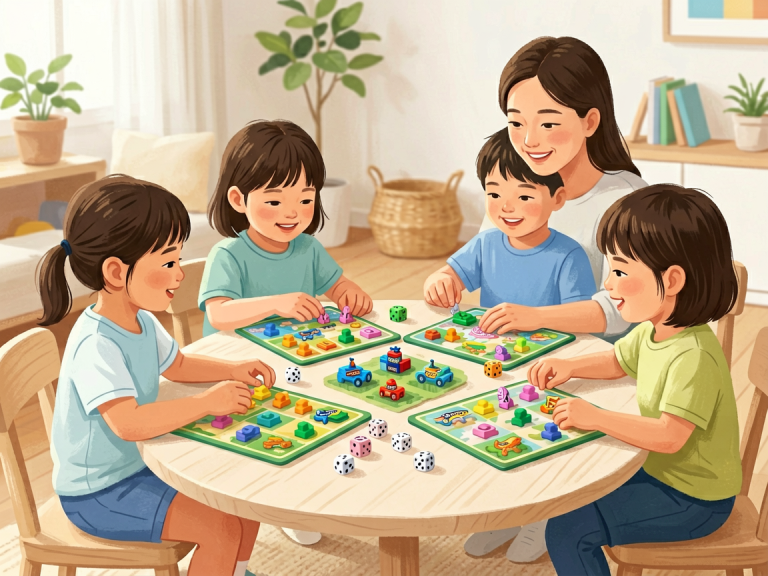
- Math board games: Games like Sum Swamp, Money Bags, or even a simple modified version of Snakes and Ladders that includes addition/subtraction dice. These teach turn-taking, strategy, and arithmetic in a low-pressure social setting.
- Fraction puzzles or pizza fraction sets: Children often struggle with fractions because they are abstract. A wooden pizza cut into halves, quarters, and eighths allows them to see that two quarters make one half. They can physically combine pieces.
Screen time can be included sparingly—apps like “Todo Math” or “Motion Math” offer adaptive practice—but the physical toys remain superior for deep understanding.
(D) Ages 9–12: Higher Level Thinking and Real-World Applications
Tweens are capable of abstract reasoning, but they still need bridges between the concrete and the theoretical. Math toys at this stage focus on logic, probability, geometry, and algebraic thinking.
- Geometric construction sets: Toys like Geomag, Magz, or Zometool allow children to build 3D structures using rods and connectors. They can explore angles, symmetry, and even simple polyhedra. Building a tetrahedron or a cube teaches properties of shapes in a way that a textbook never could.
- Logic puzzles and brain teasers: Think of Rush Hour (a traffic jam logic game), Mastermind, or Rubik’s Cube. These require deduction, pattern matching, and systematic thinking—all vital for math and computer science.
- Probability kits: A set of dice in different colors, spinners, and a bag of colored marbles can be used to run experiments. “If I roll two dice 50 times, which sum appears most often?” Children tally results, compute fractions, and begin to grasp the law of large numbers.
- Measuring tools: A tape measure, a kitchen scale, a stopwatch, and a thermometer. Let your child measure the perimeter of the room, weigh ingredients for baking, or time how long it takes to walk to the mailbox. Real-world measurement cements units, decimals, and estimation.
At this stage, avoid toys that are “math worksheets in disguise.” Look for toys that encourage open-ended exploration and creative problem-solving.
Part Three: How to Choose a Quality Math Toy – A Parent’s Checklist
With hundreds of math toys available on the market, it’s easy to be overwhelmed. Keep these five criteria in mind before you buy:
- Is it open-ended? The best math toys can be used in many ways, not just one. A set of interlocking cubes can be used for counting, building, creating patterns, measuring length, and even exploring volume. A battery-powered toy that only asks “What is 2+3?” has limited play value.
- Does it allow for error-friendly exploration? Good math toys let children make mistakes and try again without penalty. Blocks fall down; you rebuild. A puzzle piece doesn’t fit; you rotate it. This builds resilience—a key math mindset.
- Is the material durable and safe? Children will drop, throw, and chew on toys (especially the younger ones). Look for non-toxic finishes, sturdy construction, and washable materials. Wood, silicone, and thick cardboard are usually better than cheap plastic.
- Does it match your child’s current interest? If your child loves dinosaurs, find a counting game with dinosaur figures. If they are into building, get a construction set that includes angles and symmetry. Personal relevance drives engagement.
- Can you play alongside them? The most powerful factor in a child’s learning is your involvement. Choose toys that invite conversation: “I wonder what would happen if you put a big block on top of a small one? Why do you think it fell?” Toys that require a partner or a parent are gold.
Part Four: Practical Tips for Using Math Toys at Home
Even the best toy will gather dust if not introduced properly. Here are strategies to maximize the learning potential:
- Follow the child’s lead, not a curriculum: Let your child explore the toy in their own way first. If they want to line up the counting bears in a row instead of counting them, that’s fine. Later, you can gently guide: “I notice you made a long line. How many bears are in the line? Let’s count together.”
- Ask open-ended questions: Instead of saying “What is 2 plus 1?”, say “If I have two cookies and you have one, how many do we have altogether? How else could we find out?” Questions that start with “What do you notice?” or “What if we tried…” encourage critical thinking.
- Mix toys with everyday activities: Math doesn’t stop when the toy is put away. Use measuring cups while cooking, count stairs while walking up, compare prices at the grocery store, or estimate how many steps to the mailbox.
- Rotate toys, don’t overwhelm: A child faced with a dozen math toys may flutter from one to another without deep engagement. Keep only three or four accessible at a time and rotate them every few weeks. This keeps novelty alive while encouraging sustained play.
- Celebrate effort, not speed: Math learning is not a race. If your child takes a long time to figure out a puzzle, praise their persistence: “You kept trying even when it was tricky. That’s how you get smarter at math.”
Part Five: Common Myths and Pitfalls to Avoid
Even well-intentioned parents can fall into traps. Here are three common misconceptions:
- Myth 1: “My child is too young for math toys.” From infancy, babies are wired to notice patterns, quantities, and shapes. A simple rattle that makes two different sounds when shaken is a math toy—it’s about comparing sounds. Start early, keep it playful.
- Myth 2: “More expensive means better.” Some of the best math toys are simple and inexpensive: a deck of cards, a set of dice, a bag of beans, a ruler. Expensive electronic toys often replace thinking with entertainment. Save your money for versatile, open-ended materials.
- Myth 3: “My child hates math, so they won’t like math toys.” Often, children who claim to hate math have only experienced it as a static, worksheet-heavy subject. Give them a chance to play with a balance scale or build a marble run, and you may see their attitude shift. The key is to avoid labeling the toy as “math.” Just say, “Let’s see how this works!”
Conclusion: The Joyful Path to Mathematical Confidence
Math toys are not a replacement for good teaching, nor are they magic bullets that guarantee a future mathematician. But they are powerful allies in creating a positive relationship with mathematics. When a child discovers through play that patterns repeat, that numbers can be split and combined, that mistakes are stepping stones to understanding, they internalize a growth mindset that will serve them for life.
As a parent, your role is not to be a tutor but a play partner. Sit on the floor, build towers together, roll dice, wonder aloud. Your enthusiasm is contagious. Let the math toys be the tools, but your love and curiosity are the real engines of learning.
So go ahead—buy that set of colorful blocks, that balance scale, or that logic puzzle. Bring it home, unwrap it with excitement, and let the adventure begin. The magic of mathematics is waiting to be unlocked, one toy at a time.
Start with the complete guide: Beyond Counting: The Best Early Math Toys That Build a Foundation for Lifelong Numeracy.