The Evolution of Play: How Toy Progression Fuels Creativity
Word Count: 1,024
—
1. Introduction
Creativity is not a fixed trait; it is a cognitive muscle that can be exercised and developed through deliberate, engaging experiences. Among the most powerful tools for nurturing this muscle in children are toys. Yet not all toys are created equal. A simple wooden block and a complex programmable robot serve vastly different functions in a child’s creative journey. The concept of *toy progression* refers to the deliberate sequence of introducing toys with increasing complexity, openness, and interactivity as a child matures. This progression is not merely about age-appropriate amusement; it is a carefully calibrated scaffolding system that challenges children to move from concrete manipulation to abstract thinking, from imitation to innovation. Understanding how toy progression supports creativity can help parents, educators, and designers craft environments where imagination flourishes naturally.
—
2. The Foundations of Creative Play: Simple Toys for Early Childhood
In the first years of life, the brain is highly plastic, forming neural connections at an astonishing rate. The best toys for this stage are the simplest: rattles, stacking rings, soft blocks, and nesting cups. These objects are *closed-ended* in the sense that they have clear, intended uses—a ring fits on a peg, a block stacks on another—yet they also invite open-ended exploration. A toddler may discover that a block can be a phone, a car, or a building, revealing the earliest seeds of symbolic thought.
This stage of toy progression is crucial because it establishes the habit of manipulation. Children learn cause and effect: pounding a block makes a sound, dropping a cup makes it disappear. These micro-experiments are the building blocks of divergent thinking. According to developmental psychologist Jean Piaget, sensorimotor play (0–2 years) allows infants to construct knowledge through physical interaction. Simple toys that respond predictably to action create a safe sandbox for trial and error, the bedrock of creative problem-solving.
Moreover, these toys are progressive in their minimalism. Because they lack flashing lights or pre-recorded sounds, they demand that the child supply the narrative. A silent block becomes whatever the child imagines; a plain ball can roll, bounce, or be hidden. This forces the young mind to generate possibilities, rather than passively receive them. Thus, the foundation of toy progression is paradoxically about withholding complexity—offering just enough structure to support play, but not so much that it stifles invention.
—
3. Building Blocks of Imagination: Construction Toys and Problem-Solving
Around ages three to five, children enter what Piaget called the preoperational stage, where symbolic play and language blossom. This is the golden age for construction toys: interlocking bricks, magnetic tiles, wooden train tracks, and simple puzzles. These toys introduce a new layer of complexity: they have multiple valid solutions. A set of LEGO Duplo bricks can become a tower, a bridge, a spaceship, or a zoo enclosure. The toy itself does not prescribe a final product; it provides a grammar of parts and connectors, and the child composes the story.
This stage of progression cultivates executive functions such as planning, working memory, and cognitive flexibility—all essential for creative thinking. When a child tries to build a bridge that spans two block towers, they must mentally simulate, test, and revise. Failure is not only tolerated but expected. A tower that falls teaches a lesson in physics and resilience. Researchers at the University of California found that children who engaged in guided block play demonstrated significantly higher levels of divergent thinking (the ability to generate many solutions to a single problem) compared to those who spent equivalent time with passive entertainment.
The key here is that construction toys are semi-structured. They offer constraints (bricks only connect in certain ways) but not a fixed goal. This tension between freedom and constraint is the engine of creativity. Too much freedom can overwhelm; too much structure can bore. The progression from simple stacking to complex building systems—like switching from Duplo to standard LEGO, or from basic magnet tiles to sets with wheels and hinges—gradually increases the cognitive load, forcing the child to integrate more variables into their mental model.
Moreover, these toys encourage social creativity when played with peers or caregivers. Negotiating who builds which part, resolving disputes over design, and combining ideas into a shared creation all require flexible thinking and empathy. Toy progression at this stage is therefore not just about the object itself, but about the evolving context of play.
—
4. The Rise of Complexity: Role-Playing and Open-Ended Kits
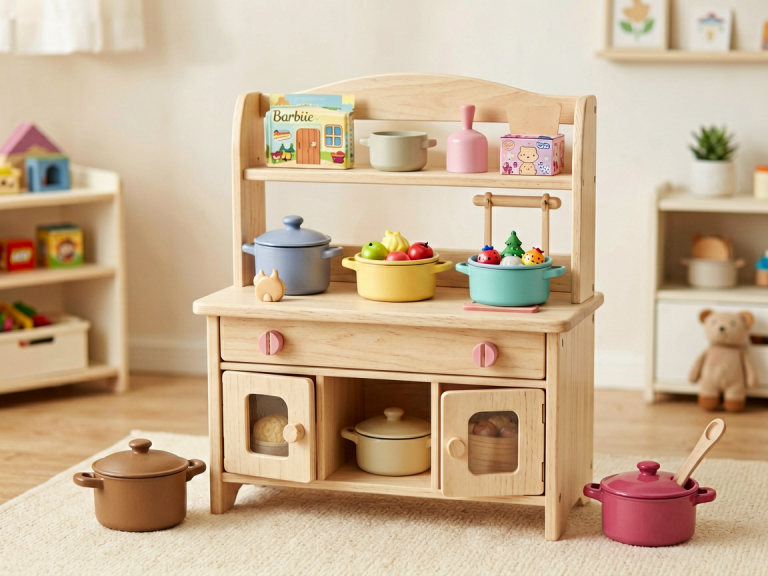
As children enter middle childhood (ages six to ten), their capacity for abstract reasoning and narrative construction grows dramatically. This is the ideal time to introduce open-ended kits and role-playing props that mimic real-world systems. Examples include doctor’s kits with realistic tools, kitchen sets with pretend food, art supplies with multiple media, or simple science kits for growing crystals or building circuits.
These toys differ from earlier ones in that they demand narrative integration. A child using a doctor’s kit is not merely manipulating objects; they are enacting a story: the patient is sick, the diagnosis is made, the treatment is applied. This kind of pretend play requires perspective-taking (the ability to imagine another’s point of view), cause-and-effect reasoning, and emotional regulation. According to psychologist Lev Vygotsky, make-believe play is a leading factor in the development of creativity because it separates meaning from objects—a stick becomes a horse.
Toy progression at this stage also introduces systems thinking. A more advanced building set, such as a marble run or a simple robotics kit, forces the child to consider feedback loops, sequences, and dependencies. For instance, a marble run must be designed so that gravity, direction, and speed work together to achieve a desired outcome. If the marble falls off at a certain point, the child must analyze why and redesign. This iterative process mirrors the creative workflow of engineers, artists, and scientists.
Importantly, these toys often come with no single correct outcome. A child can use a set of wooden dollhouse furniture to stage a family dinner, a hospital emergency, or a space station. The same set of clay can become a dinosaur one day and a cell phone the next. This open-endedness is the hallmark of toys that fuel creativity: they are *tools for thinking* rather than *scripts for doing*.
—
5. Digital and Hybrid Toys: Balancing Technology and Imagination
In the 21st century, no discussion of toy progression is complete without addressing digital and hybrid toys. Tablets, coding robots, and augmented reality kits are increasingly common. The danger is that these toys can become passive consumption devices if not designed thoughtfully. However, when used correctly, they represent the next tier of complexity in toy progression, offering programmable interactivity and adaptive feedback.
For example, a toy like the Osmo system merges physical blocks with a tablet screen, requiring children to arrange tangible pieces to solve puzzles that appear on the screen. Another example is a simple robotics kit like the Bee-Bot, where children press directional buttons to program a toy bee to move along a grid. These toys teach computational thinking—decomposition, pattern recognition, abstraction, and algorithm design—all of which are forms of creative problem-solving.
The key to maintaining creativity in digital toys is to ensure they remain open-ended. A game that only allows one path is a puzzle, not a creativity tool. A coding toy that lets children invent their own animations or stories, on the other hand, becomes a canvas. Also, hybrid toys that require physical manipulation (touching blocks, moving figures) engage the sensorimotor system, which reinforces learning and prevents the passive screen-time trap.
Toy progression at this stage is not about replacing analog with digital, but about integrating both. A child who first mastered wooden blocks, then LEGO, then a simple coding robot will have a rich mental library of cause-and-effect relationships, spatial reasoning, and symbolic representation. The digital layer adds abstraction and complexity, but only if the analog foundations are solid.
—
6. The Role of Parents and Educators in Guiding Toy Progression
Toys alone do not guarantee creativity; they are tools that require scaffolding from caring adults. The most effective progression is not a rigid curriculum, but a sensitive response to the child’s current interests and developmental edge. Parents can observe: Does the child prefer solitary or social play? Are they drawn to building, pretending, or exploring? The toy progression should follow the child’s curiosity, not a checklist.
Adults also play a critical role in modeling creative thinking. When a parent says, “What else could this block be?” or “What if we built the bridge upside down?” they invite divergent thinking. Similarly, asking open-ended questions like “Tell me about your creation” validates the child’s process rather than evaluating the product. This kind of feedback encourages risk-taking and intrinsic motivation.
Furthermore, rotating toys is a simple but powerful strategy. Too many toys at once can overwhelm a child, leading to shallow play. By offering a small, curated set and then swapping in new, slightly more complex toys over weeks and months, adults can maintain novelty without overstimulation. This rotation ensures that each toy’s potential is fully explored before moving on.
Finally, toys should be gender-neutral and culturally diverse to maximize the creative possibilities. A toy kitchen that includes food from diverse cuisines, or a set of action figures representing different professions and backgrounds, expands the child’s imaginative world. The goal of toy progression is not to push a child prematurely into adult-like thinking, but to honor the natural developmental trajectory while gently challenging it.
—
7. Conclusion
Creativity is not magically bestowed; it is cultivated through a lifetime of playful experimentation. Toy progression—the thoughtful sequencing of playthings from simple manipulatives to complex, open-ended systems—provides a structured yet flexible pathway for this cultivation. Each stage builds on the last: sensorimotor exploration lays the foundation for symbolic play, which in turn supports narrative construction and systems thinking. Digital and hybrid toys, when integrated properly, add new dimensions of abstraction and control.
Crucially, the adult’s role is to observe, scaffold, and rotate, ensuring that the child remains an active creator rather than a passive consumer. The most creative children are not those who own the most toys, but those who have experienced a deliberate progression that respects their developmental readiness while constantly inviting them to ask, “What if?” In the end, the best toy is one that becomes invisible, allowing the child’s own imagination to shine through. That is the true power of toy progression for creativity.