Building a Numerical Foundation: The Essential Role of Early Math Toys in the Home Environment
Introduction: Why Early Math Matters Before the Classroom
Mathematics is often misunderstood as a subject reserved for formal schooling—something that begins with worksheets, memorized multiplication tables, and timed tests. Yet the truth is far more organic. Long before a child enters a classroom, they are already engaging with mathematical concepts: stacking blocks (spatial reasoning), dividing snacks among siblings (fractions and distribution), or noticing that three bears require three bowls (one-to-one correspondence). These everyday moments are the raw material of mathematical thinking.
However, not all children naturally encounter these experiences with sufficient frequency or variety. This is where early math toys for home become invaluable. Carefully designed toys can transform passive observation into active exploration, turning the living room floor into a laboratory of numbers, shapes, patterns, and logic. In this article, we will examine why early math toys matter, what types are most effective, how to select them for different developmental stages, and how parents can integrate them into daily routines without turning play into a drill session. The goal is not to create child prodigies, but to cultivate a positive, intuitive relationship with mathematics that will support learning for years to come.
The Cognitive Science Behind Early Math Play
To appreciate the power of math toys, we must first understand how young children’s brains develop numerical cognition. Research from cognitive scientists like Stanislas Dehaene (author of *The Number Sense*) shows that humans are born with an approximate number system—an innate ability to roughly estimate quantities. But this system is imprecise. Formal mathematical ability requires building upon this foundation with exact numerical representation, symbolic understanding, and operational fluency.
The early years (roughly age 1 to 6) are a period of rapid neural plasticity. During this window, experiences shape the brain’s architecture. A child who plays regularly with counting beads, pattern blocks, or balance scales is not just “learning math” in a narrow sense; they are strengthening neural pathways that link visual, tactile, and auditory inputs with abstract concepts. For example, when a toddler places a small cube into a numbered slot, their brain is forging a connection between the physical action of “one” and the abstract label “1.” Repetition across varied contexts—different toys, different settings—solidifies these connections.
Moreover, math toys that encourage spatial reasoning (puzzles, tangrams, building sets) have been linked to later success in STEM fields. A 2013 study from the University of Chicago found that the amount of spatial language (e.g., “under,” “above,” “rotate”) that parents used during play predicted children’s spatial skills at age three. Math toys naturally elicit such language. When a parent says, “Can you fit the triangle into the triangular hole?” they are embedding geometric vocabulary in a meaningful, memorable context.
Types of Early Math Toys: A Categorized Guide
Not all toys marketed as “educational” deliver genuine mathematical value. The best early math toys share key characteristics: they are open-ended, they invite manipulation, and they provide immediate, non-judgmental feedback. Below are four essential categories, with specific examples for each.
1. Counting and Number Recognition Toys
These toys help children move from rote counting (reciting “one, two, three” like a song) to rational counting (understanding that the last number said represents the total quantity).
- Example: Melissa & Doug’s “Abacus” is a classic. Its sliding beads allow children to count forward, backward, and group numbers visually.
- Example: “Counting Bears” with matching cups let children sort by color, then count how many bears are in each cup, introducing both classification and enumeration.
- Example: Montessori-style “Number Rods” provide a clear, tangible representation of quantity: a rod of length 2 is twice as long as a rod of length 1, making addition and subtraction visible.
2. Pattern and Sequence Toys
Recognizing patterns is a cornerstone of algebraic thinking. Toys that require children to continue, create, or predict sequences train the brain to detect regularities.
- Example: “Pattern Blocks” (wooden or plastic shapes in different colors) can be used to create repeating sequences like red-blue-red-blue.
- Example: “Lacing Beads” with shaped beads—children can string them in a pattern (cube, sphere, cube, sphere) while also practicing fine motor skills.
- Example: Simple “pegboards” with colored pegs: copy a pattern card, then extend it independently.
3. Geometry and Spatial Awareness Toys
These toys develop an understanding of shapes, symmetry, and how objects relate in space.
- Example: “Magna-Tiles” or magnetic building tiles allow children to construct 3D shapes from 2D pieces, exploring volume, angles, and symmetry.
- Example: “Wooden Shape Sorters” are deceptively simple: a cube requires a child to rotate the shape until it aligns with the hole, a fundamental spatial transformation.
- Example: “Tangrams” (seven pieces forming a square) can be rearranged into hundreds of silhouettes, teaching part-whole relationships.
4. Measurement and Comparison Toys
Understanding size, weight, volume, and length is essential for later work with measurement and data.
- Example: A “balance scale” with weighted numbers or animals: children can experiment with what makes the scale tip, intuiting concepts of equality and inequality.
- Example: “Stacking cups” of graduated sizes: nesting them teaches seriation (ordering by size) and volume (how many small cups fill a large one).
- Example: A simple “ruler” toy with different measuring tools—or even a set of string pieces of different lengths—can turn any object into a comparison exercise: “Is the teddy bear longer than the block?”
How to Choose the Right Toys for Your Child’s Developmental Stage
One of the biggest mistakes parents make is purchasing toys that are either too simple (leading to boredom) or too advanced (leading to frustration). Here is a rough developmental guide.
Ages 1–2: Sensory and Motor Foundation
At this stage, children explore through mouthing, banging, and dropping. Choose toys that are large (to prevent choking) and offer basic cause-and-effect math.
- Recommendation: Nesting cups, large stacking rings, and textured shape sorters with only two or three shapes. Focus on vocabulary: “big,” “little,” “round,” “square.”
Ages 2–3: Early Counting and Classification
Children begin to notice differences and similarities. They can count two or three objects by pointing, though they may not use numbers accurately.
- Recommendation: Simple puzzles with knobs, animal counters, and color-matching games. Introduce one-to-one correspondence: “Give each bear one cup.”
Ages 3–4: Symbolic Thinking
Children start understanding that numbers represent quantities. They can count up to ten and may recognize written digits.
- Recommendation: Abacus, number puzzle boards, and pattern cards. Encourage them to “write” numbers with finger paint or in sand—multisensory approaches reinforce memory.
Ages 4–6: Operations and Logical Reasoning
Preschoolers and kindergartners can handle simple addition and subtraction (using objects), compare numbers, and solve basic story problems.
- Recommendation: Balance scales, magnetic tiles, dice games (roll and count), and simple board games that require counting spaces. Introduce vocabulary like “more than,” “less than,” “equal.”
Integrating Math Toys into Daily Home Life Without Pressure
The most effective math-play happens not during a designated “learning time,” but woven seamlessly into everyday activities. Here are practical strategies for parents.
Strategy 1: Follow the Child’s Lead
If your child is stacking blocks, join them and introduce math language naturally: “Your tower has five blocks. What if we add one more? How many now?” Avoid correcting mistakes immediately—observe and let them self-correct through trial and error.
Strategy 2: Create Inviting Displays
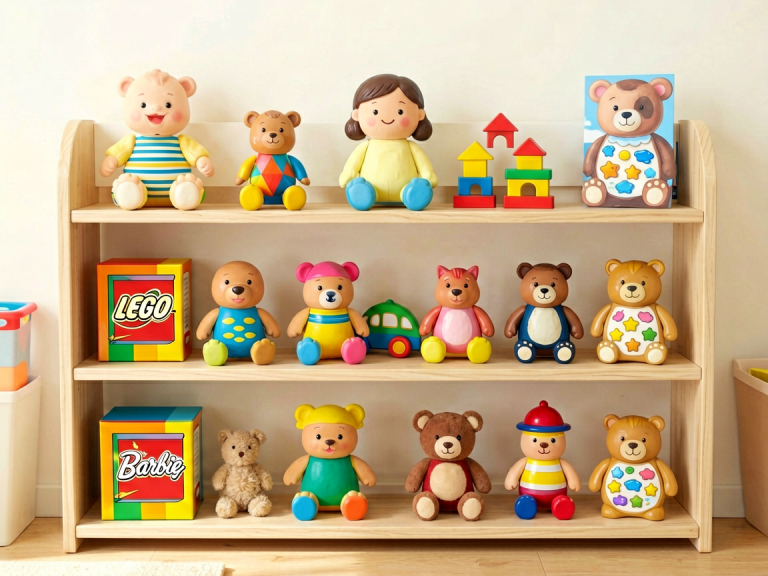
Keep math toys accessible, not hidden in a closet. A low shelf with a few rotating items (e.g., a basket of counting bears, a puzzle, a set of pattern cards) invites spontaneous exploration. Change the selection every week or two to maintain novelty.
Strategy 3: Use Math Toys to Solve Real Problems
Instead of abstract exercises, embed math in real contexts. “We have six cookies, and three people. How many does each get?” Let the child use their counting bears to model the division. Or, while cleaning up, “Let’s put all the square blocks in this bin. How many squares are there?”
Strategy 4: Embrace Mess and Mistakes
Math understanding often requires repeated failure. A child who cannot fit the star into the star hole is not “bad at shapes”; they are learning spatial orientation. Allow them to struggle briefly before offering a gentle hint. Resist the urge to demonstrate the “correct” way immediately—discovery builds confidence.
Strategy 5: Storytelling and Imagination
Combine math toys with narrative. “The three bears each need a bed. Your job is to make sure the big bed goes to Papa Bear, the medium bed to Mama Bear, and the tiny bed to Baby Bear.” This turns seriation into a story, making the math meaningful and memorable.
Common Pitfalls to Avoid
Even with the best intentions, parents sometimes undermine the value of early math toys. Watch out for:
- Overemphasis on speed and correctness: Math is not a race. If your child miscounts, ask “How do you know?” rather than “That’s wrong.”
- Toys that do too much: Electronic toys that shout “Five!” or “Correct!” can rob children of the chance to process. Simple, non-electronic toys often are superior because they require active thinking.
- Gendered expectations: Research shows that parents tend to buy more spatial toys (blocks, puzzles) for boys and more verbal toys for girls. Expose both genders to all types of math toys.
- Forgetting fun: If a toy feels like a chore, put it away. The goal is to associate math with joy, not stress.
Conclusion: Lasting Benefits Beyond Numbers
Early math toys for home are more than a trendy educational tool; they are a bridge between the abstract world of mathematics and the concrete, sensory world of childhood. By providing carefully chosen toys and a supportive, playful environment, parents lay the groundwork for not only mathematical competence but also critical thinking, problem-solving, and a growth mindset.
A child who grows up manipulating pattern blocks, balancing scales, and counting bears is a child who learns that math is not a mysterious language spoken only in classrooms, but a way of making sense of the world. That child enters kindergarten with confidence, curiosity, and a toolkit of intuitive strategies. And perhaps most importantly, that child knows that math can be fun—a discovery that will serve them for a lifetime.
So clear a shelf, set out a basket of shape sorters, and sit down on the floor. The numbers will come, but the connection you build today will last far longer than any worksheet.
*(Word count: approximately 1,520 words)*
Start with the complete guide: Beyond Counting: The Best Early Math Toys That Build a Foundation for Lifelong Numeracy.