Building Early Reading Skills Through Play: Fun Activities for Babies
Introduction
Long before a baby speaks their first word or picks up a book, the foundation for reading is quietly being laid. Early literacy is not about drilling letters or flashcards; it begins with rich, sensory experiences that help infants connect sounds, patterns, rhythm, and meaning. For babies, play is the most natural and powerful learning tool. Through playful interactions with caregivers, babies develop critical pre-reading skills such as vocabulary acquisition, phonological awareness, print motivation, and narrative comprehension. This article explores five categories of play activities specifically designed to nurture early reading abilities in babies from birth to 12 months. Each activity is simple, joyful, and requires no expensive materials—only your presence, voice, and a little creativity.
1. The Power of Sensory Play in Pre-Reading Development
Sensory play engages a baby’s sight, hearing, touch, and even smell, building neural connections that underpin language processing. When babies explore different textures, they are also learning to discriminate between shapes and patterns—a skill essential for recognizing letters later on.
- Texture books and fabric squares: Offer cloth books with crinkly pages, soft fur, or bumpy textures. While you turn the pages, say simple words like “soft,” “rough,” or “bumpy.” Your baby will associate the tactile sensation with the spoken word, building vocabulary through multisensory input.
- Treasure baskets: Fill a shallow basket with safe objects of varying materials—a wooden spoon, a smooth stone, a silky scarf. Let your baby handle each item while you name it. This introduces new nouns and reinforces the connection between an object and its label, which is the essence of reading comprehension.
- Water and sand play: Under supervision, let your baby splash in a shallow tray of water or run fingers through dry sand. Describe what you see: “The water is wet. Drip, drop, drip.” These rhythmic phrases mimic the cadence of storybooks and train the ear to recognize linguistic patterns.
2. Interactive Storytelling: Beyond the Book
Reading to a baby is not about finishing the story—it’s about the exchange between you, the baby, and the book. Interactive storytelling turns a passive listening experience into an active, playful dialogue.
- Point-and-name routines: Choose board books with large, bright images of familiar objects (e.g., ball, cat, banana). As you point to each picture, say the word clearly, then pause and wait. Even if your baby only babbles back, you are teaching turn-taking and that pictures carry meaning.
- Make it dramatic: Vary your voice—high for a mouse, low for a bear—and use facial expressions. Babies are captivated by exaggerated intonation, which highlights the emotional arc of a story. This builds narrative understanding long before they can follow a plot.
- Personalized photo books: Create a simple album with pictures of your baby, family members, and favorite toys. Flip through and name each person or object. Babies love seeing themselves, and this activity connects real life to the concept of a “book” as something that represents the world.
3. Sound and Rhyme Games for Phonological Awareness
Phonological awareness—the ability to hear and play with the sounds in words—is one of the strongest predictors of later reading success. Babies are naturally attuned to rhythm and rhyme, and playful sound games are ideal for developing this skill.
- Nursery rhymes and lullabies: Sing “Itsy Bitsy Spider” or “Twinkle Twinkle Little Star” while doing corresponding hand motions. The repetition of rhyming words (“star” and “are”) helps babies detect sound patterns. Even if they cannot repeat the words, their brains are mapping the auditory structure.
- Sound imitation: Make silly sounds like “ba-ba-ba,” “ma-ma-ma,” or “vroom vroom” during play. Pause and encourage your baby to copy you. This back-and-forth builds the oral-motor skills needed for speech and reinforces that sounds carry meaning.
- Rhythmic bouncing and clapping: Hold your baby on your lap and bounce gently while chanting, “Up, up, up… down, down, down.” Clap to the beat of a simple poem. The physicality of rhythm embeds a sense of phrasing that will later help your child chunk words into sentences while reading.
4. Visual Tracking and Pattern Recognition Activities
Reading requires the eyes to track from left to right across a page. Strengthening visual tracking and pattern recognition through play prepares babies for the mechanics of reading.
- Slow-moving toys: Dangle a soft toy or a bright scarf and move it slowly from one side of your baby’s vision to the other. Encourage them to follow it with their eyes. Describe the movement: “Here comes the red scarf, swishing left… now right.” This mimics the eye movements needed for reading lines of text.
- High-contrast cards: Newborns see best in black and white. Show them simple geometric patterns (stripes, checkerboards, circles) and slowly move the card. As they grow, introduce patterns with increasing complexity. Recognizing these patterns lays the groundwork for distinguishing letter shapes.
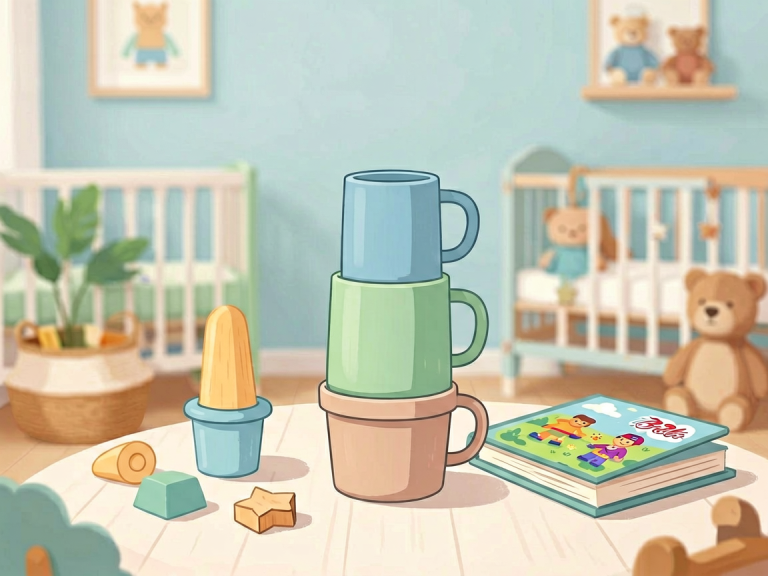
- Stacking and nesting toys: When your baby tries to stack rings or fit shapes into a sorter, they are learning about order and sequence—skills crucial for understanding how letters follow one another in a word. Narrate their actions: “First the big red ring, then the small blue ring.”
5. Creating a Print-Rich Play Environment
Babies absorb the world around them passively, so surrounding them with print in playful ways normalizes the presence of written language. This builds “print awareness”—the understanding that text has meaning and purpose.
- Labeling objects in the play area: Write simple labels (e.g., “ball,” “block,” “cup”) on cards and tape them near the corresponding items. You don’t need to teach your baby to read the words at this stage; just point to the label and say the word during play. Repetition creates familiarity.
- Homemade picture-word cards: Use index cards and glue pictures from magazines. Under each picture, write the word in large lowercase letters. Spread the cards on the floor and let your baby crawl among them. Whenever they touch a card, say the word. This playful exposure builds a visual memory for common words.
- Interactive wall displays: Hang a felt board or a magnetic board at baby’s eye level. Change the pictures and simple words weekly. For example, a felt apple with the word “apple” underneath. Let your baby touch the felt pieces while you talk about the color, taste, and shape.
Conclusion
Building early reading skills in babies does not require formal lessons or pressure. The most effective approach is to weave language-rich, playful moments into your daily routines. When you bounce your baby on your knee while chanting a rhyme, when you point to a picture of a dog and say “woof-woof,” or when you let them crinkle a cloth book page, you are nurturing the brain’s literacy network. Each playful interaction strengthens the neural pathways that will eventually enable your child to decode words, understand stories, and love reading. Remember that the goal is not early reading in the conventional sense, but early joy in the world of sounds, symbols, and stories. So laugh, sing, babble, and explore—your baby is learning to read through every playful moment you share.