Engaging Activities for Preschoolers to Boost Language Development
Introduction
Language development in the preschool years—typically between ages three and five—is one of the most dynamic and critical periods in a child’s life. During this stage, children move from simple two-word phrases to constructing complex sentences, asking endless “why” questions, and using language to express emotions, tell stories, and interact with peers. While every child develops at their own pace, parents, caregivers, and educators can significantly support this growth through purposeful, playful activities. The key is to integrate language learning into everyday experiences that feel natural, fun, and engaging. This article explores a variety of hands-on, research-backed activities designed to expand vocabulary, improve sentence structure, enhance listening comprehension, and boost overall communication skills in preschoolers. Each activity is simple to set up, requires minimal materials, and can be adapted to a child’s individual interests. By weaving these practices into daily routines, adults can turn ordinary moments into powerful language-learning opportunities.
The Importance of Language Development in Preschoolers
Before diving into specific activities, it is helpful to understand why language development matters so much at this age. Language is the foundation for literacy, social skills, academic success, and emotional regulation. When preschoolers have a rich vocabulary and the ability to express themselves clearly, they are better equipped to follow instructions in a classroom, make friends on the playground, and articulate their needs and feelings. Moreover, strong language skills are closely linked to later reading comprehension and writing abilities. Research from the National Institute for Literacy shows that children who enter kindergarten with a larger vocabulary are more likely to become proficient readers by third grade. The preschool years are also a time when the brain is highly plastic—neural connections related to language are forming rapidly, and exposure to diverse words, sentence structures, and conversational patterns can literally shape the architecture of a child’s developing mind. Therefore, investing time in language-rich activities is not just beneficial; it is essential for long-term cognitive and social development.
Storytelling and Reading Aloud: Building Vocabulary and Narrative Skills
Interactive Picture Book Sessions
Reading aloud is perhaps the single most powerful activity for language development, but the quality of the interaction matters more than the quantity. Instead of simply reading the words on the page, engage your preschooler in a dialogue about the story. Pause after each page to ask open-ended questions: “What do you think will happen next?” “Why is the bear sad?” “Can you find something red in this picture?” This technique, known as dialogic reading, encourages children to become active participants rather than passive listeners. It builds vocabulary by introducing new words in context, and it helps children practice formulating complete sentences as they respond. For example, while reading a book about farm animals, you might say, “This is a piglet. A piglet is a baby pig. Can you say ‘piglet’? What sound does a piglet make?” These small exchanges expand a child’s word bank and reinforce correct pronunciation.
Story Retelling and Puppet Shows
After finishing a book, invite your preschooler to retell the story using their own words. You can provide props—stuffed animals, finger puppets, or simple drawings—to make the activity more concrete. Retelling requires a child to recall sequence, characters, and key events, all of which strengthen memory and narrative organization. For instance, after reading “The Three Little Pigs,” gather three small toy pigs and a toy wolf, and let your child act out the story. As they move the characters, prompt them with phrases like “What happened first? Then what did the wolf say?” This activity not only improves vocabulary (words like “huff,” “puff,” “brick,” “straw”) but also teaches cause and effect, a critical component of language reasoning.
Interactive Games and Songs: Making Language Playful
“I Spy” with Descriptive Language
The classic game “I Spy” can be adapted to target specific language skills. Instead of simply naming an object, require your child to describe it using adjectives, colors, shapes, or functions. For example, you might say, “I spy something round, blue, and that you can bounce.” The child must listen carefully to the multisensory cues and then respond with the correct item (e.g., “a blue ball”). This game builds listening comprehension, vocabulary for describing attributes, and the ability to process multiple pieces of information at once. To increase difficulty, ask the child to take the role of the “spyer” and describe objects for you to guess. This reverses the linguistic demand—now they have to produce descriptive phrases instead of just processing them.
Action Songs and Finger Plays
Songs like “The Wheels on the Bus,” “If You’re Happy and You Know It,” and “Head, Shoulders, Knees, and Toes” are more than just fun—they are linguistic goldmines. The repetitive lyrics, predictable rhythms, and accompanying gestures help children internalize sentence structures, verb tenses, and prepositions. When you sing “The wheels on the bus go round and round,” your child learns that the word “round” describes motion, and the repetition reinforces that phrase structure. Finger plays like “Itsy Bitsy Spider” also build fine motor coordination while teaching sequencing words (“first,” “then,” “next”) and action verbs. Sing these songs together daily, and intentionally pause before a familiar word to let your child fill in the blank: “The wheels on the bus go ___ and ___.” This cloze technique encourages active recall and builds confidence.
Creative Arts and Crafts: Language Through Hands-On Creation
Labeled Collage Making
Arts and crafts provide a natural context for introducing new vocabulary. For a simple but effective activity, give your preschooler a large piece of paper, glue, and a collection of magazine cutouts, fabric scraps, or natural materials like leaves and twigs. As they arrange their collage, narrate what they are doing using descriptive language: “You are placing a shiny red button next to a fuzzy green leaf.” Then, after the artwork is complete, invite your child to “read” their collage to you. Encourage them to name each item and explain why they chose it. Writing simple labels on sticky notes (e.g., “button,” “leaf,” “sky”) and placing them next to the corresponding items introduces the concept that spoken words have written counterparts, building pre-literacy skills. This activity expands vocabulary related to textures, colors, shapes, and categories.
Dress-Up and Pretend Play Centers
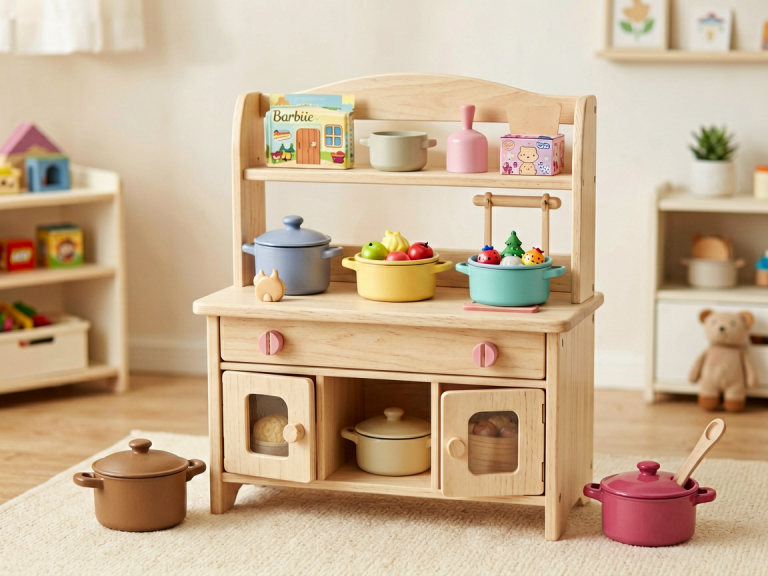
Set up a simple dress-up corner with hats, scarves, old clothes, and props like a toy phone, a plastic stethoscope, or a play kitchen. When children engage in pretend play, they naturally use language to negotiate roles (“I’ll be the doctor, you be the patient”), describe actions (“I’m stirring the soup”), and express character dialogue (“Hello, how can I help you today?”). This unstructured play is one of the richest environments for language development because it forces children to generate their own sentences in real time. To maximize the benefit, join in as a play partner and model more complex language. For example, if your child is playing chef, you can say, “Chef, what are you cooking for dinner tonight? I hope it’s a delicious soup with carrots and celery.” This models expanded sentences and new food vocabulary. The key is to follow the child’s lead and expand on their utterances without correcting or dominating the play.
Daily Conversations and Role Play: Authentic Language in Action
Describe-Your-Day Routine
One of the simplest yet most effective activities is embedding language practice into your daily routine. During meals, bath time, or while driving, ask your preschooler open-ended questions about their day: “Tell me one fun thing you did at the park today.” “What did you see on our walk?” These questions require a child to recall past events and formulate a narrative. Encourage them to add details by prompting with “And then what happened?” or “How did that make you feel?” You can also model a “turn-taking” conversation where each person shares one thing. This teaches the back-and-forth rhythm of dialogue—a crucial social communication skill. Additionally, labeling objects and actions as they occur throughout the day (“Let’s put on your blue sweater. Feel how soft it is!”) constantly enriches vocabulary without feeling like a lesson.
Phone Call Practice with a “Silly Phone”
Provide your child with a toy phone (or an old, deactivated smartphone) and pretend to call them. Have a scripted but playful conversation: “Ring, ring! Hello, this is Grandma. How is my favorite little one today? What did you have for breakfast?” The child must respond in complete sentences, using appropriate greetings and turn-taking. You can also swap roles, with the child calling you. This activity teaches pragmatic language skills—how to start a conversation, listen to the other person, and reply appropriately. It also reinforces question-answer structures and social scripts. For added fun, use silly voices or characters (a pirate, a fairy, etc.) to keep engagement high.
Conclusion
Language development in preschoolers does not require expensive toys, formal lessons, or screen time. The most powerful tools are already available: your voice, your attention, and a willingness to play. By incorporating storytelling, interactive games, creative arts, and authentic daily conversations, you create a rich linguistic environment where a child can experiment with words, build comprehension, and gain the confidence to express themselves. The activities described above are flexible and can be tweaked to match a child’s developmental stage and unique interests. Remember that the goal is not perfection—it is connection and joy. Every time you sing a silly song together, describe the pattern on a leaf, or ask an open-ended question about a picture book, you are laying down neural pathways that will support literacy, learning, and relationships for years to come. Start small, be consistent, and watch your preschooler’s language skills blossom naturally through the magic of everyday play.