Building Blocks of Language: How Toys Foster Language Development in Elementary School Children
Introduction
Language development is one of the most critical milestones in a child’s early education. For elementary school children—typically ages six to twelve—the ability to express thoughts, understand complex instructions, and engage in meaningful conversations forms the foundation for academic success and social integration. While classrooms and textbooks play a significant role, the power of play should never be underestimated. Toys are not merely sources of entertainment; they are powerful tools that can accelerate language acquisition, enrich vocabulary, and enhance communication skills. This article explores how carefully selected toys can support language development in elementary-age children, offering practical insights for parents, educators, and caregivers who wish to turn playtime into a rich linguistic experience.
The Role of Play in Language Acquisition
Children learn best when they are actively engaged and having fun. Play provides a low-anxiety environment where children feel safe to experiment with new words, sentence structures, and conversational patterns. Unlike formal instruction, which can feel pressured, play encourages spontaneous language use. According to child development experts, play-based learning activates multiple areas of the brain simultaneously, strengthening neural connections related to language processing, memory, and creativity. For elementary students, who are already building on their basic vocabulary from preschool years, toys offer a natural bridge from simple phrases to more sophisticated speech. The key is to choose toys that require communication, whether with peers or adults, rather than passive entertainment.
Vocabulary Building Through Interactive Toys
One of the most direct ways toys support language development is by introducing and reinforcing new vocabulary. Toys such as flashcards, word games, and matching puzzles expose children to words in context. For example, a set of animal figurines accompanied by cards with names and facts encourages a child to say “giraffe,” “herbivore,” or “savanna.” Similarly, building sets that include themed pieces—like a medieval castle with knights, drawbridges, and towers—prompt children to learn specific terminology related to history, architecture, and fantasy. Unlike rote memorization, these toys make vocabulary acquisition memorable because words are attached to physical objects and actions. The tactile experience reinforces meaning, and repetition during play solidifies retention. For older elementary children, complex board games like “Bananagrams” or “Scrabble Junior” turn word formation into a competitive yet enjoyable activity, expanding both spelling and vocabulary.
Storytelling and Narrative Skills with Construction Toys
Narrative ability—the capacity to tell a coherent story—is a cornerstone of language development. Construction toys such as LEGO, wooden blocks, and magnetic tiles are exceptional for fostering storytelling. When a child builds a spaceship, a farm, or a city, they naturally invent a backstory: “This is the captain’s quarters, and the aliens attack at midnight.” Adults can scaffold this process by asking open-ended questions: “What happens next?” “Why did the character go there?” This dialogue encourages children to sequence events, use transition words (first, then, finally), and develop character dialogue. Moreover, construction toys allow for physical manipulation of narrative elements; a child can literally move the “characters” through the setting, which strengthens the connection between words and actions. Storytelling kits that combine figurines with settings—such as a pirate ship with a treasure map—further enhance the child’s ability to organize thoughts and express them clearly. Over time, these skills transfer to written composition, making construction toys a stealthy but powerful language tool.
Social Language Development through Group Games
Language is inherently social, and toys that require interaction with others are invaluable for developing pragmatic language skills—the ability to use language appropriately in social contexts. Board games, card games, and cooperative games teach children how to take turns, negotiate rules, express frustration politely, and celebrate success without gloating. For instance, a game like “Codenames” or “Charades for Kids” forces children to give clear clues and interpret ambiguous messages. Even simpler games like “Go Fish” require the repeated use of question forms: “Do you have any sevens?” This repetitive structure strengthens grammar and syntax naturally. Furthermore, group games expose children to different speaking styles, accents, and conversational rhythms. They learn to adjust their language based on who they are talking to—a skill that formal drills rarely teach. For children who are shy or have language delays, structured games provide a predictable framework that reduces anxiety and encourages participation. The peer feedback in these settings also helps children self-correct their language use in real time.
The Power of Role-Play and Pretend Toys
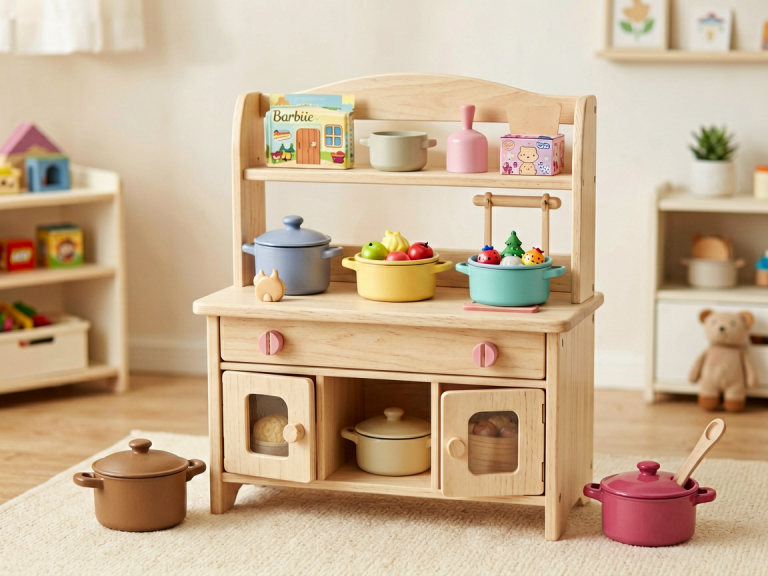
Role-playing toys—such as kitchen sets, doctor kits, tool benches, and dress-up costumes—are among the most effective for language development because they simulate real-world scenarios. When a child pretends to be a cashier, they inevitably use transactional language: “That will be five dollars, please,” “Do you want a bag?” This mirrors authentic communication patterns. Similarly, pretending to be a teacher, a parent, or a superhero requires adopting different registers and vocabularies. A child playing “doctor” learns medical terms like stethoscope, thermometer, and prescription, while also practicing empathy through language: “Don’t worry, this will just pinch a little.” These toys also encourage dialogue between multiple players, fostering back-and-forth conversation. Teachers and parents can extend the benefits by introducing props that prompt new vocabularies—a menu for a restaurant play, a map for a travel agency, or a set of traffic signs for a car play. The more varied the scenarios, the richer the linguistic input.
Digital Toys and Apps: Balancing Screen Time with Language Growth
In the modern era, digital toys and educational apps have become unavoidable. While concerns about excessive screen time are valid, well-designed digital tools can complement physical toys in building language. Apps that focus on storytelling, vocabulary games, or interactive reading—such as “Epic!” or “Endless Reader”—use animations and audio feedback to engage children. Some apps allow children to record their own voices and listen back, which improves pronunciation and self-monitoring. However, the crucial factor is interactivity; passive video watching does not support language development as effectively as apps that require active responses. Parents should also co-view or co-play with children, discussing what happens on screen and relating it to real life. The best digital toys for language are those that encourage creation rather than consumption—for instance, apps where children build their own stories by selecting characters, settings, and dialogues. When used in moderation, digital toys can be a valuable supplement, especially for children who are motivated by technology.
Practical Tips for Parents and Educators
To maximize the language-building potential of toys, consider the following strategies: First, rotate toys regularly to maintain novelty and expose children to diverse vocabularies. A static toy collection loses its educational value over time. Second, engage in “parallel talk” and “self-talk” while playing with your child. For example, if you are building a tower, say, “I am placing this blue block on top of the red one because it is heavier.” This models descriptive language and causal reasoning. Third, ask open-ended questions that require more than a yes/no answer: “How did you decide to arrange the animals that way?” or “What would happen if the prince didn’t find the castle?” Fourth, combine toys with books. If a child enjoys playing with dinosaur figures, read a book about dinosaurs together, then act out the concepts. This cross-modal learning deepens understanding. Finally, don’t underestimate the value of simple, open-ended toys like balls, puppets, and art supplies. The best language-building toy is often the one that sparks conversation—and that can be anything from a cardboard box to a set of colorful scarves.
Conclusion
Toys are far more than playthings; they are the unsung heroes of language development in elementary school children. From building vocabulary through themed sets, to fostering narrative skills with construction toys, to encouraging social communication through group games, the right toys transform play into a vibrant language laboratory. By choosing toys that require interaction, imagination, and collaboration, parents and educators can create rich linguistic environments where children grow not only as speakers but as confident communicators. The next time you hand a child a toy, remember: you are also handing them a tool for building sentences, stories, and connections. And that is a gift that lasts a lifetime.