Building Young Minds: Play Activities That Foster Critical Thinking in Babies
Introduction
Critical thinking is often associated with older children, adolescents, and adults — the ability to analyze, evaluate, and synthesize information logically. However, its foundations are laid much earlier, even in infancy. From the moment babies are born, they are natural explorers, driven by curiosity to understand the world around them. Every rattle they shake, every block they topple, and every finger they examine is an act of inquiry. Through carefully designed play activities, parents and caregivers can nurture this innate curiosity and help babies develop the cognitive tools that underpin critical thinking: cause-and-effect reasoning, problem-solving, pattern recognition, and decision-making. This article explores a range of age-appropriate play activities that specifically target these skills, offering practical guidance for infants from newborn to 24 months. Each activity is explained with the developmental science behind it, ensuring that play is not just fun but also deeply enriching.
—
1. Cause-and-Effect Toys: The First Lessons in Logic
1.1 Why Cause-and-Effect Matters
Critical thinking begins with the simplest of realizations: “If I do this, then that happens.” This understanding — cause and effect — is the bedrock of logical reasoning. For babies, discovering that their actions produce predictable outcomes helps them build mental models of how the world operates.
1.2 Recommended Activities
- The Rattle Game. Even from 3 months, a rattle is more than a noise-maker. When a baby shakes it and hears a sound, they quickly learn that their movement causes the noise. To deepen this, use two different rattles (one loud, one soft) and encourage the baby to shake each. Pause and observe: Do they shake the loud one harder? Do they seem puzzled when no sound comes? This tiny experiment teaches comparison and prediction.
- Drop-and-Retrieve. Around 6–9 months, babies become fascinated with dropping objects. Place a soft block in their hand and let them drop it from their highchair tray. Then, retrieve it and hand it back. Repeat. Next, try dropping a spoon versus a crinkle toy. The different sounds and movements help the baby differentiate causes (the object dropped) and effects (thud vs. rustle).
- Simple Switches and Buttons. For older babies (12–18 months), toys with buttons that activate lights or music are excellent. Point to the button, say “push,” and watch the reaction. Then cover the button with your hand — does the baby try to move your hand? That is a sign they are forming a mental cause-and-effect chain.
—
2. Object Permanence Games: Building Memory and Anticipation
2.1 The Cognitive Leap
Object permanence — understanding that objects continue to exist even when out of sight — is a major milestone in cognitive development, typically emerging around 8–10 months. This concept is directly tied to critical thinking because it allows babies to hold mental representations and anticipate outcomes.
2.2 Recommended Activities
- Peek-a-Boo Variations. Classic peek-a-boo is powerful. To enhance it, use a thin cloth and hide a small toy underneath. Lift the cloth, say “There it is!” then cover it again. Wait a few seconds before lifting. Does the baby reach for the cloth? Do they pull it off themselves? These actions demonstrate that they are actively predicting where the toy will reappear.
- Three-Cup Hide and Seek. For toddlers (18–24 months), use three identical cups and a small ball. Place the ball under one cup while the baby watches. Shuffle the cups slowly (or not at all, if they are very young). Ask, “Where is the ball?” Encourage them to point or lift the cup. This introduces basic logic: the ball is under one cup, not the others.
- Disappearing Treat. Place a favorite snack (e.g., a puff) under an opaque bowl. Let the baby see you do it. Then slide the bowl slightly to the side — does the baby look at the original spot or follow the bowl? Following the bowl indicates understanding that the object moves with its container.
—
3. Sorting and Matching: The Roots of Categorization
3.1 Developing Analysis Skills
Categorization is a fundamental critical-thinking skill. Babies who learn to sort objects by color, shape, or size are essentially performing the early steps of data analysis. They must observe attributes, compare them, and group like items.
3.2 Recommended Activities
- Color Bowls. Provide two bowls — one red, one blue — and a handful of red and blue blocks. Show the baby how to place red blocks in the red bowl and blue in the blue. Initially, they may simply dump all blocks in one bowl. Model the action slowly; eventually, they will start placing them correctly. Celebrate each success.
- Shape Sorter Adaptations. Traditional shape sorters are excellent, but for a twist, remove the lid and let the baby try to push a square peg into a round hole. They will encounter resistance — a perfect opportunity for problem-solving. Watch their facial expressions: frustration, then curiosity, then a new attempt. That is critical thinking in action.
- Texture Matching. Gather three pairs of textured fabrics (felt, silk, corduroy). Let the baby feel two pieces that are the same and one that is different. Talk about “soft” and “rough.” Older babies can be encouraged to find the matching pair by touch alone. This strengthens sensory discrimination, a precursor to analytical thinking.
—
4. Problem-Solving Through Simple Obstacles
4.1 Encouraging Persistence and Strategy
Problem-solving is the heart of critical thinking. Babies face small “problems” every day — reaching a toy, opening a container, fitting one object inside another. Deliberately setting up low-stakes challenges empowers them to experiment with solutions.
4.2 Recommended Activities
- The Tummy Time Challenge. For newborns (2–4 months), place a favorite toy just out of reach during tummy time. The baby will wiggle, reach, and possibly cry. Instead of handing it over immediately, encourage them by saying “Almost! Try a little more.” When they finally grasp it, their brain registers: “My effort led to success.” This is early critical-thinking: evaluating distance and motor planning.
- Blanket Pull Toy. Tie a string to a soft toy and place the toy on a blanket, just out of the baby’s reach (6–12 months). The baby sees the toy but cannot grasp it directly. Show them how to pull the blanket using the string. Then, let them try. They may pull the string, then the blanket, and eventually the toy — a multi-step solution.
- Lids and Containers. Provide a small plastic container with a loose lid. Put a few cheerios inside. The baby must figure out how to remove the lid to get the treat. If they struggle, model the twisting motion once, then let them imitate. This teaches trial-and-error and persistence.
—
5. Imitation and Pretend Play: The Birth of Hypothesis Testing
5.1 Why Pretend Play is Logical
By the second year, babies begin to engage in simple pretend play — feeding a doll, talking on a toy phone, or stirring an empty pot. This is not mere fantasy; it is a form of hypothesis testing. The baby is asking, “What happens if I act like Mommy?” and then observing the result. This “what-if” thinking is a key critical-thinking process.
5.2 Recommended Activities
- Toy Phone Conversations. Hold a toy phone to your ear and say, “Hello! Yes, I’ll have lunch.” Then hand the phone to your baby. Do they bring it to their ear? Do they babble? Encourage them. Later, introduce a second phone — you talk into yours, they listen. This back-and-forth mimics dialogue, teaching turn-taking and logic of conversation.
- Feed the Stuffed Animal. Gather a stuffed bear, a spoon, and an empty bowl. Pretend to scoop food and feed the bear, saying “Yummy!” Then, give the spoon to your baby. Let them feed the bear. Then pretend the bear is crying — what will your baby do? They might try to comfort or feed more. This shows they understand the cause (hunger) and effect (feeding soothes).
- Hide-and-Seek with a Doll. Hide a small doll under a blanket and say, “Where’s Dolly?” Peek under, exclaim “Found her!” Then hide it again but in a different location. Your baby will start searching the new spot, demonstrating that they remember past outcomes and adjust their strategy — a clear sign of critical thinking.
—
6. Language-Rich Play: Naming, Questioning, and Reasoning
6.1 Verbal Scaffolding
Language and critical thinking are deeply intertwined. When caregivers narrate actions, ask open-ended questions, and offer choices, they help babies form mental connections. Even pre-verbal infants benefit from hearing their experiences labeled.
6.2 Recommended Activities
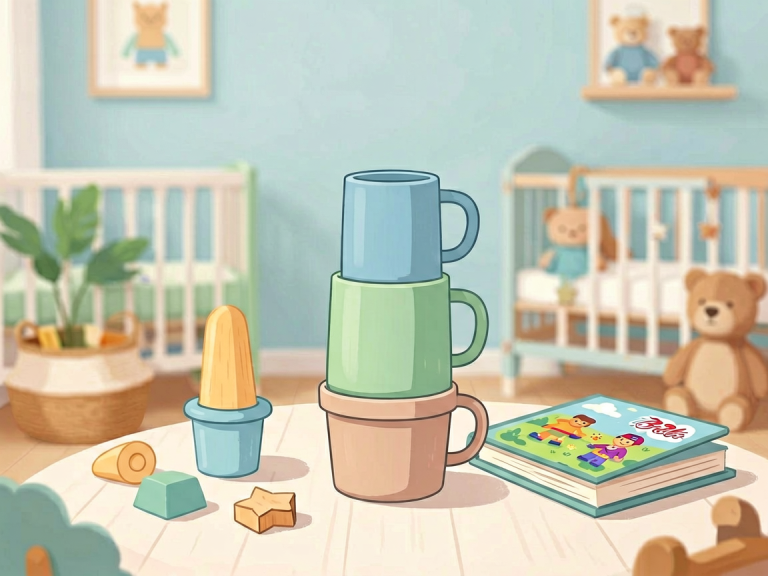
- Narration During Play. While playing with stacking cups, say: “You put the small cup inside the big cup. Now the big cup is full. Let’s take it out. Oh, it’s empty again!” This verbal mapping of events reinforces cause-and-effect and sequencing.
- Choice Giving. Put two toys in front of an 8-month-old and ask, “Do you want the ball or the book?” Point to each. When they reach for one, label it: “You chose the ball!” This builds decision-making and self-awareness.
- Simple Why Questions (for toddlers 18–24 months). Even if they cannot answer, ask “Why did the block fall?” or “Why is the cat hiding?” Pause and look curious. Then provide a simple answer: “Because you pushed it off the table.” Over time, they will start offering their own explanations, moving from observation to simple reasoning.
—
Conclusion
Critical thinking is not a skill that suddenly appears in school — it is cultivated from the very first smiles and coos. By turning everyday play into deliberate learning opportunities, parents and caregivers can give babies the cognitive foundation they need to become curious, logical, and resilient thinkers. The activities described above — from rattles and peek-a-boo to shape sorters and pretend feeding — all share one essential element: they invite the baby to ask, “What happens if…?” and then discover the answer themselves. As you engage in these playful moments, remember that the process is far more important than the product. Let your baby struggle a little, experiment freely, and celebrate each small breakthrough. In doing so, you are not just playing — you are building a mind that will question, analyze, and innovate for a lifetime.