Building Blocks of the Mind: Play Activities That Foster Spatial Reasoning in Babies
Introduction
From the moment they enter the world, babies are natural explorers. They gaze at ceiling fans, track moving faces, reach for dangling toys, and eventually learn to stack blocks, fit shapes into holes, and crawl through tunnels. These seemingly simple acts are, in fact, profound cognitive workouts. At the heart of many of these early interactions lies a crucial mental skill: spatial reasoning. Spatial reasoning—the ability to understand, manipulate, and mentally rotate objects in two and three dimensions—is a foundational pillar of mathematical thinking, scientific problem-solving, and even artistic creativity. For decades, researchers have emphasized that early spatial experiences predict later STEM achievement more reliably than early verbal skills. Yet many parents and caregivers are unsure how to deliberately cultivate this ability in their youngest children. The good news is that babies are born with the raw neural machinery for spatial processing, and the right play activities can dramatically strengthen those connections. This article explores the science behind spatial reasoning in infancy and provides a comprehensive, evidence-based guide to play activities that build this essential skill, from birth through the toddler years.
The Science of Spatial Thinking in Infancy
To appreciate why certain play activities are effective, we must first understand how a baby’s brain builds spatial knowledge. Spatial reasoning is not a single ability but a cluster of interrelated competencies, including spatial visualization, mental rotation, spatial perception, and spatial memory. In the first year of life, babies undergo a remarkable transformation from being passive perceivers of a blurry world to active agents who can anticipate where a rolling ball will stop.
Neonates possess rudimentary spatial abilities. Within days of birth, they can discriminate between different orientations of lines and shapes. By four months, infants demonstrate object permanence—the understanding that an object continues to exist even when hidden. This is a critical spatial milestone because it requires the baby to maintain a mental representation of an object’s location. As babies begin to reach and grasp around five or six months, they start to understand the relationship between their own body and objects in space—a concept known as egocentric spatial coding. Later, around nine to twelve months, they develop allocentric coding, which allows them to understand spatial relationships between objects independent of their own viewpoint.
Neuroimaging studies show that the parietal cortex, particularly the region around the intraparietal sulcus, is heavily involved in spatial processing. This area matures rapidly during infancy, and its development is heavily influenced by experience. When a baby manipulates objects, crawls through different environments, or watches a parent stack blocks, the brain’s spatial circuits are exercised. The more varied and challenging these experiences, the more robust the neural networks become. This phenomenon, known as experience-dependent plasticity, means that the play activities we choose for our babies can literally shape the architecture of their developing brains.
Age-Specific Play Activities for Spatial Reasoning
Play is the work of childhood, and for babies, play is the primary vehicle for cognitive development. Below, I outline developmentally appropriate activities organized by age range, each designed to target specific spatial skills.
0–6 Months: Laying the Groundwork with Visual and Tactile Exploration
Even before a baby can sit up or grasp objects intentionally, their spatial world is rich with information. At this stage, the goal is to provide visual contrast, varied textures, and opportunities for tracking and reaching.
High-Contrast Visual Stimuli: Newborns see best with high-contrast patterns (black and white, bold stripes, checkerboards). Hanging a mobile with contrasting geometric shapes—spirals, concentric circles, or triangular prisms—over the crib encourages visual tracking. As the mobile rotates or moves with a gentle breeze, the baby practices following moving objects, a skill known as visual pursuit, which is a prerequisite for later spatial prediction.
Tummy Time with Mirrors and Textured Mats: Tummy time strengthens neck and shoulder muscles, but it also offers spatial learning. Place a baby-safe mirror in front of the infant during tummy time. The baby sees their own reflection, which helps them understand the spatial relationship between their movements and the reflected image. Meanwhile, a textured mat with different raised patterns (bumps, ridges, soft fur, crinkly fabric) provides tactile spatial input. The baby learns that different surfaces occupy different positions relative to their body.
Reaching and Batting at Hanging Toys: When a baby lies on their back, hang a low-hanging toy (such as a ring of colorful plastic keys) just within reach. At first, the baby will swipe accidentally. Over time, they learn to coordinate vision and movement to make contact. This activity builds hand-eye coordination and the understanding that objects have a specific location in three-dimensional space. Change the toy’s position periodically to challenge the baby to adjust their reach.
6–12 Months: Active Manipulation and Object Relations
Once babies can sit unsupported and begin to crawl, their spatial world expands dramatically. They now have the ability to move toward objects, pick them up, and explore their properties.
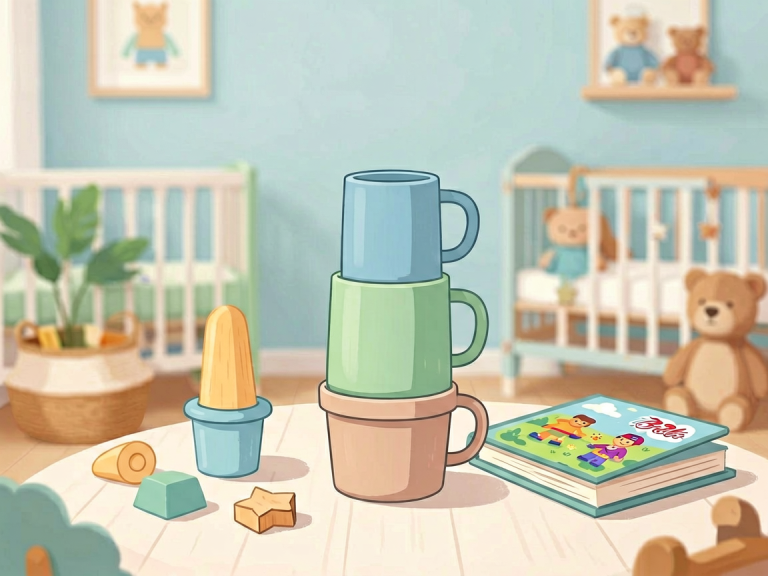
Stacking and Nesting Cups: This classic toy is a powerhouse for spatial reasoning. Provide a set of brightly colored cups that can be stacked into a tower or nested inside one another. As the baby tries to place a smaller cup inside a larger one, they must judge size, orientation, and depth. When they attempt to stack cups vertically, they learn about balance and the relationship between base and top. Initially, the baby may bang cups together or scatter them; that’s fine. With practice, they will begin to align cups correctly. Offer verbal commentary: “The big cup goes at the bottom. The little cup fits inside the big one.”
Shape Sorters: Around nine to ten months, many babies are ready for simple shape sorters. A classic shape sorter with a cube and three or four distinct shapes (circle, square, triangle) is ideal. The baby must rotate the shape in their hand to match the orientation of the hole. This is an early form of mental rotation—the ability to imagine how an object looks from a different angle. To make it easier, start with only one shape and introduce more gradually. Celebrate each successful insertion; the triumph reinforces the baby’s motivation to persist.
Crawling Through Tunnels and Over Pillows: Physical movement through space is perhaps the most powerful spatial learning tool. Create a simple obstacle course using pillows, cushions, and a play tunnel. As the baby crawls through a tunnel, they experience changes in perspective. They must judge how far to crawl before emerging, and they learn that the tunnel has an inside and an outside. When they crawl over a pillow, they gauge the incline and adjust their body position accordingly. This full-body engagement strengthens what researchers call “embodied spatial cognition”—the idea that our sense of space is rooted in bodily movement.
Object Permanence Box (or DIY Version): An object permanence box is a small wooden box with a hole on top and a removable tray on the front. When a baby drops a ball into the hole, it rolls out into the tray. This simple cause-and-effect mechanism reinforces the concept that objects continue to exist even when out of sight. Each time the baby retrieves the ball from the tray, they affirm the spatial relationship between the top hole and the exit point. You can make a DIY version with a shoebox: cut a hole in the lid and place a small toy inside. Let the baby open the lid to find the toy.
12–24 Months: Advanced Manipulation and Symbolic Play
As babies become toddlers, their spatial reasoning becomes more sophisticated. They can now solve simple puzzles, engage in pretend play, and understand spatial vocabulary.
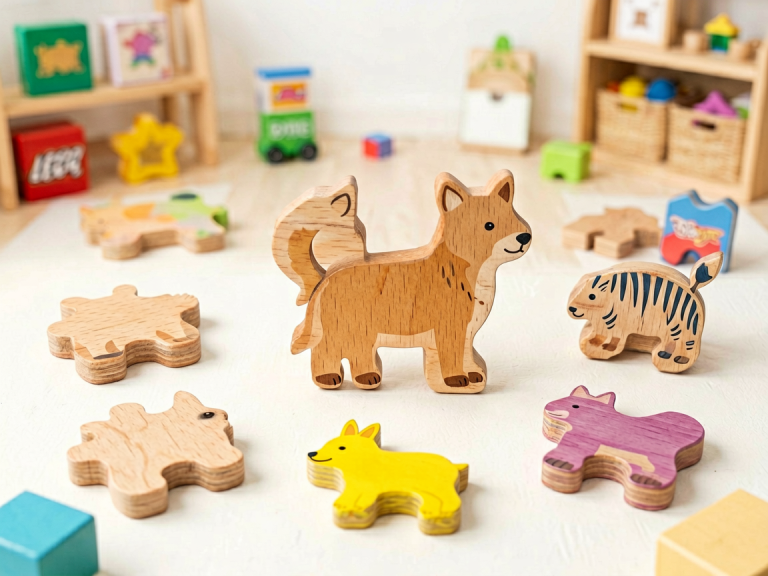
Simple Jigsaw Puzzles: Two- or three-piece puzzles with large knobs are excellent for 12- to 18-month-olds. The child must align the shape with the matching cutout, rotate it if necessary, and press it down. This requires spatial analysis of the shape’s contour and orientation. As the child progresses, introduce puzzles with more pieces (four to six) and different themes (animals, vehicles). Discuss the pieces’ positions: “The cow’s head goes at the top. The tail goes on the left side.”
Block Building and Construction: By 12 months, many babies can stack two blocks. By 18 months, they may build towers of four or five blocks. Provide a variety of blocks—wooden cubes, unit blocks, Duplo-style bricks, and foam blocks. Encourage open-ended building. Ask questions like, “Can you make a tower as tall as your arm?” or “Let’s build a bridge so the car can go under it.” Building activities develop spatial visualization (imagining the final structure) and spatial memory (remembering where each block was placed). It also introduces concepts like symmetry, balance, and proportion.
Matching and Sorting Games: While not strictly spatial, sorting objects by size, shape, or color requires careful observation of spatial attributes. Provide a set of identical objects of varying sizes (e.g., three balls: small, medium, large) and three containers labeled accordingly. Ask the baby to put each ball in the correct container. This activity sharpens the ability to compare spatial dimensions. Similarly, sorting shape tiles into corresponding slots deepens the understanding of geometric properties.
Imaginative Play with Spatial Props: Around 18 months, pretend play begins. Provide a small toy kitchen set, a playhouse, or a dollhouse. As the child places toy furniture in the house, they are learning about spatial layout—a bed goes in the bedroom, a table in the dining room. This kind of symbolic spatial reasoning maps real-world relationships onto a miniature representation. You can also use large cardboard boxes to create forts or cars. The act of climbing inside a box, turning it over, or stacking multiple boxes teaches volume, containment, and perspective.
Parent-Facilitated Spatial Language
The activities themselves are only half the equation. How you talk about space matters immensely. Researchers have found that the amount of spatial language parents use predicts children’s later spatial abilities. Spatial language includes prepositions (in, on, under, between, above, below), comparative words (bigger, smaller, longer, shorter), and shape names (circle, square, triangle). When playing with your baby, narrate what is happening. For example, during block play: “You put the red block on top of the blue block. Now the tower is tall. Oh, it fell over! Let’s put the big block under the small block this time.” During crawling: “You are crawling through the tunnel. Now you are inside the tunnel. I can see your feet! Pop out the other side!”
Use gestures alongside words. Point to the location of objects. When you say “put the cup on the table,” gesture from the cup to the table. Babies’ brains integrate visual and auditory spatial information, so pairing words with gestures reinforces learning. Also, ask questions that require spatial reasoning: “Where is the ball? Is it under the blanket or behind the pillow?” Even if the baby cannot answer verbally, they may point or look toward the correct location.
The Role of Music, Movement, and Outdoor Play
Spatial reasoning is not limited to manipulating objects indoors. Activities that involve whole-body movement and navigation also strengthen spatial skills.
Dance and Movement Games: Simple songs like “The Wheels on the Bus” involve spatial concepts: “Round and round” (circular motion), “Up and down” (vertical direction), and “Open and shut” (containment). Holding your baby and gently swaying left and right, or lifting them up and down, provides vestibular input that enhances spatial awareness. As the baby becomes more mobile, play “Simon Says” with spatial commands: “Stomp your feet on the floor” or “Put your hands above your head.”
Outdoor Exploration: Taking a baby outside offers a drastically different spatial environment. Point out trees, birds, clouds, and cars. Let the baby crawl on grass, sand, or pavement. The uneven terrain forces the baby to constantly adjust their balance, which fine-tunes their sense of spatial orientation. Walk along a path and talk about distances: “We are going across the bridge. The bridge goes over the water. Now we are under the big tree.” These real-world experiences ground abstract spatial concepts in concrete, memorable contexts.
Water and Sand Play: At the water table or sandbox, babies scoop, pour, and fill. Filling a cup with sand and dumping it into a bucket teaches volume estimation. Pouring water from a small container into a larger one helps the child understand conservation of volume and the concept of “more” and “less” in spatial terms. Provide different-sized scoops, funnels, and molds to encourage experimentation.
Conclusion
Spatial reasoning is not an innate gift that some babies have and others lack; it is a skill that can be nurtured through deliberate, playful interaction. From the high-contrast mobiles of the newborn nursery to the intricate block towers of the toddler playroom, every moment of play can be an opportunity to strengthen the neural circuits that underpin spatial thinking. The activities outlined in this article are simple, inexpensive, and deeply enjoyable. They require no specialized training—only a parent’s presence, patience, and a willingness to follow the baby’s lead.
The benefits extend far beyond early childhood. Children who develop strong spatial reasoning in their first two years are more likely to excel in mathematics, engineering, and the sciences later in life. They are also better at everyday tasks, such as reading maps, assembling furniture, or parking a car. But perhaps the most beautiful aspect of spatial play is the bond it creates. When you sit on the floor with your baby, stacking blocks and naming shapes, you are not just building a cognitive foundation; you are building a relationship. You are teaching your baby that the world is a fascinating place, full of patterns and possibilities, and that every object—from a squishy ball to a cardboard box—holds a secret waiting to be discovered through the magic of play. So go ahead, empty the cabinet and hand your baby the plastic containers. Let them fill, dump, stack, and scatter. In those moments of joyful chaos, a mind is being built, block by spatial block.