Boosting Language Through Play: Creative Ideas for Toddler Boys
Introduction: Why Play and Language Go Hand in Hand
Toddlerhood is a magical window of rapid brain development, particularly in the area of language acquisition. For parents and caregivers of toddler boys, finding the right balance between energetic, hands-on play and meaningful verbal interaction can feel like a challenge. Boys at this age often gravitate toward physical, noisy, and exploratory activities, which sometimes leads adults to assume that quiet, structured language lessons are more effective. In reality, the opposite is true: the most powerful language learning happens when a child is fully engaged, moving, and having fun. Play is not just a break from learning—it is the primary vehicle through which toddlers make sense of the world, build vocabulary, practice sentence structure, and develop social communication skills.
This article presents a range of play ideas specifically designed for toddler boys, each with a clear explanation of how it supports language development. Whether your little one loves trucks, animals, building blocks, or pretend kitchen play, you will find practical strategies to turn everyday playtime into a rich linguistic experience. The key is to follow your child’s interests, model language naturally, and create opportunities for him to hear, imitate, and eventually initiate words and phrases.
1. Transportation Adventures: Trucks, Trains, and Cars
1.1 Setting Up a Sensory Roadway
Toddler boys often have an inexplicable passion for anything with wheels. You can harness this enthusiasm by creating a simple indoor or outdoor road system. Use masking tape to mark roads on the floor, or set up a plastic track with ramps and tunnels. As your child pushes his cars or trucks along the track, narrate his actions in short, clear sentences: “The red truck is going fast. Vroom, vroom! Now it stops at the bridge.” Pause after your description to give him a chance to repeat a sound or word. For example, you might say, “The truck says…?” and wait expectantly. Even if he only says “vroom,” you have just modeled turn-taking and sound imitation.
1.2 Expanding Vocabulary with Descriptive Language
Instead of simply naming the vehicles, add adjectives and prepositions. “The big blue truck is under the tunnel.” “The tiny yellow car is on top of the ramp.” Use exaggerated intonation to emphasize new words. You can also introduce action verbs specifically related to transportation: “push,” “roll,” “crash,” “zoom,” “load,” and “dump.” For example, when playing with a dump truck, scoop up small blocks and say, “I am loading the rocks. Now I dump them out! Dump!” Repeat these verbs frequently, and soon your toddler will attempt to say them during play. This process of associating words with physical actions solidifies both comprehension and expression.
1.3 Interactive Sound and Word Games
Turn transportation play into a call-and-response game. Make a sound like “beep beep” and encourage your child to mimic it. Then introduce simple phrases like “car goes beep” or “train goes choo-choo.” For older toddlers (around 2.5 years), you can ask open-ended questions: “Where is the truck going?” If he doesn’t answer, provide a model: “Maybe it’s going to the store. Let’s drive to the store.” Over time, he will start to supply his own destinations. This builds narrative thinking and the ability to construct simple sentences.
2. Construction Zone: Blocks, Tools, and Engineering Play
2.1 Building Vocabulary with Blocks and Containers
Toddler boys often love stacking blocks, knocking them down, and filling containers. Use this classic play to teach words related to size, shape, and spatial relationships. As you build together, describe what you are doing: “I am putting the big block on top of the small block. Now it is tall. Uh-oh, it fell down! Crash!” Emphasize opposites: “up” vs. “down,” “big” vs. “little,” “full” vs. “empty,” “on” vs. “off.” You can also involve simple counting: “One block, two blocks, three blocks!” Even if your toddler cannot count, hearing the numbers in context builds pre-math vocabulary and rhythm.
2.2 Pretend Tool Play for Language Richness
Many toddler boys are fascinated by pretend tools—plastic hammers, screwdrivers, wrenches, and saws. This is a fantastic opportunity for language modeling because it naturally involves action words and object names. Sit on the floor with a toy toolbox and say, “I need to fix the chair. I will hammer this nail. Bang, bang, bang! Now I need the screwdriver. Twist, twist, twist.” Ask your child to hand you specific tools: “Please give me the hammer.” If he doesn’t understand, point and repeat. Over time, he will learn the names of each tool and the verbs associated with them. This also teaches the important social skill of following simple directions.
2.3 Problem-Solving Language Through Construction
When building with blocks or connectors, introduce language that involves problem-solving. For example, if a tower keeps falling, say, “Oh no, it fell! Why did it fall? Maybe the bottom block is too small. Let’s try a big block at the bottom.” This exposes your toddler to causal language: “because,” “so,” “if…then.” These are advanced grammatical structures, but hearing them in context at an early age lays the foundation for later sentence complexity. Even if he cannot respond, he is absorbing the rhythm and logic of cause and effect.
3. Animal Antics: Pretend Play with Stuffed Animals and Figurines
3.1 Animal Sounds and Action Verbs
Toddler boys often enjoy animals, especially dinosaurs, farm animals, and wild creatures. Gather a collection of animal figurines or stuffed toys and act out simple stories. Start by making animal sounds together: “The cow says moo.” “The lion says roar.” Then expand to action verbs: “The cow is eating grass. The lion is sleeping. The frog is jumping.” Use exaggerated movements to accompany the words—hop like a frog, roar like a lion. This multisensory approach helps language stick because it connects words with physical experience.
3.2 Building Simple Narratives
As your child becomes more verbal, encourage him to participate in building a story. Set up a small farm or jungle scene and ask, “What is the elephant doing?” If he points or makes a sound, you can expand on his attempt: “Yes, the elephant is spraying water with its trunk! Splash, splash!” Over time, introduce more complex elements like feelings: “The puppy is sad because he lost his bone. Can you help him find it?” This type of pretend play naturally requires dialogue and turn-taking, both of which are foundational for conversational skills.
3.3 Interactive Books and Animal Role-Play
Combine animal play with picture books. Read a simple board book about animals, then act out the scenes. For instance, after reading *Brown Bear, Brown Bear, What Do You See?*, take turns being the brown bear and the teacher. Say, “Brown bear, brown bear, what do you see? I see a red bird looking at me!” Then encourage your toddler to find a red bird figurine or point to the picture. This bridges the gap between hearing language in a book and using it in live play. It also teaches the concept of questions and answers.
4. Messy Play: Sensory Bins and Outdoor Exploration
4.1 The Language of Textures and Actions
Toddler boys are often drawn to messy, hands-on sensory play—digging in sand, pouring water, squishing playdough, or splashing in mud. While this may seem purely physical, it is a goldmine for vocabulary development. As your child plays in a sensory bin filled with rice or sand, describe what he is doing using specific adjectives: “That rice feels dry and crunchy. Now you are pouring it. It is falling down. The bucket is empty. Let’s fill it up!” For water play: “The water is wet and cold. You are squeezing the sponge. Drip, drip, drip.” Each new texture and action introduces a new word, and because the experience is vivid, the word will be remembered.
4.2 Science Talk for Toddlers
Even with a one-year-old, you can use basic science vocabulary. While playing with a funnel in the sandbox, say, “The sand goes in the top and comes out the bottom. That’s because of gravity.” He won’t understand the concept, but he will hear the word and begin to associate it with the action. For older toddlers (around 2.5 to 3), you can ask simple “what happens if” questions: “What happens if we add water to the sand? It becomes sticky. We can make mud pies!” This encourages prediction and reasoning, which are higher-level language skills.
4.3 Outdoor Scavenger Hunts
Take the messiness outdoors. Go on a nature walk and collect leaves, sticks, rocks, and flowers. At home, spread them out on a tray and talk about them: “This leaf is green and smooth. This rock is gray and bumpy. Let’s count the sticks—one, two, three.” You can also play “I spy” with simple descriptors: “I spy something brown and rough. Can you find it?” This game builds listening comprehension and descriptive vocabulary. For a toddler boy who loves to run, turn the hunt into a movement game: “Run to the tree! Find a big stick! Bring it back to me!”
5. Active Games: Run, Jump, and Obey Commands
5.1 Simon Says with Simple Words
Toddler boys have abundant energy, and language learning does not have to be sedentary. Play “Simon Says” with very simple commands appropriate for a 1- to 3-year-old: “Simon says touch your nose. Simon says clap your hands. Simon says jump up and down.” Omit the “Simon says” sometimes to make it a listening challenge. This game not only teaches body parts and action verbs but also improves auditory processing and the ability to follow multistep directions. As your child gets better, add sequences: “Simon says touch your head, then spin around.”
5.2 Obstacle Course Language
Set up a simple obstacle course in your living room or backyard using pillows, tunnels, chairs, and cushions. Guide your child through it using directional language: “Crawl through the tunnel. Now climb over the pillow. Now walk around the chair. Stop at the red mat.” Use prepositions repeatedly: “under,” “over,” “through,” “around,” “in front of,” “behind.” Each time your child performs the action while hearing the word, the connection strengthens. You can also have him give *you* directions: “Where should I go? Under the table? Okay, I am going under the table.” This empowers him to produce language in a fun context.
5.3 Musical Movement and Rhythm
Music is a powerful language tool. Sing action songs like “Head, Shoulders, Knees, and Toes,” “The Wheels on the Bus,” or “If You’re Happy and You Know It.” These songs combine rhythm, vocabulary, and movement. For toddler boys who may be reluctant singers, encourage them to just do the actions while you sing. Over time, they will start to mouth the words. You can also incorporate simple instruments—shakers, drums, bells—and teach words like “loud,” “soft,” “fast,” “slow.” This builds an understanding of dynamics and tempo, which are early literacy concepts related to fluency and expression.
6. Pretend Play: Kitchen, Doctor, and Firefighter
6.1 Cooking and Kitchen Play
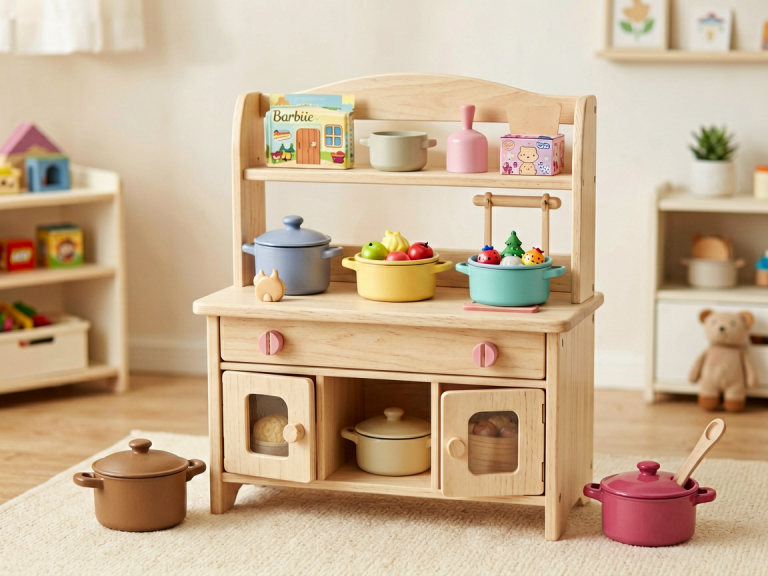
Many toddler boys enjoy pretend cooking, especially if they see a parent in the kitchen. Provide a play kitchen with pots, pans, plastic food, and utensils. Model the language of cooking: “I am stirring the soup. It is hot. Be careful! Now I am pouring the juice into a cup.” Include words for quantities: “one scoop of flour, two scoops of sugar.” Use social phrases: “Would you like some cake? Here you go. Yummy!” This type of play naturally includes turn-taking, requesting, and offering—all essential for conversational development.
6.2 Doctor and Veterinarian Play
A doctor kit is a classic for language building. Your toddler can check a stuffed animal’s temperature, give it a shot, or put on a bandage. Use phrases like: “Let me check your heart. I hear a lub-dub. You are healthy! Now I need to give you a shot. It will be quick. All done, good boy!” This play introduces medical vocabulary and also teaches empathy and caregiving language. If your toddler is the doctor, ask him, “What should I do? Is my bear sick? Where does it hurt?” Encourage him to point or say simple words like “head” or “belly.”
6.3 Firefighter and Rescue Scenarios
Toddler boys often love dressing up as firefighters, police officers, or superheroes. Use this to create rescue scenarios. Set up a small block tower and pretend it is on fire. Your child can use a toy hose to “spray” the fire. Narrate: “Emergency! There is a fire! The firefighter is coming. Turn on the water! Whoosh! The fire is out! Good job!” This play incorporates exclamations, action verbs, and problem-solving language. You can also introduce emergency vocabulary like “help,” “danger,” “safe,” and “rescue.” The dramatic play demands communication, whether it’s simple sounds or more complex sentences.
Conclusion: Consistency, Patience, and Joy
Language development in toddler boys does not require flashcards, worksheets, or formal lessons. It happens naturally when play is rich, interactive, and responsive to the child’s interests. By intentionally describing actions, asking open-ended questions, modeling new words, and creating opportunities for your child to respond, you can transform everyday play into a powerful language-learning environment. Remember that every child develops at his own pace—some toddlers are early talkers, while others are more focused on motor skills and take a little longer to speak. The key is to keep the interactions positive, playful, and pressure-free. Celebrate each new word, even if it’s not perfectly pronounced. Encourage imitation but never force it. Over time, your toddler boy will not only learn to communicate but will also associate language with joy, connection, and discovery. So get down on the floor, grab a truck, a block, or a stuffed lion, and start talking—he is listening, learning, and loving every minute of it.