Playful Pathways: Engaging Activities to Boost Baby’s Hand-Eye Coordination
Hand-eye coordination is one of the most fundamental skills a baby develops during the first years of life. It involves the synchronization of visual input with motor output—essentially, the ability to use what the eyes see to guide the hands. This skill underpins everything from feeding oneself and scribbling with a crayon to catching a ball and eventually writing. While babies are born with a primitive grasp and some visual tracking ability, true coordinated movement emerges through repeated, playful experiences. The good news is that parents and caregivers can actively support this development without expensive toys or formal lessons. Everyday play, when designed with intention, becomes a powerful tool for building neural pathways. This article explores a range of play activities, organized by developmental stage, that specifically target hand-eye coordination in babies, offering both scientific rationale and practical guidance.
The Science Behind Hand-Eye Coordination in Infants
Before diving into specific activities, it is helpful to understand why hand-eye coordination matters and how it evolves. During infancy, the brain is exceptionally plastic, meaning it adapts quickly to stimuli and experiences. The visual system and the motor cortex are not yet fully connected; they need practice to communicate efficiently. When a baby sees a rattle and reaches for it, multiple brain regions fire simultaneously: the occipital lobe processes the image, the parietal lobe integrates spatial information, and the frontal lobe plans the movement. Each successful grasp strengthens these synapses. Research shows that babies who engage in varied, goal-directed reaching activities show faster development of fine motor skills and even cognitive flexibility later on. Because babies learn through repetition and sensory feedback, play activities that encourage reaching, grasping, shaking, and transferring objects are invaluable. The key is to match the activity to the baby’s current abilities—challenging enough to be engaging, but not so difficult that it causes frustration.
Play Activities for Newborns (0–3 Months): Laying the Foundation
At birth, babies have very limited hand control. Their hands are often fisted, and they may swat randomly at objects. However, their eyes are already capable of tracking slow-moving targets. The first three months are about awakening visual attention and introducing the concept of cause and effect.
Visual Tracking with High-Contrast Objects
Newborns prefer high-contrast patterns—black and white, bold stripes, or checkerboards—because their retinal cones are not fully mature. Hold a black-and-white picture card about 8–12 inches from your baby’s face and slowly move it from side to side. As your baby’s eyes follow the card, they are practicing smooth pursuit, a precursor to coordinated reaching. When the movement stops, the baby may make a swiping motion with their hand. Even if they miss, the attempt links visual attention to hand motion. Repeat this for one to two minutes several times a day.
Gentle Hand-to-Eye Touch
While your baby is lying on their back, bring a soft, lightweight toy (like a crinkly fabric square) gently toward their hand. Let it brush their fingers. Many newborns will instinctively open their hand or try to grab. This tactile stimulation combined with visual focus teaches the brain that what the eyes see can be felt. You can also dangle a small, brightly colored ring above their chest—not quite in reach—and watch as they bat at it with increasing intention over the weeks.
Mirror Play
Place an unbreakable mirror on the floor or crib rail where your baby can see their reflection. Babies are fascinated by faces, especially their own. They will stare, then eventually try to touch the “other baby.” This activity encourages them to bring their hands toward the visual target—their own image—thereby merging vision and movement. Keep sessions short and always supervise.
Play Activities for 3–6 Months: The Age of Reaching
Between three and six months, babies begin to intentionally reach for objects. Their grasp is still clumsy (palmar grasp), but they are learning to coordinate both hands. This is a critical window for strengthening the neural loop.
Rattle Shake and Transfer
Offer a lightweight rattle with a handle that fits easily in a tiny palm. Show your baby how to shake it, then place it in their hand. As they shake, the sound reinforces the visual-motor connection—they see the rattle move and hear the noise. Once they are comfortable holding it, gently encourage them to pass it from one hand to the other. This bilateral transfer is a complex milestone; to support it, hold the rattle near their midline and let them grab it with one hand, then tap it against the other hand. Over weeks, they will learn to release and regrasp.
Hanging Toys on a Play Gym
A play gym with dangling toys is a classic for good reason. Position your baby on their back under an arch with low-hanging toys (soft animals, plastic rings, or sensory tags). Initially they will bat randomly, but as their depth perception improves, they will aim more precisely. To maximize the benefit, vary the heights and textures of the toys. When your baby successfully grabs one, celebrate! The positive feedback encourages repetition.
Water Play (Supervised)
Fill a shallow basin with warm water and place a few floating toys (like rubber ducks or foam shapes) within reach. Sit your baby in a supportive seat or on your lap. The water adds resistance and unpredictability, making the reach more challenging. As they try to grasp a floating duck, their eyes must constantly adjust to the moving target. This dynamic activity dramatically improves tracking and grasping in tandem. Always use warm, not hot, water and never leave a baby unattended.
Play Activities for 6–9 Months: Refining Grasp and Precision
Now babies can sit independently, freeing both hands. They develop a pincer grasp around 8 or 9 months—the ability to pick up small objects between thumb and forefinger. This is a major leap for hand-eye coordination.
Pom-Pom Drop
Take an empty cardboard tube (from a paper towel roll) and a small bowl of colorful pom-poms. Hold the tube upright while your baby drops a pom-pom inside. The pom-pom disappears and then falls out the bottom. Your baby must visually track the pom-pom, then coordinate their hand to release it at the right angle. This activity requires precise timing. Once they master dropping, try having them pick up a pom-pom from a flat surface using their thumb and finger—a perfect pincer practice.
Stacking Cups
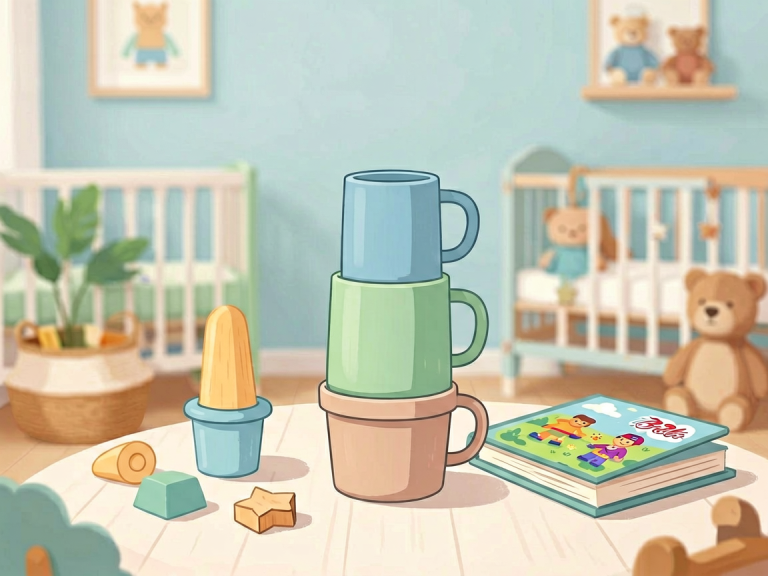
Stacking cups are incredibly versatile. Start by letting your baby knock down a tower you build (fun and motivating). Then, show them how to place one cup inside another. The act of aligning the cup’s opening with the base of another requires excellent hand-eye coordination. As they get better, encourage them to stack two or three cups vertically. Each successful stack reinforces spatial reasoning and fine motor control.
Feeding Finger Foods
Around 7–8 months, introduce small, safe finger foods such as puffs, soft peas, or steamed carrot sticks. Place a few on their high-chair tray. The baby must look at the food, reach for it, judge its size, and bring it to their mouth. This is arguably the most natural hand-eye coordination activity. Let them self-feed, even if messy. The repetition of hundreds of tiny reaches per meal builds neural connections rapidly. Offer a variety of shapes and textures to keep the challenge fresh.
Play Activities for 9–12 Months: Problem Solving and Tool Use
As babies approach their first birthday, they become more intentional and can solve simple problems. They begin to use objects as tools—for example, a stick to move a toy or a spoon to scoop. Hand-eye coordination now integrates with planning.
Ball Rolling and Catching
Sit facing your baby with legs apart, and roll a soft, lightweight ball back and forth. At first, your baby will just bat at it. Gradually, they learn to watch the ball’s trajectory, position their hands, and stop or catch it. This is a complex visual-motor sequence. To make it easier, use a brightly colored ball with a bell inside to engage auditory cues. For babies who are walking, try a slightly larger ball that they can kick or push—still requiring eye-foot coordination, which is closely related.
Puzzle Play with Pegs
Simple peg puzzles (wooden board with large knobs) are excellent. Show your baby how to lift the peg and place it back in its hole. The visual matching required—seeing the hole’s shape and positioning the peg—demands precise coordination. Start with just one or two pegs and gradually increase. When your baby succeeds, they experience a sense of accomplishment that motivates further practice.
Drawing with Crayons
At 10–12 months, babies can hold a chunky, non-toxic crayon and make marks on paper. Though scribbles are random, the act of looking at the paper while moving the hand is a direct hand-eye coordination practice. Tape the paper to a table so it doesn’t slide. Sit with your baby and make dots or lines, encouraging them to imitate. They may not copy precisely, but the visual feedback (seeing the line appear) reinforces the connection. This also lays the groundwork for later writing.
Play Activities for 12–18 Months (Toddlers): Building on the Foundation
Once babies walk, their world expands. Hand-eye coordination now involves complex sequences: throwing, catching, pouring, and using tools. These activities keep the skills advancing.
Pasta Threading
Take large, cooked pasta tubes (like ziti) and a piece of yarn with a tape-wrapped tip. Show your toddler how to thread the pasta onto the yarn. This requires them to align the hole of the pasta with the yarn end—a challenging fine motor task. It also strengthens bilateral coordination (one hand holds the pasta, the other holds the yarn). Start with just three or four pieces. You can later progress to dry cereal and a shoelace.
Pouring and Scooping
Set up a small water play station with two cups and a pitcher of water (or dry rice for less mess). Your toddler pours from the pitcher into a cup, then scoops the water back. They must watch the water level, control the angle of their arm, and stop before spilling. This is an advanced hand-eye activity that also teaches volume and cause-and-effect. Use small amounts to avoid frustration.
Obstacle Course
Create a simple indoor obstacle course using pillows, a cardboard box, and a few large balls. Have your toddler crawl over pillows, toss a ball into the box, and step over a low barrier. Each action requires them to visually assess distances and coordinate body movements. This full-body integration is crucial for overall development. Laugh and cheer to keep it fun.
Tips for Parents: Creating a Supportive Play Environment
While activities matter, the environment matters just as much. First, always follow your baby’s lead. If they turn away, they may be overstimulated or tired—stop and try later. Second, repetition is key. Babies need to practice the same motion dozens or hundreds of times before it becomes automatic. Do not replace toys too quickly; let them master each one. Third, talk to your baby during play. Narrating actions—“Look, you picked up the red ball!”—reinforces the connection between vision, action, and language. Fourth, ensure safety. Avoid small objects that pose a choking hazard (anything smaller than a ping-pong ball). Finally, embrace mess. Sensory play, including water, sand, and paint, offers rich feedback and forces the brain to adapt to changing conditions.
Conclusion
Building hand-eye coordination in babies is not about rushing milestones—it is about providing rich, loving opportunities for exploration. From the first blurry tracking of a black-and-white card to the proud victory of stacking a third cup, every playful moment wires the brain for future learning. The activities outlined here are simple, inexpensive, and adaptable to your baby’s unique pace. Remember that each baby develops differently; some may master the pincer grasp early, while others take longer. The key is consistency, patience, and joy. By weaving these playful pathways into your daily routine, you are not only enhancing hand-eye coordination but also nurturing a confident, curious, and capable little explorer. So grab a rattle, a pom-pom, or a ball, and let the play begin—one reach, one grasp, one victory at a time.