Building Blocks of Speech: How the Right Toys Can Boost Language Development in Preschool Boys
Introduction: The Crucial Window of Early Language
The preschool years—roughly ages three to five—represent one of the most dynamic periods of language development in a child’s life. During this stage, vocabulary expands from a few hundred words to several thousand, sentence structures become more complex, and the foundations for reading, writing, and social communication are laid. For preschool boys, who are sometimes stereotyped as being slower to speak or less verbally inclined than their female peers, the role of play in fostering language growth cannot be overstated. While every child develops at their own pace, research consistently shows that boys benefit enormously from targeted, engaging, and hands-on experiences that stimulate both receptive language (understanding) and expressive language (speaking). Toys, far from being mere distractions, serve as powerful tools for cognitive and linguistic scaffolding. The right toys can transform a quiet, action-oriented boy into a confident storyteller, a curious questioner, and an eager conversationalist. This article explores how specific types of toys can be strategically used to build language development in preschool boys, offering parents, caregivers, and educators practical, research-backed insights into selecting playthings that do more than entertain—they educate.
The Science Behind Play and Language: Why Toys Matter
To understand why toys are so effective for language development, we must first appreciate the neurobiological and psychological mechanisms at work. Language acquisition is not a passive process; it requires active engagement, social interaction, and repeated exposure to meaningful contexts. According to the sociocultural theory of Lev Vygotsky, language develops most robustly through social interaction within what he called the “zone of proximal development”—the gap between what a child can do alone and what they can achieve with guidance. Toys, when used with an attentive adult or alongside peers, become mediators of that interaction. They provide shared focus, a concrete topic to talk about, and a reason to communicate.
For preschool boys, who often favor physical activity and visual-spatial tasks over quiet, verbal reflection, toys can bridge the gap between their natural inclinations and the demands of language. A toy truck, for instance, is not just a vehicle; it is a catalyst for prepositions (“under the ramp,” “behind the box”), action verbs (“push,” “crash,” “rescue”), and narrative sequences (“first we load the blocks, then we drive to the construction site”). Neuroscientific studies have shown that when a child manipulates objects while hearing descriptive language, multiple brain regions—including the motor cortex, the visual cortex, and the language areas (Broca’s and Wernicke’s areas)—are activated simultaneously. This multimodal learning strengthens neural pathways, making vocabulary and syntax more memorable. Thus, choosing toys that encourage rich, interactive dialogue is not just a matter of preference; it is a deliberate strategy for building the linguistic architecture of a growing mind.
Characteristics of Effective Language-Building Toys for Preschool Boys
Not all toys are created equal when it comes to fostering language. The most effective ones share several key characteristics that align with both the developmental stage and the typical interests of preschool boys.
1. Open-Endedness: Flexibility Invites Conversation
Open-ended toys—those that can be used in multiple ways without a predetermined outcome—are linguistic goldmines. Unlike a single-purpose toy that beeps a fixed phrase when a button is pressed, open-ended toys require the child to invent scenarios, negotiate roles, and describe their actions. Building blocks, magnetic tiles, play dough, and loose parts (such as stones, tubes, or fabric scraps) fall into this category. A boy using wooden blocks might announce, “This is a castle for the dragon,” then later declare, “Now it’s a rocket ship!” Each transformation demands new vocabulary: words for shapes, sizes, spatial relationships, and imaginary elements. Open-ended play naturally generates the need for explanation, making it a fertile ground for language development.
2. Thematic Richness: Stories Emerge from Context
Toys that evoke a theme—such as a farm set, a fire station, a dinosaur world, or a construction site—immediately suggest a narrative framework. For a preschool boy, the fire station isn’t just a plastic building; it is a stage for stories about bravery, emergencies, and teamwork. When a child engages with thematic toys, he is motivated to use language to reenact known scenarios (from books, TV shows, or real life) or to create original plots. Thematic toys also naturally introduce domain-specific vocabulary: “hydrant,” “ladder,” “siren,” “rescue,” “helmet.” Moreover, they encourage the use of different sentence types—commands (“Put the fire out!”), questions (“Where is the cat?”), and declaratives (“The firefighter is very strong”). The richer the theme, the more elaborate the linguistic fabric that can be woven around it.
3. Social Interactivity: Dialogue-Driven Play
Toys that are best for language development are those that are ideally used with at least one other person. While solitary play has its merits, interactive play is where the most complex language flourishes. When a boy plays with a peer or an adult using a shared toy set—like a train track that requires two people to build, or a puppet theater that demands dialogue—he must negotiate, ask for turns, clarify intentions, and respond to questions. This back-and-forth exchange (what linguists call “conversational turn-taking”) is one of the strongest predictors of later language skills. Toys that inherently require collaboration, such as simple board games (like “Memory” or “Candy Land”), cooperative puzzles, or large building sets, force children to articulate their thoughts. For preschool boys who may be less inclined to sit and talk, the lure of a shared activity makes communication feel purposeful rather than forced.
4. Sensory and Motor Engagement: Anchoring Words in Action
Boys, on average, tend to be more physically active than girls during early childhood. Toys that satisfy a need for movement, touch, and manipulation can keep a preschool boy engaged long enough for language to emerge. Play that involves pulling, pushing, stacking, sorting, or pouring naturally integrates physical action with verbal description. For instance, a simple water table with cups and funnels encourages a torrent of language: “I’m pouring the water into the big cup—it’s almost full! Look, it’s spilling over!” Similarly, toy vehicles with ramps, train sets with switches, and interactive construction toys (like a peg-and-hammer set) allow a boy to describe what he is doing while he does it. The physical anchoring of words in action helps solidify vocabulary because the child experiences the concept—such as “fast,” “heavy,” or “through”—both physically and linguistically.
Top Toy Categories That Specifically Boost Language in Preschool Boys
With the above characteristics in mind, let us examine several specific toy categories that have proven effective in promoting language development for preschool boys. Each category is supported by both anecdotal evidence from educators and findings from developmental psychology.
Pretend Play Sets: The Gateway to Narrative Language
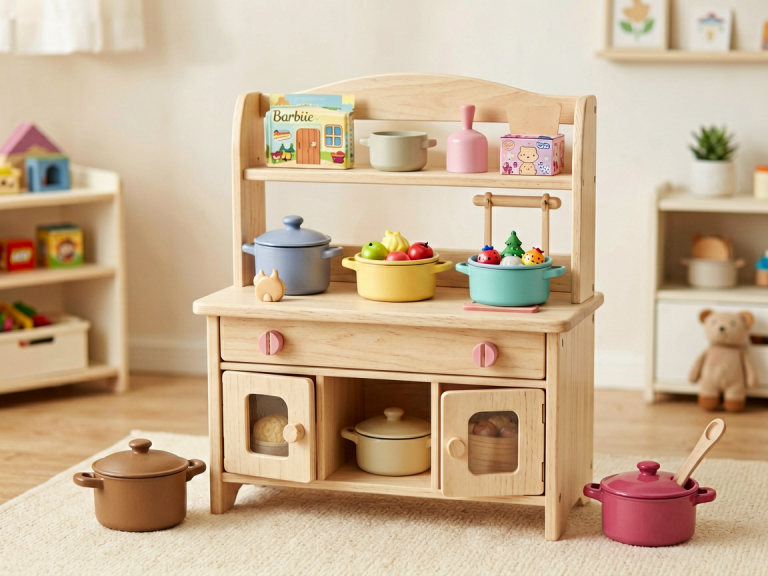
Pretend play is arguably the most powerful vehicle for language development in early childhood. When a preschool boy dons a chef’s hat and commands a play kitchen, he is not just imitating adults; he is practicing complex language in context. Kitchen sets, doctor kits, tool benches, and shopping carts all encourage role-play, which requires the child to adopt a different voice, use situational vocabulary, and follow a social script. For example, a boy playing with a doctor’s kit might say, “Open your mouth and say ‘ahh.’ Your throat is red. You need medicine.” This is not mere repetition; it is a creative synthesis of vocabulary, grammar, and pragmatics (the social use of language). Importantly, pretend play allows boys to experiment with different communicative functions: requesting (“Give me the hammer”), commanding (“Go to sleep”), questioning (“Do you have a fever?”), and narrating (“Now I’m going to fix the broken car”). To maximize language benefits, parents can participate by asking open-ended questions: “Why is the patient sick?” or “What should we cook for dinner?” This turns a simple play activity into a rich language lesson.
Construction and Building Toys: Spatial Language and Problem-Solving
Construction toys—including classic wooden blocks, LEGO Duplo, magnetic tiles, and interlocking gears—are particularly well-suited for preschool boys who are drawn to engineering and design. These toys naturally elicit a wealth of spatial and relational vocabulary: “on top of,” “beside,” “under,” “through,” “wider,” “taller,” “balance,” “support,” “angle.” As a boy builds a tower, he may announce, “This block is too small; I need a bigger one,” demonstrating comparative adjectives. He might ask for help: “Can you hold this side so it doesn’t fall?”—a question that requires subject-verb inversion and a clear request. When the structure collapses, there is an opportunity to discuss cause and effect: “Why did it fall? Because the bottom block was wobbly.” Construction play also encourages sequential thinking: “First I’ll make the base, then I’ll add the walls.” This sequencing skill is directly linked to later narrative ability. For parents, the key is to narrate the process without taking over: “I see you put the red block on the blue block. What are you building next?” Such comments validate the child’s effort and extend his language.
Puzzle and Matching Games: Vocabulary and Categorization
Puzzles, especially those that involve matching images to words or categories, are excellent for receptive and expressive vocabulary growth. For preschool boys, puzzles featuring their favorite themes—animals, vehicles, dinosaurs, or superheroes—are especially motivating. A floor puzzle of a farm scene, for instance, encourages the child to name each animal as he places it: “The cow goes in the field. The chicken is near the barn.” Jigsaw puzzles also foster descriptive language: “This piece has a blue sky and a tree branch. I think it goes in the top corner.” More structured matching games, such as “I Spy” cards or simple bingo sets, promote category knowledge (animals, foods, colors) and the ability to follow directions: “Find the one that is not a fruit.” For boys who may struggle with impulse control, puzzles provide a natural reward for sustained attention, and the accompanying language practice is woven seamlessly into the activity.
Storytelling and Puppetry: The Art of Narrative Construction
Toys that explicitly inspire storytelling—such as finger puppets, felt boards, story cubes (dice with pictures), and sequencing cards—are invaluable for developing narrative language, which is a cornerstone of literacy. Preschool boys often enjoy action-packed stories with heroes, vehicles, and conflicts. Puppetry allows a child to assign dialogue to characters, create a plot with a beginning, middle, and end, and even modulate his voice to suit different roles. A set of plastic dinosaurs paired with a volcano toy can generate a story about survival: “The T-Rex is angry because the volcano is erupting. He runs to the river to hide.” Storytelling toys also teach the use of conjunctions (“and,” “but,” “because”) and temporal markers (“then,” “after that,” “finally”). For boys who are reluctant to speak in full sentences, the puppet provides a safe distance—it is the puppet, not the boy, who is talking. This psychological detachment can lower anxiety and encourage more elaborate expression. Parents can model stories first and then invite the child to continue, gradually shifting the narrative responsibility to him.
Interactive Electronic and Audiobooks: A Modern Tool with Caution
In the digital age, interactive toys that respond to speech or feature recorded vocabulary—such as talking storybooks, voice-activated learning pads, or simple tablet apps—can supplement language development, but they must be used judiciously. The American Academy of Pediatrics recommends that digital media for preschoolers be used alongside a caregiver, not as a replacement for human interaction. An interactive toy that says, “Can you find the elephant?” when a child presses a button may teach animal names, but it lacks the conversational back-and-forth that is critical for deep learning. However, when a parent sits with a boy and uses an audiobook as a starting point for discussion (“What sound did the elephant make? Why was he sad?”), it becomes a powerful tool. Some of the best modern toys combine physical manipulatives with digital audio, such as talking pens that read out descriptions when tapped on a map. These can introduce rare vocabulary (e.g., “igloo,” “glacier,” “kayak”) that might not arise in everyday conversation. For preschool boys, the novelty of technology can capture attention, but human interaction remains the gold standard.
Practical Strategies for Parents and Educators: Making the Most of Toy Time
Even the best toy is only as effective as the interaction that surrounds it. To truly harness toys for language development, adults must adopt intentional practices that turn play into conversation.
1. Ask Open-Ended Questions
Instead of asking yes/no questions like “Is that a car?” which yield a single-word answer, try “What is your car doing?” or “Where is it going?” Open-ended questions require the child to think and formulate longer responses. For preschool boys who may default to short answers, follow-up questions (“And then what happened?”) gradually extend their utterances.
2. Use the “Serve and Return” Technique
Inspired by research from the Center on the Developing Child at Harvard University, “serve and return” means that when a child makes a sound, gesture, or word, the adult responds in a meaningful way. If a boy picks up a block and says “big,” the adult can say, “Yes, that block is very big. Is it the biggest one? Let’s find a bigger one.” This back-and-forth builds neural connections and teaches that communication is a dialogue.
3. Narrate Without Dominating
While it is beneficial to model language, adults should avoid taking over the play. The goal is to be a “language partner,” not a director. If a boy is building a train track, the adult can simply comment: “I see you are making a turn. That’s a curve. The train will have to go slowly around the curve.” This provides rich vocabulary without interrupting the child’s flow. Gradually, the child will internalize these words and begin to use them himself.
4. Rotate Toys to Maintain Novelty
Preschool boys can become bored with the same toys, leading to less verbal engagement. A rotation system—keeping only a few toys available at a time and swapping them every week or two—keeps the play fresh. When a toy is reintroduced, it feels new again, sparking renewed curiosity and conversation.
5. Include Books That Complement Toys
Pairing toys with relevant picture books can deepen language. After reading a story about a fire truck, a boy will be more motivated to use specific vocabulary when playing with his fire station toy. The book provides a narrative template that the child can then adapt during play, enhancing both comprehension and expression.
Conclusion: The Power of Purposeful Play
Language development does not happen in a vacuum. For preschool boys, who are hardwired to move, build, and explore, the most effective learning occurs when they are fully engaged in play that feels meaningful to them. Toys are not simply diversions; they are the raw material from which language is crafted. By choosing open-ended, thematic, social, and action-oriented toys, and by interacting with children in a responsive, enriching manner, parents and educators can turn everyday play into a powerful language laboratory. The boy who learns to describe his block tower, negotiate a train track conflict, or narrate a dinosaur rescue is building more than a structure or a story—he is building the foundational skills for a lifetime of communication, literacy, and learning. In a world that increasingly demands strong verbal abilities, the simple act of thoughtful play can be one of the greatest gifts we give to our youngest learners. So, the next time you see a preschool boy engrossed in a set of blocks or a toy truck, remember: he is not just playing; he is talking, thinking, and growing—one word at a time.