Building Foundations for Spatial Reasoning: Play Activities for 6-Month-Olds
Introduction
Spatial reasoning—the ability to understand and remember the spatial relationships among objects and between oneself and the environment—is a fundamental cognitive skill that underpins mathematics, science, art, and everyday problem-solving. Although it might seem too early to consider such a complex ability in a 6-month-old, research in developmental psychology shows that the first year of life is a critical period for spatial cognitive development. At around six months, infants begin to demonstrate rudimentary spatial awareness: they reach for objects with increasing accuracy, track moving items with their eyes, and show interest in hidden objects (object permanence). The key to nurturing this budding capability lies in purposeful, engaging play. This article presents a range of play activities specifically designed for 6-month-olds, each grounded in developmental science, that can help build the neural foundations for spatial reasoning. With careful attention to safety, repetition, and the infant’s natural curiosity, these activities transform everyday moments into powerful learning experiences.
—
Understanding Spatial Reasoning in Infancy
Before diving into specific activities, it is essential to understand what spatial reasoning looks like at six months. At this age, infants are transitioning from reflexive movements to intentional actions. Their visual system has matured enough to perceive depth and distance, though still with limitations. Key spatial milestones at six months include:
- Reaching and grasping: Infants can coordinate hand and eye movements to reach for a toy placed in front of them, adjusting their arm’s direction based on the object’s location.
- Depth perception: They begin to show wariness about drop-offs (e.g., on the edge of a bed or a visual cliff apparatus), indicating an emerging sense of depth.
- Object permanence: They will look for a toy that has been partially hidden, though fully hidden objects may still cause confusion.
- Tracking moving objects: They can smoothly follow a slow-moving object with their eyes and head, predicting where it might go.
These abilities are the building blocks for later skills like mental rotation, navigation, and understanding maps. The brain’s plasticity during infancy means that each playful interaction—a rattle shaken left and right, a ball rolled under a blanket—strengthens the neural circuits responsible for processing space and position. Therefore, the activities described below are not just entertainment; they are intentional exercises for the developing spatial system.
—
The Role of Play in Spatial Development
Play is the natural language of infancy. From a developmental perspective, unstructured and semi-structured play offers the most effective medium for learning because it engages multiple senses, encourages repetition, and is inherently motivating. When a 6-month-old reaches for a dangling ring, their brain is simultaneously processing visual information (distance, angle), proprioceptive feedback (where their arm is in space), and tactile input (texture of the ring). This multi-sensory integration is crucial for spatial reasoning.
Moreover, play allows for what developmental psychologists call “self-discovery.” An infant who repeatedly drops a block from their high chair is actively exploring gravity, trajectory, and object disappearance—all spatial concepts. By providing a safe and rich environment, caregivers can scaffold this exploration without over-stimulating the infant. The following activities are organized by the core spatial skill they target, ranging from depth perception to mental representation of hidden objects.
—
Activity 1: Object Permanence and Peek-a-Boo Variations
Targeted spatial skill: Understanding that objects (including people) continue to exist even when out of sight; predicting where an object will reappear.
Why it works: Object permanence is a cornerstone of spatial reasoning because it requires the infant to mentally represent the location of a hidden object. At six months, infants are just beginning to grasp this concept. Classic peek-a-boo helps them predict that a face will reappear from behind hands or a cloth.
How to play:
- Simple peek-a-boo: Sit face-to-face with your baby. Cover your face with your hands and say, “Where’s Mommy/Daddy?” Then reveal your face with a cheerful “Peek-a-boo!” Repeat several times, varying the duration of hiding.
- Toy hiding: Use a lightweight scarf or a small cloth. Show your baby a favorite toy, then slowly cover it with the cloth. Encourage them to pull the cloth away. If they do not immediately try, gently tap the cloth or lift a corner to pique their curiosity.
- Under-the-cup hiding: Place a small toy (safe, not a choking hazard) under an upside-down plastic cup while your baby watches. Slide the cup slightly to the side so part of the toy is visible. As your baby’s ability improves, hide the toy completely and let them lift the cup.
Spatial reasoning gains: The infant learns that objects have a fixed position even when hidden, practicing mental rotation and spatial memory. The act of uncovering a toy also reinforces the concept of “behind” or “under.”
—
Activity 2: Reaching and Grasping for Differently Positioned Toys
Targeted spatial skill: Distance estimation, hand-eye coordination, and understanding of “near” versus “far.”
Why it works: At six months, many babies can sit with support and will eagerly reach for interesting objects. Placing toys at various distances and directions forces their brain to compute the required arm extension and angle.
How to play:
- The “tantalizing toy” game: Seat your baby in a high chair or supported on your lap. Hold a brightly colored, noise-making toy (like a rattle) just out of their reach. Slowly move it closer, then further away. Say, “Look, it’s far! Now it’s near!” Let them grab it eventually and celebrate.
- Side-reaching: Place toys on their left and right sides alternately. Encourage them to turn their torso and reach across midline. This cross-body movement strengthens the neural connections between the two brain hemispheres, which is important for spatial orientation.
- Overhead dangling: Suspend a soft toy on a string (supervised!) above your baby’s chest while they lie on their back. Let them bat at it. Slightly vary the height and angle.
Spatial reasoning gains: The infant calibrates their reaching based on visual cues of distance and angle. They begin to differentiate between “within reach” and “out of reach,” a key spatial judgment.
—
Activity 3: Exploring Cause and Effect with Rolling Objects
Targeted spatial skill: Understanding trajectories, motion paths, and the relationship between an object’s starting position and its final position.
Why it works: When a ball rolls away after being pushed, the infant’s brain tracks the path and begins to anticipate where it will stop. This predictive tracking is a spatial skill that later helps with activities like catching a ball or navigating through a room.
How to play:
- Roll a soft ball: Sit facing your baby (they can be in a seated position or lying on their tummy). Gently roll a lightweight, textured ball toward them. Pause before it reaches them, then roll it again. As they become interested, roll it slightly to one side so they have to turn to follow it.
- Ramp rolling: If you have a clean, shallow cardboard ramp (like a piece of a cardboard box), prop it up at a slight angle. Place a small car or ball at the top and let it roll down. Your baby will watch with fascination. Repeat and say “Down it goes!”
- Chase the rolling cup: Use a lightweight plastic cup (no sharp edges). Place a small toy inside, then tilt the cup so the toy rolls out. Your baby may try to grab the moving toy.
Spatial reasoning gains: The infant learns that objects move in continuous paths, that their starting position determines their ending position, and that motion can be manipulated (e.g., by tilting). This builds an intuitive understanding of physics and space.
—
Activity 4: Stacking and Nesting Toys
Targeted spatial skill: Understanding size relationships, spatial order, and containment.
Why it works: Stacking rings, cups, or blocks introduces the concept that objects have sizes and that smaller objects can fit inside larger ones. Six-month-olds may not yet be able to stack independently, but they can explore the materials with guidance.
How to play:
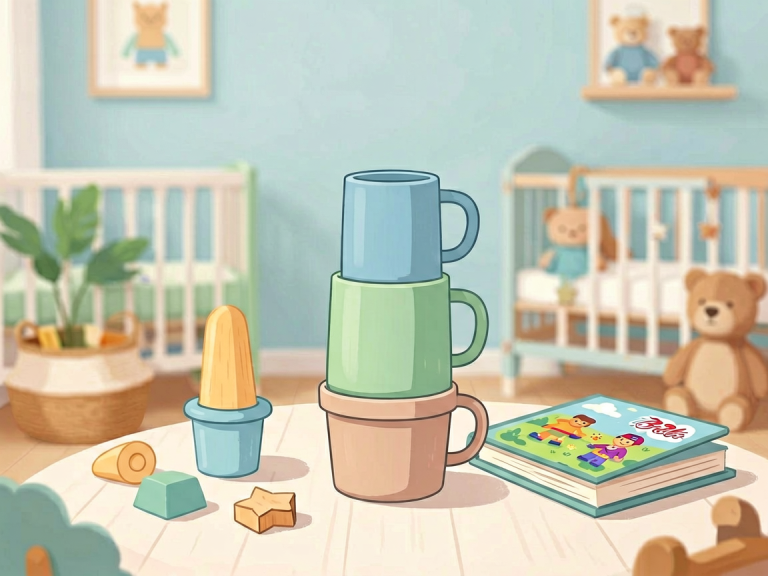
- Nesting cups: Provide a set of brightly colored plastic nesting cups (ensure they are BPA-free and too large to be swallowed). Show your baby how a smaller cup fits inside a larger one. Let them hold and mouth the cups—oral exploration is normal and informative. Gently guide their hand to place a small cup inside a big one.
- Soft blocks: Use fabric or foam blocks that are safe to chew. Build a short tower of two or three blocks in front of your baby while they watch. Then knock it down with a playful “Boom!” Let them try to grab a block and bring it to their mouth.
- Ring stacker: Choose a ring stacker with a wide base and large rings. Hold the rings one by one and slowly place them on the peg. Allow your baby to pull them off (they love this reversal of the action).
Spatial reasoning gains: Nesting and stacking teach the infant that objects have different volumes and that there is an order—biggest first, smallest last. They also learn about balance and verticality.
—
Activity 5: Tummy Time with Mirrors and Mobiles
Targeted spatial skill: Visual depth perception, spatial awareness of self in relation to environment, and tracking.
Why it works: Tummy time is essential for physical development, but it also offers rich spatial experiences. When an infant lies on their tummy and looks at a mirror, they begin to recognize that the reflection is a representation of space. Mobiles overhead require them to look up and judge distance.
How to play:
- Tummy time mirror: Place a safe, unbreakable mirror on the floor in front of your baby during tummy time. Encourage them to look at themselves. Tap the mirror and say, “Who’s that? It’s you!” The visual feedback helps them understand the relationship between their own movements and the reflection.
- Low-hanging mobile: Hang a simple black-and-white or high-contrast mobile about 12–18 inches above the mat where your baby does tummy time. Gently tap the mobile to make it sway. As your baby watches, they practice focusing at different depths.
- Obstacle tummy time: Place a few soft pillows or rolled towels around your baby during tummy time. They will have to lift their head and look around, processing the spatial layout of the obstacles.
Spatial reasoning gains: The infant develops depth perception by focusing on objects at varying distances. They also begin to understand that they are a separate entity moving through space.
—
Tips for Parents and Caregivers
To maximize the benefits of these activities, keep the following guidelines in mind:
- Follow the baby’s lead: If your baby seems fussy or disinterested, stop and try again later. Forced play is counterproductive.
- Repeat, repeat, repeat: Spatial learning requires repetition. The same activity done daily will strengthen neural pathways.
- Provide a safe environment: Ensure all toys are too large to be swallowed, have no sharp edges, and are made of non-toxic materials. Always supervise play.
- Use simple language: Narrate the action with spatial terms like “up,” “down,” “inside,” “behind,” “far,” and “near.” Even though your baby doesn’t understand the words yet, the rhythm and tone help them associate sounds with spatial concepts.
- Limit screen time: At six months, direct human interaction and physical exploration are far superior to any digital media for spatial development.
- Celebrate small successes: When your baby successfully reaches for a toy or uncovers a hidden object, show excitement. Positive reinforcement encourages further exploration.
—
Conclusion
Spatial reasoning is not a skill that suddenly appears in preschool; it begins to develop in the very first months of life, nourished by everyday interactions and playful discoveries. For a 6-month-old, every reach for a rattle, every peek behind a cloth, and every roll of a ball is a small but potent lesson in understanding the geometry of the world. The activities outlined in this article—ranging from object permanence games to tummy time with mirrors—are simple, low-cost, and deeply effective. They honor the infant’s natural curiosity and provide the repetitive, multi-sensory experiences that the developing brain craves.
By investing a few minutes each day in intentional spatial play, caregivers are not only making their babies smile; they are laying the groundwork for future mathematical thinking, problem-solving, and even athletic coordination. The journey of spatial reasoning begins with a gentle push of a ball and a joyful game of peek-a-boo—and that is a beautiful foundation to build upon.