The Magic of Discovery: Integrating Science Play for Preschoolers
In a sunlit corner of a preschool classroom, four children huddle around a shallow tray of water. One child drops a cork into the water, watching it bob to the surface. Another adds a pebble and squeals with delight as it sinks. A third child tries to balance a leaf on the water’s surface, while the fourth blows gently to create ripples. There is no formal lesson plan here, no worksheet, no pre‑test. There is only curiosity, mess, and joy. This is science play for preschoolers — a powerful, natural way for young children to build foundational understanding of the world around them.
Science play is not about memorizing facts or reciting vocabulary. It is about hands-on exploration, asking questions, making predictions, testing ideas, and revising theories based on evidence. For children aged three to five, the world is a vast laboratory. Every puddle, every fallen leaf, every spinning top holds the potential for discovery. When adults intentionally create space for science play — and when they step back to let children lead — they unlock a lifelong love of learning, critical thinking, and wonder. This article explores why science play matters, what makes it effective, practical activities for home and classroom, the adult’s role, and how to overcome common challenges.
Why Science Play Matters for Preschoolers
The early years are a period of extraordinary brain development. Neural connections form at a rate of more than one million per second, and experience shapes this architecture. Science play provides rich, multisensory experiences that strengthen cognitive pathways related to observation, classification, cause and effect, and problem-solving.
First, science play nurtures curiosity — the engine of all scientific thinking. Preschoolers are naturally inquisitive; they ask “why” dozens of times a day. Science play channels this energy productively. When a child experiments with rolling different objects down a ramp, they are not just playing — they are investigating variables like weight, shape, and surface texture. This process builds executive function skills such as attention, persistence, and flexibility.
Second, science play lays the groundwork for STEM (Science, Technology, Engineering, Mathematics) literacy. Research shows that early exposure to science concepts predicts later academic success not only in science but also in reading and mathematics. Children who engage in guided science play develop stronger vocabulary, more sophisticated use of language (e.g., “I hypothesize this will float because it’s light”), and greater comfort with data collection and interpretation. They learn that it is okay to be wrong — that a failed prediction is simply new information.
Third, science play supports social-emotional development. When preschoolers work together to build a tower or investigate a worm, they practice negotiation, turn-taking, and sharing ideas. They learn to listen to peers, defend their reasoning, and accept that others may have different perspectives. These are the roots of collaboration and respectful debate — skills essential for scientists and citizens alike.
Finally, science play is joyful. Children who associate science with fun, mess, and wonder are far more likely to maintain interest in scientific subjects later in school. The fear of science — often instilled by dry textbooks or high‑stakes tests — has no place in preschool. Instead, science play says: *You are already a scientist. Let’s explore together.*
Key Principles of Effective Science Play
Not all play is equally powerful for science learning. Adults can maximize the benefit by following several key principles.
Open-ended exploration is the heart of science play. Activities should have no single “right” answer. Give children a tray of sand with water, scoops, and funnels, and let them discover what happens when they add more water or tilt the tray. Resist the urge to direct their actions. The goal is process, not product.
Sensory-rich experiences are crucial. Young children learn through their senses — touch, sight, sound, smell, and even taste (when safe). A sensory bin with ice cubes, cloth, and plastic animals invites children to observe melting, texture differences, and weight. The more senses engaged, the more neural connections are forged.
Embedded language matters. While children play, adults can quietly narrate or ask open-ended questions: *I notice the water is spilling over the edge. How could we stop it?* This builds scientific vocabulary naturally. Words like *observe, predict, compare, measure, evidence* become part of the child’s active lexicon simply through repeated use in context.
Allow repetition and variation. Children need to repeat experiments many times to consolidate learning. The child who drops the same toy into water fifty times is not bored — they are systematically testing a theory about sinking and floating. Adults should resist interrupting and instead provide variations (a different liquid, a slightly different object) to deepen understanding.
Safe failure is essential. In science play, mistakes are not errors but experiments. When a tower of blocks collapses, the child learns about balance and gravity. Adults can model a growth mindset: *That didn’t work — what could we try differently?* This teaches resilience and fosters a love of challenge.
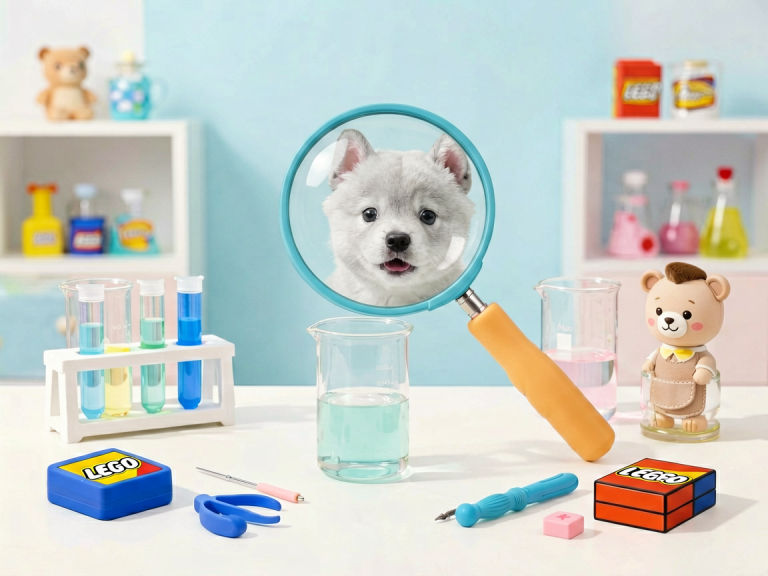
Incorporate real tools. Children thrive when given authentic materials: magnifying glasses, measuring cups, tweezers, eyedroppers, balances. These tools feel exciting and important, and they teach fine motor control while reinforcing scientific practices.
Practical Science Play Activities for Home and Classroom
Here are several tried-and-true science play activities that require minimal materials and provide rich learning.
Water Play and Sink-or-Float Experiments
Fill a shallow tub with water. Provide a variety of safe objects: a cork, a metal spoon, a plastic bottle cap, a sponge, a wooden block, a pebble, a feather. Let children freely test each item. Ask: *What do you think will happen before you drop it in? Why?* Then, after testing, ask: *Were you right? What surprised you?* This simple activity teaches prediction, observation, and the concept of density. Extend it by adding salt to the water and observing whether objects that once sank now float.
Magnet Discovery
Give children a set of magnets (bar, horseshoe, ring) and a collection of items: paper clips, coins, plastic toys, aluminum foil, cork, a key. Let them explore which items are attracted. Ask: *How do you know it’s a magnet? Can the magnet pull through paper? Through water?* Children will naturally test the limits of magnetic force. This activity introduces concepts of force, materials, and invisible energy fields.
Plant Growth Observations
Plant fast-growing seeds (beans, peas, or radishes) in clear plastic cups with wet cotton balls or soil. Place one cup in sunlight, another in a dark closet, and a third in the refrigerator. Children can water them (just a little) and check daily. Draw pictures or take photos of the changes. Ask: *What do you notice? Why do you think this one is taller?* This teaches the needs of living things, the scientific process of fair testing, and patience.
Shadow Play
On a sunny day, go outside and trace shadows with chalk. Return every hour to see how shadows move. Use a flashlight and objects in a dark room to create shadows on a wall. Let children make animal shapes with their hands. Ask: *Why does the shadow get longer? Can you make your shadow disappear?* This introduces the concepts of light, opaque objects, and the Earth’s rotation in a concrete way.
Simple Chemical Reactions: Baking Soda and Vinegar
Place a small amount of baking soda in a shallow dish. Add a few drops of food coloring (optional). Then let children use an eyedropper to add vinegar. The fizzing reaction is captivating. This is a classic example of cause and effect. Ask: *What do you see? What does it smell like? What happens if we add more vinegar?* This activity also teaches careful measurement and observation of visible and invisible outcomes.
The Role of Adults in Facilitating Science Play
Adults — whether parents, caregivers, or teachers — are not passive observers in science play. Their role is crucial, but it differs from traditional teaching.
Be a guide, not a director. Instead of telling children what to do, ask questions that nudge their thinking: *What happened? What would happen if we changed that? How could we find out?* Use phrases like “I wonder…” or “Let’s see…” to model curiosity.
Document and reflect. Take photos or videos of the activity. Later, look at them with the child and talk about what they did. This reinforces memory, language, and the idea that scientific work is worth revisiting. An “observation journal” — a simple notebook where children draw or dictate — can become a treasured record of discoveries.
Provide just enough challenge. If an activity is too easy, children lose interest. If it’s too hard, they become frustrated. The sweet spot is in the “zone of proximal development.” For example, if a child is happily mixing water and sand, you might introduce a new tool like a funnel or a sieve. This extends the play without taking over.
Model scientific attitudes. Let children see you wondering, making mistakes, and trying again. Say: *That didn’t work the way I thought. Let me try another way.* This teaches that science is a process, not a set of perfect answers.
Connect play to everyday life. Point out science in the kitchen: *Look — the butter melted because it’s hot.* In the garden: *The worm lives underground. Why do you think it likes dark, damp places?* This shows children that science is not a separate subject but a way of understanding everything.
Overcoming Common Challenges
Despite the benefits, many adults hesitate to embrace science play. Common concerns include mess, cost, time, and lack of knowledge. Here are practical solutions.
Mess is manageable. Use a plastic tablecloth, a large tray, or an old shower curtain. Dress children in aprons or old clothes. Designate a specific area for messy play. Clean-up can be part of the learning — children can help wipe, rinse, and sort materials. In fact, clean-up often involves measurement and classification (dry vs. wet, clean vs. dirty).
Cost is minimal. Most science play uses household items: water, empty containers, magnets from old speakers, food coloring, vinegar, baking soda. Even the most elaborate activity rarely costs more than a few dollars. Libraries and thrift stores are excellent sources of books and materials.
Time is short, but science play doesn’t need a full hour. A ten-minute observation of a caterpillar can be profound. Keep a “science shelf” with a rotating collection of interesting objects (feathers, shells, pinecones, magnifying glass) so children can explore spontaneously.
Lack of knowledge is not a barrier. You do not need a degree in physics to facilitate science play. The key is to be curious alongside the child. If you don’t know why a boat moves when you blow on a paper sail, say: *I don’t know either — let’s find out together.* Google it, test it, ask a local scientist. This models lifelong learning.
Disagreements among children can be redirected into scientific debates. If two children argue about whether a feather will float, say: *Great question — let’s test it! Each of you makes a prediction, and we’ll see who is right.* This turns conflict into collaborative inquiry.
Conclusion: Cultivating a Generation of Little Scientists
Science play for preschoolers is not a luxury or a fancy add-on to the curriculum. It is a fundamental way of learning that honors children’s natural curiosity and builds the cognitive, social, and emotional foundations for a lifetime of discovery. When a preschooler spends twenty minutes dropping the same toy into water, watching it splash, and doing it again, they are not wasting time — they are practicing the scientific method: observation, hypothesis, experiment, conclusion. They are learning that the world is full of patterns and surprises, and that they have the power to investigate.
As adults, our job is to provide the materials, the space, the time, and most importantly, the attitude. We must resist the urge to rush to an answer or to correct a child’s “mistake.” Instead, we must stand back and watch, smile, and ask one more question. We must embrace the mess, the noise, and the joy.
The seeds of tomorrow’s scientists, engineers, and explorers are planted today — not through flashcards or worksheets, but through the simple, profound act of playing with water, magnets, and light. So let the water spill. Let the blocks tumble. Let the fizz overflow the cup. In the chaos of science play, children find order, meaning, and wonder. And so, perhaps, do we.