The Renaissance of Screen-Free Learning Toys: Nurturing Young Minds in a Digital Age
Introduction: The Digital Dilemma
In an era where toddlers swipe before they speak and preschoolers navigate tablets with more ease than picture books, the concept of screen-free learning toys has emerged as both a nostalgic whisper and a revolutionary call to action. The pervasive glow of screens—from smartphones to educational apps—has transformed childhood, raising urgent questions about how children truly learn best. While digital devices offer undeniable convenience and interactive engagement, a growing body of research suggests that the most profound cognitive, emotional, and social development occurs through tangible, hands-on experiences. Screen-free learning toys—those that operate without batteries, pixels, or Wi-Fi—are not merely relics of a pre-digital past; they are carefully designed tools that leverage the innate curiosity of children to foster deep, multisensory learning. This article explores the multifaceted world of screen-free learning toys, examining their psychological foundations, developmental benefits, practical applications, and enduring relevance in a world saturated with screens. By understanding the principles behind these analog treasures, parents and educators can make informed choices that balance technology with the irreplaceable value of physical play.
The Case for Screen-Free Learning: Why Unplugged Play Matters
The Science of Tangible Learning
Humans are embodied creatures. Our brains evolved in a physical world where learning occurred through manipulation, exploration, and sensory feedback. When a child stacks wooden blocks, they are not merely building a tower; they are internalizing principles of gravity, balance, spatial relationships, and cause-and-effect. When they mold clay, their fingers transmit tactile information that stimulates neural pathways linked to creativity, problem-solving, and fine motor control. Screen-based learning, by contrast, often reduces complex experiences to two-dimensional, touchless interactions. A drag-and-drop puzzle on a tablet may teach shape recognition, but it cannot replicate the proprioceptive feedback of fitting a wooden piece into a carved slot—the slight resistance, the satisfying click, the adjustment of grip. Neuroscientific studies indicate that such multisensory engagement strengthens memory formation and conceptual understanding. The hippocampus, a brain region critical for learning, is more actively stimulated when multiple senses are simultaneously engaged. Screen-free toys naturally provide this richness, while screens tend to isolate visual and auditory inputs, leaving touch, smell, and movement behind.
Addressing the Attention Crisis
Another compelling argument for screen-free learning toys lies in their relationship with attention. Digital environments are designed to capture and redirect attention at a frenetic pace—bright colors, sudden sounds, pop-up rewards, and endless scrolling. This constant novelty can train young brains to expect high levels of stimulation, making sustained focus on slower, more contemplative activities difficult. Screen-free toys, on the other hand, require patience and persistence. A child working on a 100-piece jigsaw puzzle must tolerate the slow process of trial and error. A child building a marble run must test, fail, adjust, and retest. This process builds what psychologists call "executive function"—the ability to plan, inhibit impulses, and regulate emotions. Research from the American Academy of Pediatrics has linked excessive screen time in early childhood with reduced attention spans and increased impulsivity. By intentionally incorporating screen-free learning toys, parents create a counterbalance that nurtures deep focus and delayed gratification—skills that are increasingly rare and increasingly valuable.
Types of Screen-Free Learning Toys: A Spectrum of Possibilities
Construction and Building Toys
Perhaps the most iconic category of screen-free learning toys includes construction sets like wooden blocks, LEGO bricks, magnetic tiles, and interlocking gears. These toys are marvels of open-ended design: they have no predetermined outcome, allowing children to build anything from a simple tower to a complex castle. The learning that occurs is profound. In stacking blocks, children experiment with equilibrium. In connecting gears, they discover mechanical relationships. In following a LEGO instruction booklet, they practice sequencing and attention to detail. Unlike many digital games that provide instant success or failure, building toys offer gradual, trial-based learning. A structure that falls teaches resilience. A design that wobbles teaches physics. Moreover, these toys encourage collaborative play—siblings working together to build a city, negotiating roles and solving conflicts. Brands such as Magna-Tiles, HAPE, and Grimm’s have become synonymous with quality construction play, but even simple unit blocks from a local toy store can provide hours of deep learning.
Puzzles and Logic Games
Puzzles, from simple wooden jigsaw pieces for toddlers to complex 3D interlocking puzzles for older children, are quintessential screen-free learning tools. They directly target spatial reasoning, pattern recognition, memory, and problem-solving. A child piecing together a puzzle must hold multiple visual representations in mind—the shape of a piece, its position, its relationship to surrounding pieces. This mental manipulation is a workout for the prefrontal cortex. Logic games such as Rush Hour, Chocolate Fix, or the classic Tower of Hanoi teach conditional thinking: "If I move this piece here, then that piece can slide there." These games often have a single correct solution, but the path to that solution requires systematic reasoning and patience. Unlike a screen-based game that might highlight the next move or offer hints, a physical puzzle demands that the child rely entirely on their own cognitive resources. This independence builds confidence and a sense of accomplishment that no digital reward can match.
Art and Craft Kits
Art supplies—paints, clay, scissors, glue, yarn, beads—are perhaps the most freeform of screen-free learning toys. They encourage creativity without boundaries, allowing children to express emotions, experiment with color and texture, and develop fine motor skills. More structured art kits, such as weaving looms, origami sets, or printmaking blocks, combine artistic expression with problem-solving and procedural thinking. For example, a child learning to weave must follow a pattern, count threads, and adjust tension—skills that integrate math, design, and patience. Occupational therapists often recommend these toys for children with sensory processing challenges because they provide rich proprioceptive and tactile input. Furthermore, art creation has been shown to reduce stress and improve mood, offering a healthy emotional outlet in a high-pressure world.
Board Games and Card Games
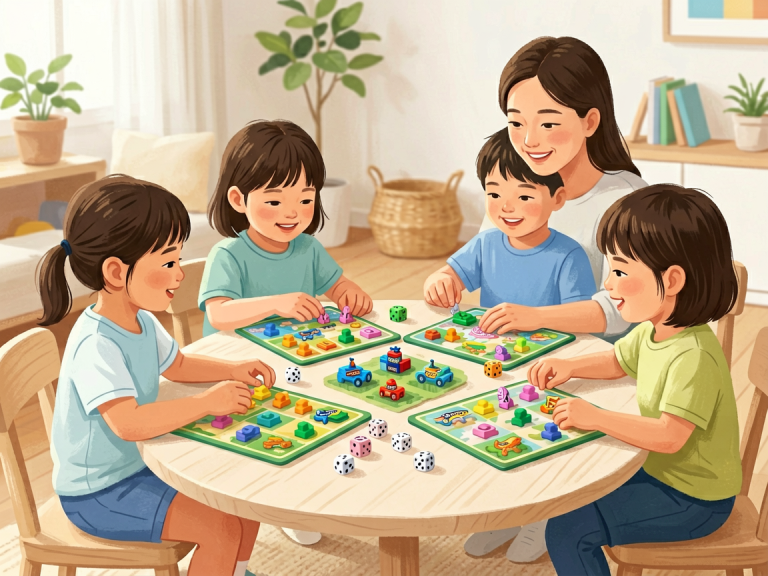
Board games have experienced a renaissance in recent years, and for good reason. Modern board games for children (such as My First Castle Panic, Outfoxed, or Sequence for Kids) incorporate elements of strategy, cooperation, counting, reading, and social interaction. Unlike solitary screen play, board games require turn-taking, following rules, reading social cues, and managing emotions—both winning and losing gracefully. For older children, more complex games like Settlers of Catan (junior version) or Ticket to Ride introduce resource management, planning, and negotiation. Card games like Uno, Go Fish, or memory matching games sharpen attention and working memory. The face-to-face interaction that board games demand is irreplaceable; it teaches children the subtleties of eye contact, body language, and verbal communication. In a world where digital communication often strips away these nuances, board games are a powerful tool for social-emotional learning.
STEM and Discovery Kits
Science, technology, engineering, and math (STEM) learning can absolutely happen without screens. Chemistry sets, crystal-growing kits, simple machines, microscopes, and robotics kits (like the non-digital Gears! Gears! Gears! or wooden marble runs) provide hands-on exploration of scientific principles. A child mixing vinegar and baking soda witnesses a chemical reaction with all five senses. A child constructing a catapult learns about levers and force. Many of these kits include instruction booklets that require reading and following step-by-step directions, reinforcing literacy and procedural comprehension. The key difference from digital versions is that the child must physically assemble, test, and—often—fail before succeeding. This iterative process mirrors real-world scientific inquiry far more closely than a simulation on a screen.
Cognitive and Developmental Benefits: Beyond Entertainment
Enhancing Executive Function
Executive function—a set of cognitive skills including working memory, inhibitory control, and cognitive flexibility—is widely considered a better predictor of academic success than IQ. Screen-free learning toys directly cultivate these skills. When a child plays a memory matching game, they are exercising working memory. When they must wait their turn in a board game, they practice inhibitory control. When they try a different strategy after a building collapses, they demonstrate cognitive flexibility. Digital toys, by contrast, often scaffold executive function too heavily—they provide reminders, timers, and visual cues that reduce the child's need to self-regulate. Over-reliance on these scaffolds can hinder the development of independent self-regulation.
Fostering Creativity and Imagination
A screen, no matter how interactive, ultimately presents a curated reality. A digital game about farming shows a cartoon pig and a row of corn; the child can only interact with predefined elements. A box of wooden blocks, on the other hand, can become a farm, a spaceship, a castle, a hospital, or a time machine. Screen-free toys are often "loose parts"—objects that can be reimagined in infinite ways. This openness is essential for divergent thinking, the foundation of creativity. Psychologist Alison Gopnik has argued that young children are natural explorers and causal learners, and that the most effective learning environments are those that allow them to experiment with novel combinations. Screen-free toys provide exactly that: a rich, low-stakes environment for creative play.
Supporting Emotional Regulation
There is something inherently calming about manipulating physical objects. The repetitive motion of threading beads, the soothing sensation of kneading playdough, the slow satisfaction of completing a puzzle—these activities activate the parasympathetic nervous system, helping children self-soothe and regulate stress. In contrast, screen time, particularly passive consumption, has been linked to increased cortisol levels and agitation. Many occupational therapists use screen-free toys as tools for sensory integration and emotional regulation. For children with anxiety or attention disorders, a quiet session with a sand tray, a marble game, or a simple construction set can provide much-needed grounding.
How to Choose the Right Screen-Free Learning Toys
Age Appropriateness and Stage of Development
The best screen-free learning toys are those that match a child's developmental stage while offering just enough challenge to promote growth. For infants and toddlers, toys that engage the senses are ideal: textured blocks, rattles, stacking rings, and simple shape sorters. For preschoolers (ages 3–5), puzzles with larger pieces, magnetic tiles, playdough, and simple board games like "The Sneaky, Snacky Squirrel Game" support fine motor skills, counting, and turn-taking. For elementary-aged children (ages 6–10), construction sets with more parts (LEGO Technic, K'NEX), strategy board games, art kits, and STEM kits like snap circuits provide deeper cognitive challenges. For preteens, consider complex logic puzzles, coding without screens (like Write & Code workbooks or binary beads), or elaborate model-building kits.
Open-Ended vs. Closed-Ended Toys
A critical distinction in selecting learning toys is between open-ended and closed-ended. Open-ended toys—blocks, clay, loose parts—have no single correct outcome. They promote creativity, divergent thinking, and independent problem-solving. Closed-ended toys—puzzles, pegboard patterns, certain board games—have a defined goal. Both are valuable, but research suggests that open-ended play is especially important for fostering imagination and intrinsic motivation. A good playroom should contain a balance of both. Avoid toys that are too prescriptive or that have only one correct way to play, as they limit a child's agency.
Quality Over Quantity
In a market flooded with cheap plastic toys that break easily, quality matters. Screen-free learning toys are often an investment, but well-made wooden toys, durable metal construction sets, and quality art supplies can last for years and be passed down to siblings. Look for toys with natural materials, nontoxic finishes, and sturdy construction. Brands like PlanToys, Melissa & Doug, HABA, and Learning Resources prioritize sustainability and safety. Moreover, quality toys are often more aesthetically pleasing, which can inspire careful handling and respect for materials—a learning outcome in itself.
Integrating Screen-Free Learning Toys into Daily Life
Creating a "Low-Tech" Play Environment
To maximize the benefits of screen-free learning toys, it is important to create an environment that invites their use. Designate a play area with low shelves where toys are visible and accessible, organized by category (e.g., building, puzzles, art). Rotate toys periodically to maintain novelty—a technique known as "toy rotation" that keeps children engaged without overwhelming them. Avoid storing toys in bins where they are out of sight; out of sight often means out of mind. Instead, display a few carefully chosen toys at a time, and swap them every week or two.
Modeling Screen-Free Play
Children learn by imitation. If parents are constantly on their phones or tablets, children will naturally gravitate toward screens. Conversely, when adults engage in screen-free activities—reading, cooking, gardening, building, drawing—they model the value of hands-on play. Family game nights, building challenges, and joint art projects turn screen-free learning into a shared, joyful experience. This not only deepens parent-child bonds but also signals to children that these activities are important and enjoyable.
Balancing Screen Time and Unplugged Play
The goal is not to eliminate screens entirely—they are an inescapable part of modern life and can offer benefits when used mindfully. Instead, aim for a balanced "media diet" where screen time is intentional, limited, and supervised, while screen-free play occupies the majority of a child's free time. The American Academy of Pediatrics recommends no more than one hour per day of high-quality screen time for children ages 2 to 5, and a focus on creative, interactive content for older children. Screen-free learning toys should fill the remaining play hours, providing the rich, multisensory, and self-directed experiences that screens cannot replicate.
Conclusion: The Timeless Power of Tangible Play
In our rush to embrace the digital frontier, we must not forget the simple, profound wisdom embedded in a wooden block, a jigsaw puzzle, or a set of colorful beads. Screen-free learning toys are not a rejection of technology but a celebration of the human capacity to learn through touch, movement, imagination, and social interaction. They build the foundational skills—attention, creativity, persistence, empathy—that no app can fully impart. As parents and educators, we have the privilege and responsibility to offer children a childhood rich in hands-on discovery. By choosing screen-free learning toys thoughtfully, we give our children not just toys, but tools for a lifetime of learning, growth, and wonder. In the end, the most powerful learning tool is not any device, but a curious mind, a pair of hands, and the freedom to explore the real world—one block, one puzzle piece, one brushstroke at a time.