The Power of Play: How Early Learning Toys Shape a Childs Developing Mind
Introduction: More Than Just Fun and Games
In the quiet corner of a nursery, a one-year-old girl grasps a brightly colored wooden block, examining its texture before bringing it to her mouth. She drops it, watches it roll, and then reaches for another. To an observer, this appears to be simple, aimless play. Yet beneath the surface, an extraordinary cognitive and physical revolution is taking place. That block is not merely a toy; it is a tool for understanding gravity, spatial relationships, cause and effect, and the very nature of the physical world. In the United States alone, parents spend over $20 billion annually on toys, with a significant and growing portion dedicated to early learning toys for children aged 0–5. This investment reflects a deep, instinctive understanding that the first years of life are a critical window for brain development, and that the objects children interact with can profoundly influence that development.
Early learning toys are purposefully designed or selected to stimulate a child's senses, encourage exploration, and build foundational skills in areas such as language, motor coordination, problem-solving, and social-emotional understanding. Unlike passive entertainment (such as many digital screens), quality early learning toys demand active engagement. They invite the child to manipulate, test, experiment, and discover. This article explores the multifaceted world of early learning toys, examining their developmental significance, the diverse types available, the criteria for selecting them wisely, and the scientific principles that underpin their effectiveness. By understanding these dimensions, parents, educators, and caregivers can make informed choices that turn playtime into a powerful catalyst for growth.
The Critical Role of Early Learning Toys in Child Development
The human brain undergoes its most rapid period of growth during the first three years of life. At birth, a baby's brain has about 100 billion neurons, but the connections between them—synapses—are still sparse. In the early months and years, experiences literally wire the brain. Every sight, sound, touch, and movement shapes neural pathways. Early learning toys serve as concentrated sources of such experiences. They provide structured yet flexible opportunities for a child to practice skills that have been proven essential for later academic and life success.
Cognitive Development
Cognitive development encompasses thinking, memory, problem-solving, and understanding cause and effect. For a toddler, stacking rings on a cone requires recognizing size order—a precursor to mathematical reasoning. A simple shape-sorter challenges the child to match geometric forms to corresponding holes, demanding visual discrimination and spatial logic. Puzzles with increasing complexity teach planning and persistence. Research from the University of Cambridge's Centre for Neuroscience in Education shows that children who engage with manipulative toys that require hand-eye coordination and logical sequencing demonstrate stronger executive function skills by age 5, including better attention control and working memory. These toys are not "teaching" in a conventional sense; they are providing the raw material for the brain to construct its own understanding.
Motor Skills Development
Gross motor skills—the use of large muscle groups—and fine motor skills—the precise movements of hands and fingers—are both nurtured by appropriate toys. A baby reaching for a dangling mobile strengthens neck and shoulder muscles while learning to coordinate vision with limb movement. A one-year-old pushing a wooden train along a track practices balance and bilateral coordination. By age two, threading large beads onto a string refines the pincer grip essential for later writing. Occupational therapists frequently recommend specific early learning toys (such as play dough, pegboards, and building blocks) to support children with developmental delays, precisely because the repetitive, purposeful motions involved help build neural connections in the motor cortex.
Language and Communication
Language acquisition is one of the most remarkable achievements of early childhood, and toys can accelerate this process when combined with adult interaction. Picture books with tactile elements, sound-making toys that name animals or objects, and simple puppets for pretend play all provide rich language input. Critically, the American Academy of Pediatrics emphasizes that the best language-learning toys are those that encourage back-and-forth conversation: a toy telephone invites the child to "call" a parent; a set of plastic animals prompts naming and storytelling. Unlike passive screen media, which may expose a child to words without requiring engagement, interactive toys create a social context for language use. A study in the *Journal of Applied Developmental Psychology* found that toddlers who played with dialogic toy sets (e.g., a farm set with figures that the parent and child could talk about together) showed significantly higher vocabulary growth over six months compared to those who watched equally educational videos.
Social and Emotional Learning
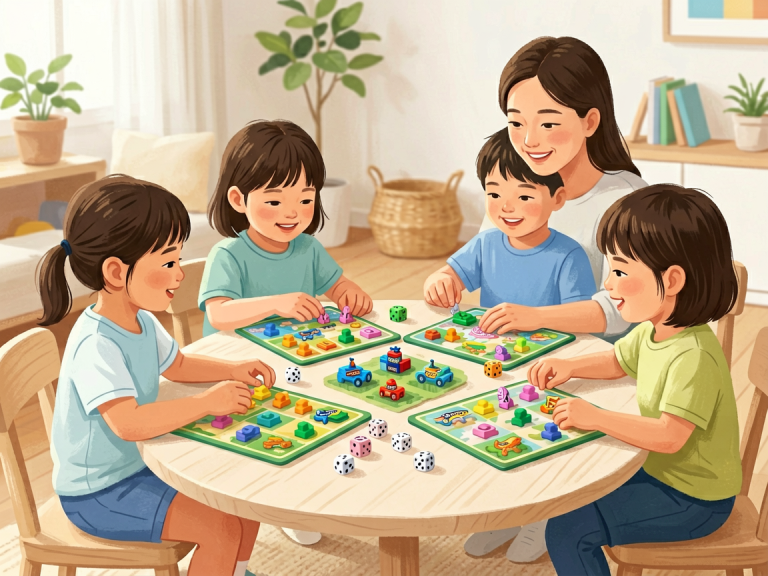
Toys also play a vital role in helping children understand themselves and others. Dolls and stuffed animals become companions for role-playing emotions: feeding a hungry bear, putting a doll to bed, or acting out a visit to the doctor. Through such play, children practice empathy, problem-solving in social scenarios, and emotional regulation. Building with blocks alongside a sibling teaches sharing, negotiation, and collaboration. Board games designed for preschoolers (like simple matching or memory games) introduce the concept of turn-taking, winning and losing gracefully, and following rules. These experiences are the foundation of emotional intelligence, which predicts long-term success in relationships, school, and work more reliably than IQ in many studies.
Types of Early Learning Toys and Their Benefits
The market offers an overwhelming array of products labeled "educational" or "learning toys." However, not all are created equal. The most effective early learning toys tend to fall into a few broad categories, each targeting specific developmental domains. Understanding these categories helps caregivers choose toys that align with their child's current stage and emerging needs.
Sensory Toys for Infants (0–12 Months)
In the first year, the world is experienced through the senses. Sensory toys stimulate sight, hearing, touch, taste, and smell. Examples include: black-and-white contrast cards for newborns (whose vision is still developing), colorful rattles and crinkle toys for auditory and tactile feedback, textured balls and teething rings, and mobiles hanging above the crib. Benefits: These toys soothe and engage babies, encourage visual tracking, strengthen neck and trunk muscles as the baby reaches, and promote early neural mapping of sensory input. The key is simplicity: one or two features per toy rather than overwhelming electronic stimulation.
Manipulative and Construction Toys (1–3 Years)
As children gain more control over their hands, they become fascinated with putting things together and taking them apart. Classic examples: nesting cups, stacking rings, large wooden blocks, Duplo-style bricks, shape sorters, and simple puzzles with knobs. Benefits: These toys directly build fine motor skills, hand-eye coordination, spatial reasoning, and early problem-solving. They also introduce concepts of size, shape, color, and order. Importantly, they are open-ended—a child can use them in countless ways, fostering creativity and divergent thinking. A set of wooden blocks can become a tower, a house, a bridge, or a road, depending on the child's imagination.
Imitative and Pretend Play Toys (2–5 Years)
Between ages two and four, children begin to engage in symbolic play—using one object to represent another (a stick becomes a horse, a box becomes a car). Toys that support this include: play kitchens and food sets, doctor kits, tool benches, dolls, action figures, animal sets, and dress-up clothes. Benefits: Pretend play is crucial for language development (children narrate their actions and create dialogue), social skills (playing roles requires cooperation and negotiation), emotional intelligence (acting out scenarios like "going to the doctor" helps process anxiety), and cognitive flexibility. Research by Dr. Laura Berk at Illinois State University indicates that children who engage in frequent, high-quality pretend play score higher on measures of self-regulation and executive function.
Creative and Artistic Toys (18 Months–5 Years)
Art supplies designed for young children—chunky crayons, washable markers, finger paints, play dough, modeling clay, safety scissors, and collage materials—allow for self-expression and motor practice. Benefits: These toys develop the small muscles of the hand and wrist in preparation for writing. They also teach cause and effect (pressing harder makes a darker line), color mixing, and planning (drawing a picture requires deciding what to draw first). Perhaps most importantly, they give children a non-verbal outlet for emotions and ideas, which is especially valuable before they have full command of language.
Music and Movement Toys (Any Age)
Simple instruments like maracas, drums, xylophones, bells, and shakers, as well as toys that encourage dancing or gross motor movement (like push/pull toys, ride-on cars, and small climbing structures), support physical development and auditory processing. Benefits: Rhythmic activities engage multiple brain regions simultaneously, improving coordination, timing, and even early math skills (patterns, counting beats). Moving to music enhances balance and body awareness. Singing songs together builds phonemic awareness, a strong predictor of later reading success.
Problem-Solving and Logic Toys (3–5 Years)
As preschoolers approach kindergarten, they benefit from toys that involve more structured thinking: memory card games, simple board games (e.g., Candy Land or Chutes and Ladders), matching games, pattern-making kits, and early coding toys (like programmable robots that respond to directional arrows). Benefits: These toys explicitly teach sequencing, categorization, planning, rule-following, and flexible thinking. They also introduce the concept of symbols (a game piece stands for a player) which is a precursor to literacy and numeracy.
How to Choose the Right Early Learning Toys
With countless options available, selecting toys that genuinely support development requires more than reading the "educational" label. Parents and caregivers should consider several key factors to ensure that the toys they bring home are safe, age-appropriate, and genuinely enriching.
Safety First
Always check for small parts that could pose choking hazards for children under three. Look for non-toxic materials, especially for toys that will go in the mouth. Avoid toys with sharp edges, long cords that could cause strangulation, or loud noises that could damage hearing. Reputable manufacturers often display safety certifications (e.g., ASTM in the U.S., CE in Europe). For painted toys, confirm they use lead-free paint. Age recommendations on packaging are legally required in many countries and should be taken seriously.
Age and Developmental Stage
A toy that is too advanced can frustrate a child, while one that is too simple may bore them. The best toys fall within the child's "zone of proximal development"—just challenging enough to require effort but achievable with support. For example, a 15-month-old may enjoy a shape sorter with three large shapes, while a 2-year-old might need one with five or six shapes and some spatial rotation. Observing the child's current interests is informative: if she spends time dumping and filling containers, nesting cups or a bucket with small objects will captivate her. If he loves sorting objects by color, provide a color-coordinated puzzle or a set of colored blocks.
Open-Ended Over Closed-Ended
Toys that can be used in multiple ways (open-ended) generally offer more developmental value than those that have a single correct use (closed-ended). A set of wooden blocks is open-ended; an electronic toy that plays a specific song when a button is pressed is closed-ended. Even within the category of "learning toys," choose those that allow the child to lead the play rather than merely responding to prompts. The child should be the active agent, not a passive recipient.
Minimalist and Sensory-Rich
Current research in early childhood education increasingly cautions against overstimulating toys with flashing lights, loud sounds, and many features. Such toys can overwhelm young children and actually reduce focused attention. The Montessori approach advocates for simple, natural materials—wood, metal, cotton—that engage the senses without overloading them. A beautifully crafted wooden puzzle invites concentration; a plastic puzzle that sings a song when the piece is placed correctly can distract from the problem-solving process.
Avoid Gender Stereotyping
Toys labeled "for boys" or "for girls" can unintentionally narrow a child's experiences. Research shows that both boys and girls benefit equally from building toys, dolls, art supplies, and pretend play sets. Encourage cross-gender play: a boy learns nurturing from playing with dolls; a girl gains spatial skills from building with blocks. The best early learning toys are those that are neutral in design or that allow children to project their own interests onto them.
Consider the Role of the Adult
No toy, no matter how well designed, can replace the presence of an engaged caregiver. The richest learning occurs when an adult or older sibling interacts with the child while playing. A parent can model language ("You put the red circle into the red hole!"), ask open-ended questions ("What do you think will happen if we put the big block on top?"), and provide encouragement. This "scaffolding" helps the child achieve more than they could alone. When selecting toys, think about how you might play together with them.
The Science Behind Learning Through Play
Why are early learning toys effective? The answer lies in the intersection of neuroscience, developmental psychology, and education. Play is not a frivolous activity; it is the primary way young children learn. The scientific community has amassed compelling evidence for this.
Neuroplasticity and Critical Windows
The term "neuroplasticity" refers to the brain's ability to reorganize itself by forming new neural connections throughout life. This capacity is at its peak in early childhood. When a child repeats a movement—say, grasping a crayon and making a mark—the associated neural circuits are strengthened. Each repetition makes the connection faster and more automatic. Early learning toys provide the opportunity for such repetition in a joyful context. For example, the hundredth time a toddler drops a spoon from the high chair is not annoying misbehavior; it is a deep investigation into gravity and a practice of releasing objects. A toy that encourages such experimentation (like a set of nesting bowls that can be dropped and retrieved) supports this natural drive.
Flow State and Intrinsic Motivation
Psychologist Mihaly Csikszentmihalyi described "flow" as a state of deep engagement where challenge matches skill. Young children naturally seek flow when playing with toys that are just right for them. In this state, they are fully absorbed, time disappears, and learning is effortless. The brain releases dopamine, reinforcing the behavior and making the child want to repeat it. This intrinsic motivation is far more powerful than external rewards (like stickers or praise) for long-term learning. Early learning toys that allow self-correction—like a puzzle piece that only fits one way—support this by providing immediate feedback without adult intervention.
The Role of Repetition and Variation
Neuroscience confirms that learning requires repetition with variation. A child does not learn the concept of "roundness" by seeing one circle; they need to encounter circles in different sizes, colors, textures, and contexts. This is why a well-stocked toy collection includes multiple examples of the same concept. For instance, a shape sorter, a set of circular beads, a wheel on a toy car, and a ring from a stacking set all teach "roundness." The child's brain generalizes across these experiences. Early learning toys are designed to offer such variations within a single category.
Reducing Stress for Optimal Learning
Chronic stress (from poverty, trauma, or chaotic environments) elevates cortisol levels, which can damage developing brain structures, particularly the hippocampus (memory) and prefrontal cortex (executive function). Play, conversely, reduces stress. When a child feels safe and engaged in play, their parasympathetic nervous system activates, allowing the brain to enter a state of optimal learning. Early learning toys that are calming, predictable, and responsive (e.g., a simple wooden rainstick that produces a soothing sound) can be particularly valuable for children in stressful circumstances.
Conclusion: Investing in the Future, One Toy at a Time
Early learning toys for kids are far more than commercial products; they are tools for building the architecture of a child's mind and soul. From the first rattle that teaches cause and effect to the complex board game that teaches cooperation and strategy, each toy has the potential to contribute to the child's journey toward becoming a capable, creative, and compassionate human being. The choices we make in the toy aisle matter.
However, the most powerful "toy" remains the attentive, loving adult who kneels beside the child and enters their world of play. No electronic gadget can replace the warmth of a parent's voice, the encouragement in their eyes, or the shared laughter over a tower of blocks that tumbles down. The best early learning toy is not the one with the most features, but the one that sparks connection, curiosity, and joy. As we fill our homes with these objects, let us also fill them with our presence. In that combination—the right toy and the right relationship—we give children the greatest gift: the freedom and support to learn through the natural, eternal language of play.