From Rattle to Reader: The Art of Toy Progression for Early Reading Development
Introduction
In the quiet corner of a sunlit nursery, a six-month-old grasps a soft, crinkly book with her tiny fingers, her eyes wide with curiosity. A few years later, the same child will be sounding out letters on a wooden phonics puzzle, then tracing them in sand before finally reading her first simple sentences aloud. What bridges this gap between sensory play and literacy is not a single toy, but a carefully designed progression of objects and activities. The concept of toy progression for early reading recognizes that children acquire pre-reading and reading skills through a sequence of increasingly complex, interactive experiences. Far from being mere entertainment, well-chosen toys serve as scaffolds that build phonological awareness, print concepts, vocabulary, and comprehension. This article explores a structured framework for selecting and using toys across developmental stages, from infancy through the early elementary years, to cultivate a lifelong love of reading.
—
Stage One: Sensory Exploration and Oral Language Foundation (Birth – 12 Months)
Long before a child can recognize a single letter, the foundation for reading is laid through multisensory exploration and rich oral language exposure. Toys at this stage should stimulate the senses, encourage babbling, and build the neural pathways that later support decoding and comprehension.
Key Toy Types: Soft Books, Rattles, and Textured Mats
Soft cloth books with high-contrast patterns (black, white, and red) are ideal. They are safe to mouth, crinkle, and grasp. The act of turning fabric pages—even clumsily—introduces the concept of page-turning and directionality (left to right) without pressure. Rattles and toys that produce sound when shaken teach cause-and-effect, which is a precursor to understanding that symbols (letters) produce sounds. Textured mats or activity gyms with hanging objects encourage reaching and visual tracking, skills that later support eye movement across a line of text.
Parent-Child Interaction: The Essential Ingredient
A toy alone is insufficient. The adult’s role is to narrate: “Oh, you found the crinkly star! That feels bumpy, doesn’t it?” This talk builds vocabulary and exposes the child to the rhythm and melody of language. Research shows that the quantity and quality of words a child hears in the first year strongly predicts later reading success. Toys that prompt joint attention—such as a mirror toy that allows the infant to see both her own face and yours—encourage the back-and-forth “conversation” that is the bedrock of literacy.
—
Stage Two: Phonological Awareness and Sound Play (12 – 24 Months)
As toddlers begin to walk and talk, their play becomes more intentional. This is the prime window for developing phonological awareness—the ability to hear and manipulate the sounds of spoken language. Toys at this stage should emphasize rhyme, alliteration, and syllable segmentation.
Key Toy Types: Musical Instruments, Rhyming Puzzles, and Sound-Matching Games
Simple percussion instruments (drums, shakers, xylophones) allow toddlers to produce and discriminate between different sounds. Pairing this with songs—“We tap the drum for *ba*, *ba*, *ba*”—links sound production to language. Rhyming puzzles (e.g., a puzzle where “cat” fits next to “hat”) introduce the concept of word families. Sound-matching games, where a child presses a button to hear a word and then finds a corresponding picture, train the ear to distinguish phonemes.
Building Vocabulary Through Pretend Play
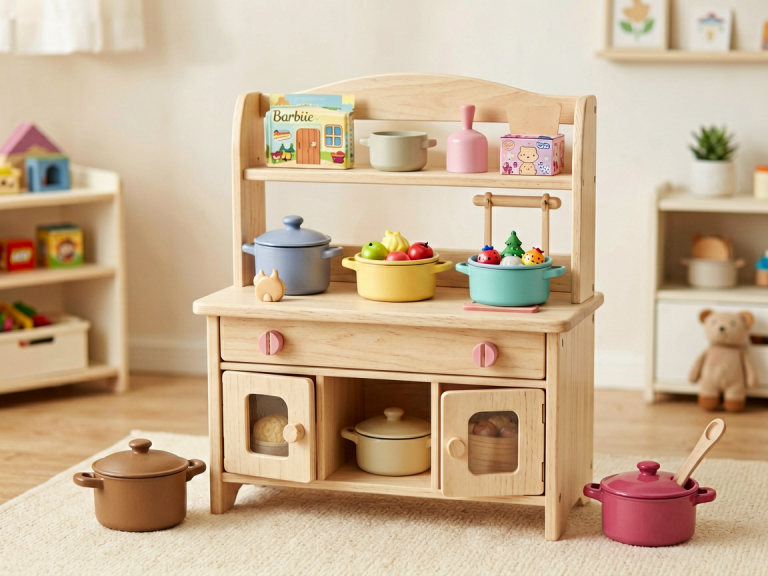
At this stage, toy kitchens, tool sets, and animal figurines become powerful literacy tools when combined with language. A toddler who pretends to “cook” with a toy pot and spoon can be prompted: “What sound does the soup make? Sssssss!” This incidental practice with the /s/ sound builds phonemic awareness without drills. The key is playful repetition. A toy telephone that records and plays back the child’s voice is especially effective; the child hears her own attempts at words and begins to self-correct.
—
Stage Three: Letter Knowledge and Print Awareness (2 – 3 Years)
Now the child is ready to notice that those squiggles on a page have meaning. Toy progression should shift toward alphabet recognition, uppercase/lowercase differentiation, and understanding that print carries a message.
Key Toy Types: Magnetic Letters, Alphabet Puzzles, and Name Stamps
A set of large, magnetic letters—especially those with a sensory texture (sandpaper, foam, or magnetic with bumps)—allows a child to feel the shape of each letter while saying its name. Start with the letters in the child’s own name; personal relevance accelerates memory. Alphabet puzzles that require matching a letter to its cutout reinforce shape recognition. Name stamps or letter stamps with washable ink let the child “write” her name on paper, introducing the concept of authorship.
Environmental Print: The Real-World Toy
Point out letters on cereal boxes, street signs, and toy packaging. Create a “letter hunt” by hiding foam letters around the room and asking the child to find “the letter that starts *your* name.” The toy progression here is intentional: move from large, single manipulatives (magnetic letters) to smaller, more precise tools (stamps). At this age, avoid overwhelming the child with the entire alphabet. Focus on a few letters at a time, using toys that allow for repetition in varied contexts—such as an alphabet book with flaps that reveal letters hidden under pictures.
—
Stage Four: Phonics, Decoding, and Simple Word Building (3 – 4 Years)
The bridge between knowing letters and actual reading is phonics—the ability to link letters to their sounds and blend them into words. Toys at this stage should encourage active decoding through hands-on manipulation.
Key Toy Types: Letter Cubes, Word Building Kits, and Interactive Electronic Readers
Letter cubes with consonants and vowels (e.g., foam cubes that can be tossed to form CVC words like “cat,” “dog,” “pig”) provide endless combinations. The child rolls the cubes, sees “c-a-t,” and sounds it out. Word building kits with sliding tiles or cards that allow the child to change the first sound (“cat” → “bat” → “hat”) reinforce rhyming and substitution. Interactive electronic readers that highlight words as they are spoken (e.g., LeapFrog Tag or similar) provide immediate auditory feedback, helping the child self-correct.
The Role of Board Games
Simple board games like “Alphabet Bingo” or “Sight Word Snakes and Ladders” transform phonics practice into a social, motivating activity. The toy is the game board; the progression is from single-word recognition to short phrases. For example, a game might require a child to read a word like “the” to move forward. Using a spinner or dice adds an element of chance that reduces anxiety. The key is that the child’s success depends on decoding, not memorization—so the toy must offer enough variety to prevent rote recall.
—
Stage Five: Fluency, Comprehension, and Independent Reading (4 – 6 Years)
The final stage of toy progression moves beyond decoding to building reading stamina and understanding. Toys should now encourage the child to read full sentences, follow a narrative, and engage with text critically.
Key Toy Types: Decodable Book Sets, Story Cubes, and Puppets
Decodable book series (e.g., BOB Books or similar) are designed with a controlled vocabulary that matches the child’s phonics knowledge. These are not “toys” in the traditional sense, but the physical format—small, colorful, and manageable—makes them feel like play. Story cubes (dice with pictures on each face) allow the child to roll and create a story by naming the objects, then attempting to write or read a sentence about them. Puppets give the child a character to “read to,” fostering expression and comprehension.
Interactive Apps and Digital Toys: A Cautionary Note
In the digital age, well-designed apps can support reading if used in moderation. For example, an app that allows the child to tap a word and hear its pronunciation—while still requiring her to blend sounds before tapping—can bridge the gap. However, the toy progression principle demands that physical manipulatives precede digital tools. A child who has not built hand-eye coordination through magnetic letters may struggle with virtual tracing. Therefore, digital toys should be introduced only after the child demonstrates comfort with concrete reading materials.
The Power of Choice: Building Motivation
At this stage, toy progression should prioritize the child’s agency. Provide a small library of decodable books from which she can choose, a box of word cards she can sort into “words I can read” and “words I want to learn,” and a simple journal with stickers to mark each book finished. The toy becomes the system of tracking progress—like a reading chart with moveable stars. This autonomy fosters intrinsic motivation, which is far more powerful than any flashcard drill.
—
Conclusion: The Lifelong Gift of Playful Literacy
Toy progression for early reading is not a rigid curriculum but a thoughtful trajectory that respects the child’s developmental readiness. It begins with the crinkle of a soft book and ends with the thrill of reading a story aloud to a stuffed bear. Each stage builds on the last, ensuring that no skill is rushed and no foundation is skipped. Parents and educators who understand this progression can confidently choose toys that are both engaging and pedagogically sound.
The true magic lies not in the toys themselves but in the interactions they inspire. A wooden letter puzzle is just wood until a caregiver says, “That’s an M! It makes the mmmm sound, like the motor of your toy train.” The toy transforms into a vehicle for connection, language, and joy. By aligning play with the science of reading acquisition, we give children not just the mechanics of literacy, but the passion for it. And that passion, once ignited, will burn brightly through a lifetime of books.