Math Play for Toddlers: Building a Foundation for Lifelong Learning Through Joyful Discovery
Introduction: The Hidden Mathematics in a Toddler’s World
When we think of mathematics, images of complex equations, algebra, and geometry often come to mind. But for a toddler, mathematics begins much earlier and far more intuitively. A one-year-old stacking blocks, a two-year-old sorting colored toys, or a three-year-old counting steps as they climb the stairs — these are not just adorable moments of childhood play. They are the very building blocks of mathematical thinking. Math play for toddlers is not about formal instruction, flashcards, or workbooks. It is about creating an environment where numbers, shapes, patterns, and spatial relationships become natural, enjoyable parts of everyday exploration. This article will explore the profound importance of math play in early childhood, provide concrete activities tailored to different developmental stages, and offer practical strategies for parents and caregivers to integrate mathematical concepts into a toddler’s world without pressure or stress.
Why Mathematics Matters So Early: The Critical Window of Development
The Brain’s Readiness for Mathematical Thinking
Neuroscientific research has demonstrated that the human brain is wired for numerical cognition from infancy. Even newborns can distinguish between small quantities, and by the age of six months, babies show a preference for patterns and sequences. The first three years of life are a period of rapid neural growth, during which the foundations for logical reasoning, problem-solving, and spatial awareness are laid. When toddlers engage in math play, they are not merely learning to count — they are strengthening the neural pathways that will later support complex mathematical reasoning, reading comprehension, and scientific thinking.
Beyond Numbers: The Full Spectrum of Early Math Skills
Many parents mistakenly believe that math for toddlers means only learning to recite numbers from one to ten. In reality, early mathematical understanding encompasses far more: number sense (understanding quantity, more and less), pattern recognition (repeating sequences, rhythms), spatial sense (shapes, positions, distances), measurement (size, weight, length), and classification (sorting by color, shape, or function). Each of these domains can be developed through playful, hands-on experiences. A toddler who fills and empties a container of water is exploring volume; one who arranges toy cars in a line is exploring ordering and sequencing; one who builds a tower of blocks is exploring balance, symmetry, and geometry.
Creating a Math-Rich Environment at Home
The Power of Loose Parts and Open-Ended Materials
The most effective math play for toddlers does not require expensive educational toys. Simple, everyday objects often provide the richest mathematical learning opportunities. Loose parts — items that can be moved, combined, and transformed — encourage experimentation and creativity. A collection of wooden spools, pebbles, bottle caps, fabric scraps, or pinecones can be used for counting, sorting, patterning, and measuring. When toddlers manipulate these objects, they develop fine motor skills while simultaneously internalizing mathematical concepts. The key is to offer materials that are safe, accessible, and varied, and then allow the child to lead the play.
Designing Spaces That Invite Mathematical Exploration
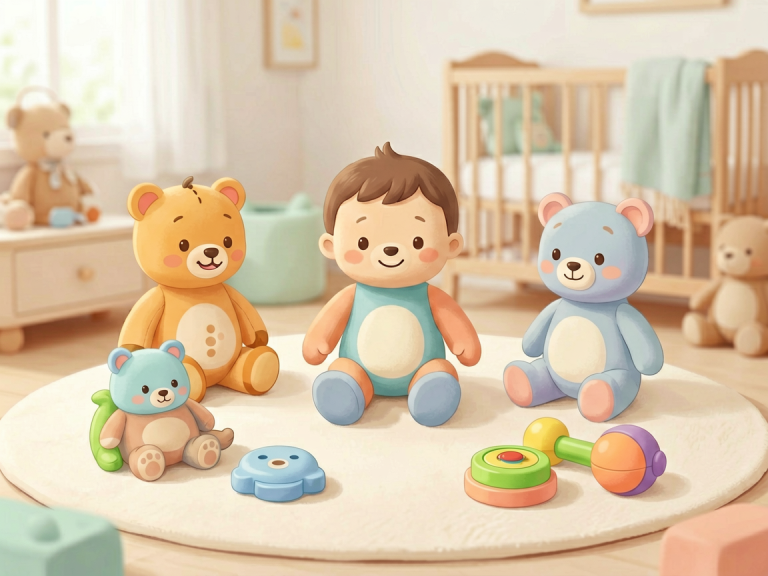
The physical environment plays a crucial role in supporting math play. A low shelf with baskets of carefully selected materials invites a toddler to choose, explore, and return items independently. A small rug or mat defines a workspace where a child can arrange objects without distraction. Wall space can display simple number charts, shape posters, or family photos arranged in a pattern. Even the arrangement of furniture can create opportunities for spatial reasoning — a tunnel made of cushions, a pathway of stepping stones, or a cozy nook where a child can line up stuffed animals. The goal is to make mathematical thinking a natural, embedded part of the daily landscape, not a separate “lesson” that must be scheduled.
Age-Appropriate Math Play Activities for Toddlers
12 to 18 Months: Sensory Exploration and First Encounters with Quantity
At this earliest stage, toddlers explore the world primarily through their senses. Math play should focus on direct, physical experiences. Fill a shallow tray with dry rice or sand and hide small objects inside — a toddler will dig, scoop, and pour, discovering concepts of “full” and “empty,” “more” and “less.” Provide stacking cups of different sizes; the child will learn about relative size and nesting through trial and error. Sing counting songs with simple hand gestures (e.g., “Five Little Ducks” or “One, Two, Buckle My Shoe”), and use your fingers to show the numbers. At this age, repetition is comforting and effective. A toddler may not say “two,” but they will begin to associate the sound with a visual quantity.
18 to 24 Months: Sorting, Matching, and Beginning Patterns
As toddlers gain more control over their hands and develop language, they become ready for more structured sorting and matching activities. Offer a muffin tin and a bowl of large buttons or pom-poms in two or three colors. Gently model placing all the red ones in one cup, all the blue ones in another. The child may imitate for a few minutes before reverting to simply dumping everything out — and that is perfectly fine. The learning is in the exposure, not the mastery. Pattern play can begin with simple alternating sequences: a red block, a blue block, a red block, a blue block. Lay out two or three repetitions and invite the toddler to continue. Even if they place a blue on red, the act of making a choice is mathematically valuable. At this stage, the adult’s role is to narrate the actions: “You put the big bear next to the little bear. One big, one little. That’s a pattern!”
24 to 36 Months: Counting with Meaning, Shapes, and Measurement
By the time toddlers reach two years old, many can recite numbers in order, but true counting — one-to-one correspondence — is still developing. Provide opportunities to count objects that the child can touch and move. Hand them three crackers and say, “Let’s count: one, two, three.” As you set the table, ask them to count the spoons, one for each plate. Play shape-hunting games: “Can you find something round in the kitchen? Something with four corners?” Introduce simple measuring tools like a balance scale or a set of measuring cups during bath time or sand play. Ask, “Which bucket holds more water?” Let them pour and compare. The concept of “longer” and “shorter” can be explored with ribbons or pieces of string, comparing them to a teddy bear’s height.
Integrating Math Play into Daily Routines
Mealtime Mathematics
Mealtime offers a natural, frequent opportunity for mathematical thinking. As you prepare food, talk about the number of plates needed, the shape of a slice of bread (square, triangle after cutting), or the size of different pieces of fruit. Let your toddler help set the table, matching each plate to a cup. Count the number of peas on their plate, or arrange carrot sticks into patterns. Even simple actions like pouring milk into a cup demonstrate concepts of volume and conservation (how much milk fits in a small cup versus a large one). The goal is not to drill but to weave mathematical language effortlessly into the conversation: “We have three plates on the table. Can you put one napkin at each plate? Let’s see — one, two, three.”
Bath Time and Water Play
Water play is a treasure trove of mathematical learning. Provide various containers — cups, bowls, funnels, squirt bottles — and let your toddler experiment with filling and emptying. They will observe that a wide, shallow container holds the same amount of water as a tall, narrow one — a precursor to understanding conservation of volume. Add floating toys and a net; count how many ducks you have caught. Use foam numbers or shapes that stick to the wall; name them and compare their sizes. The bath is also a perfect place to explore the concept of “sink” and “float,” which involves prediction and classification.
Outdoor Adventures
Nature provides endless mathematical provocations. On a walk, collect leaves, acorns, or pebbles. At home, sort them by size or color. Count the number of steps from the front door to the mailbox. Look for patterns in nature: the spots on a ladybug, the petals on a flower, the stripes on a snail shell. Draw a hopscotch grid on the sidewalk with chalk and practice hopping from one number to the next. Play “I Spy” with shapes: “I spy a round manhole cover! I spy a rectangle window!” Outdoor play also naturally involves spatial reasoning — climbing, balancing, navigating around obstacles — all of which are mathematical activities.
The Role of the Adult: Facilitating Without Forcing
The Art of Mathematical Language
One of the most powerful tools a parent or caregiver can use is language. Research shows that the amount and quality of “math talk” that children hear in early childhood significantly predicts later math achievement. Instead of simply saying, “Put that there,” use descriptive, quantitative words: “Put the red car next to the blue car. Now we have two cars in a row. How many cars do we have — let’s count together: one, two.” Use comparative language (“bigger,” “smaller,” “more,” “less”), positional language (“under,” “behind,” “next to,” “inside”), and temporal language (“first,” “then,” “after”). Embed these words naturally into your interactions, without turning every moment into a test.
Following the Child’s Lead
Effective math play is child-led, not adult-directed. Observe what your toddler is naturally interested in. If they are repeatedly taking the lids off jars and putting them back on, join in and talk about the size of the lid relative to the opening. If they are lining up toy cars, comment on the length of the line and compare it to other objects. When a toddler shows frustration or loses interest, back off. The goal is to keep mathematical experiences positive and connected to joy. Forcing a counting lesson when a child wants to run and play will only create resistance. Trust that the informal, playful exposure is doing its work below the surface.
Common Myths About Math Play for Toddlers
Myth 1: Only Gifted Children Can Grasp Math Early
This is simply untrue. Every typically developing child has the capacity to develop early mathematical thinking through appropriate experiences. What matters is not innate talent but exposure, encouragement, and a supportive environment. The brain is designed to notice patterns, quantities, and relationships — these are survival skills, not elite abilities. By offering a math-rich environment, we are not “teaching math” but rather allowing the child’s natural curiosity to flourish.
Myth 2: Math Play Means Workbooks and Screens
Many parents feel pressure to use flashcard apps or structured worksheets to give their toddler a head start. Research strongly suggests the opposite: hands-on, concrete, sensory experiences are far more effective for young children than abstract symbols on a screen or page. Toddlers learn by touching, moving, and manipulating real objects. Digital tools can be used sparingly and with intention — for example, an interactive number song video — but they should never replace direct physical play with a caregiver.
Myth 3: If They Can Count to Ten, They Understand Numbers
Rote counting is a memory skill, not a mathematical one. A toddler who can chant “one, two, three, four, five” often has no concept that “three” means three objects. True number sense develops when the child can count a set of objects and understand that the last number represents the total quantity. This understanding emerges gradually, typically around age three or four, through repeated hands-on experiences. Do not be discouraged if your toddler skips numbers or points to the same object twice when counting — they are learning the process, and perfection will come with time.
Conclusion: Planting Seeds That Will Bloom for a Lifetime
Math play for toddlers is not about early acceleration or academic pressure. It is about giving young children the gift of seeing the world as a place full of patterns, relationships, and order — a world that makes sense and can be explored with curiosity and confidence. When a toddler stacks a tower of blocks, they are not just playing; they are learning about balance, geometry, and cause and effect. When they sort buttons by color, they are developing classification skills that underlie all scientific thinking. When they sing a counting song, they are internalizing the rhythm of numbers that will later become arithmetic.
As parents and caregivers, our role is not to teach but to create conditions for learning. By offering open-ended materials, using rich mathematical language, following our child’s interests, and above all, sharing in the joy of discovery, we lay a foundation that will support not just future math classes, but a lifelong love of learning. The toddler who learns that mathematics is playful, meaningful, and connected to the real world will carry that belief into every subsequent stage of education. So let the blocks fall, let the water spill, let the counting songs be sung off-key. In these small, messy moments, the seeds of mathematical understanding are being planted — and they will bloom in due time.