Screen-Free Early Learning Toys: Nurturing Young Minds Without Digital Distractions
Introduction
In an era where toddlers swipe tablets before they can tie their shoes, the phrase “screen-free early learning toys for kids” has become a rallying cry for parents, educators, and child development experts alike. The average preschooler now spends over two hours per day in front of a screen, according to the American Academy of Pediatrics, yet research consistently shows that the most profound learning happens through hands-on, tactile, and unstructured play. Screen-free early learning toys are not merely nostalgic artifacts from a pre-digital past; they are essential tools that foster creativity, problem-solving, fine motor skills, and emotional resilience in the critical first five years of life. This article explores why stepping away from glowing rectangles and returning to wooden blocks, sensory bins, and puzzles is one of the most powerful investments we can make in a child’s future.
The Science Behind Screen-Free Play
How the Young Brain Learns Best
Neuroscience has firmly established that early brain development is driven by sensory-motor experiences. When a child grasps a textured wooden block, hefts its weight, and stacks it against another, neural pathways are forged through touch, proprioception, and cause-and-effect feedback. Screens, by contrast, offer a two-dimensional, passive experience that bypasses many of these critical sensory inputs. Dr. Dimitri Christakis, a pediatrician and researcher at Seattle Children’s Research Institute, has found that excessive screen time in early childhood is linked to attention difficulties and delayed language development. Screen-free toys encourage what psychologists call “active learning”—the child is the agent of discovery, not a passive recipient of flashing images.
The Role of Open-Ended Play
One of the most compelling arguments for screen-free early learning toys is that they are almost always open-ended. A digital app may teach a child to tap the correct animal when it squeaks, but a set of wooden animal figures invites the child to create a farm, a zoo, a rescue mission, or a tea party. Open-ended toys do not prescribe a single “right” answer; instead, they allow the child to impose their own narrative, test hypotheses, and iterate. This kind of play builds executive function—the cognitive control system that enables planning, self-regulation, and flexible thinking. A recent longitudinal study from the University of Cambridge followed children who played predominantly with open-ended physical toys versus those who used digital educational apps; the former group demonstrated significantly higher scores on creativity and divergent thinking tests by age seven.
Key Categories of Screen-Free Early Learning Toys
Building and Construction Sets
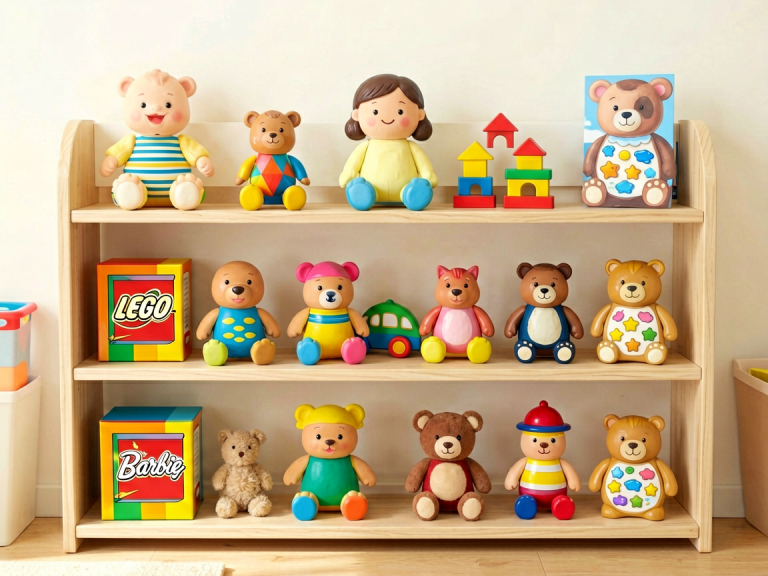
Wooden blocks, magnetic tiles, and interlocking plastic bricks are the quintessential screen-free learning toys. They teach spatial reasoning, symmetry, balance, and basic physics. When a child stacks a tower that inevitably topples, they learn about gravity and stability—a lesson far more visceral than any cartoon character explaining the same concept. Moreover, building toys encourage mathematical thinking: counting, sorting by shape or color, and later, understanding fractions and geometry. Unlike digital building games where a block can be placed with a click, physical blocks require fine motor coordination, hand-eye coordination, and patience. Brands like Unit Blocks, Magna-Tiles, and LEGO Duplo have stood the test of time for good reason.
Puzzles and Shape-Sorting Toys
From simple chunky puzzles for infants to complex jigsaw puzzles for preschoolers, these toys develop pattern recognition, problem-solving, and visual-spatial skills. A shape-sorter forces a child to mentally rotate a triangle to fit into the triangular hole—a concrete exercise in mental transformation that is foundational for later math and reading success. Screen-free puzzles also teach persistence: when a piece doesn’t fit, the child must try a different angle or look for clues, building frustration tolerance and grit. Montessori-inspired knob puzzles with realistic images of animals, vehicles, or body parts also expand vocabulary as the child names each object.
Sensory and Loose Parts Play
Sensory bins filled with rice, sand, water, or beans, combined with scoops, funnels, and small figurines, provide rich tactile input that screens cannot replicate. Loose parts—anything from buttons and pinecones to fabric scraps and bottle caps—invite infinite creativity. These toys stimulate the development of neural connections in the somatosensory cortex, which is crucial for body awareness and manual dexterity. For children with sensory processing differences, such play can be especially therapeutic. Furthermore, sensory play often involves pouring, measuring, and mixing, which introduces early concepts of volume, capacity, and cause-and-effect without a single pixel.
Pretend Play and Role-Playing Sets
Kitchen sets, tool benches, doctor kits, and dollhouses are screen-free early learning toys that nurture social-emotional development. Through pretend play, children practice empathy, negotiation, and language skills. They create scenarios—“You be the patient, I’ll be the doctor”—which requires them to take perspectives and follow narrative logic. Unlike scripted digital games that dictate what happens next, pretend play is completely child-led. A cardboard box can become a spaceship one day and a cave the next, fostering divergent thinking. Research shows that children who engage in rich pretend play develop stronger executive functions and are better at regulating emotions.
Art and Craft Materials
Crayons, finger paints, modeling clay, scissors, and glue offer a tactile, messy, and wonderfully unpredictable learning experience. Art materials support fine motor development, hand strength, and bilateral coordination (using both hands together). They also encourage self-expression and creativity. When a child draws a purple sun or a green dog, they are not making a mistake; they are telling a story and exploring possibilities. Screen-free art allows for process-oriented play rather than product-oriented consumption. Digital drawing apps, no matter how sophisticated, cannot replicate the resistance of crayon on paper or the smell and texture of play-dough.
Why Screen-Free Toys Outperform Digital “Educational” Apps
Attention and Sustained Focus
One of the most insidious effects of screen-based learning is the fragmentation of attention. Apps are designed to capture and redirect attention with rapid scene changes, rewards, and sounds. The child learns to expect constant novelty, making it harder to focus on a single, slower-paced activity. Screen-free early learning toys, on the other hand, require sustained concentration. A child working on a 24-piece puzzle may spend ten minutes in focused silence—a skill that translates directly to reading comprehension and math problem-solving in school. A 2019 study in *JAMA Pediatrics* found that children who used touchscreens more frequently had more difficulty sustaining attention and showed higher impulsivity.
Language and Social Interaction
Digital toys often replace, rather than supplement, human interaction. When a child plays with a screen, they are interacting with an algorithm; when they play with a physical toy, they are more likely to narrate their actions or engage a parent or sibling. “Look, I made a tower!” invites a conversation about height, stability, or color. This back-and-forth dialogue is the single most important predictor of early language development, according to research by Hart and Risley. Screen-free toys naturally encourage such exchanges because they are tangible and socially shareable. A digital puzzle game does not hand the child a piece and say, “Try turning it sideways”—a parent does.
Sleep and Physical Activity
Screen exposure, particularly before bedtime, suppresses melatonin and disrupts sleep patterns. Screen-free toys, especially when played with on the floor or outdoors, promote physical movement. A toddler pushing a wooden train set needs to crawl, kneel, and reach—active, gross motor behaviors that screens simply cannot provide. Physical activity boosts cognitive function, mood, and overall health. Replacing even thirty minutes of passive screen time with active play with blocks or balls can make a measurable difference in a child’s sleep quality and daily energy.
Practical Tips for Choosing and Using Screen-Free Early Learning Toys
Follow the Child’s Interests
The best screen-free toy is one that the child is naturally drawn to. Observe what your child likes: are they fascinated by how things move? Then a marble run or a set of ramps will captivate them. Do they love to cook? A play kitchen with realistic pots and wooden vegetables will encourage hours of role play. Resist the urge to buy what the marketing says is “educational” if it does not spark genuine curiosity. Good toys are simple, durable, and allow for multiple uses.
Prioritize Quality Over Quantity
A few well-chosen, high-quality toys are far more valuable than a room filled with plastic blinking gadgets. Look for toys made from natural materials like wood, metal, or organic cotton when possible. They are not only safer (no BPA, no small batteries) but also have a satisfying weight and texture that enhances the play experience. Brands like Grimm’s, Hape, and PlanToys are known for their commitment to sustainable, non-toxic materials. Remember that open-ended toys—blocks, fabrics, art supplies—never become obsolete because the child keeps discovering new ways to use them.
Create a Screen-Free Play Environment
Designate a physical space where screens are not allowed. This could be a corner of the living room with a low shelf of accessible toys, a playmat on the floor, or a dedicated playroom. Store toys in open bins so children can see and choose their materials. Rotate toys every few weeks to renew interest. Avoid interrupting deep play with TV in the background; even ambient screen noise can distract. Make the play area inviting and organized so that the child is drawn to it naturally.
Model Screen-Free Behavior Yourself
Children learn far more from what we do than what we say. If you are scrolling on your phone while handing them a wooden block, they will intuit that the screen is more valuable. Set aside dedicated times—such as after dinner or on weekend mornings—where the whole family is screen-free. Engage in parallel play: build your own tower next to theirs. This not only models focused attention but also strengthens your bond. Screen-free early learning is most effective when it is part of a family culture, not just a rule for children.
Conclusion: A Return to the Tangible World
The rise of screen-free early learning toys is not a rejection of technology; it is a recognition that the most fundamental human skills cannot be downloaded. Creativity, empathy, resilience, and critical thinking are forged in the messy, slow, repetitive, and joyful process of manipulating real objects in the real world. A child who builds with blocks, paints with their fingers, and pretends to be a firefighter is not merely playing—they are constructing the neural architecture that will support a lifetime of learning. As parents, educators, and caregivers, the simplest gift we can offer is to take away the screen and hand them something that asks for their imagination, their hands, and their whole selves. In doing so, we give them the greatest educational advantage of all: the freedom to learn at their own pace, through their own senses, and in their own time.