Unlocking the Joy of Language: A Comprehensive Guide to Language Toys for Beginners
Introduction
Learning a new language is a journey that begins with curiosity and is sustained by engagement. For beginners—whether young children acquiring their first language or older learners stepping into a foreign tongue—the process must be natural, enjoyable, and multi-sensory. This is where language toys come into play. Far from being mere distractions, well-designed language toys for beginners bridge the gap between abstract linguistic rules and tangible, hands-on experience. They transform passive listening into active exploration, turning vocabulary drills into games and grammar puzzles into playful challenges. In this article, we will explore the profound role that language toys play in early language acquisition, categorize the most effective types for beginners, discuss criteria for selection, and offer practical tips for maximizing their educational value. By the end, you will understand why these tools are not just entertaining but essential stepping stones on the path to fluency.
The Importance of Play in Language Acquisition
Why Play Matters for Beginners
Play is the natural language of childhood, but its benefits extend to learners of all ages. Research in developmental psychology and neuroscience consistently shows that play activates multiple regions of the brain simultaneously, strengthening neural connections that underpin language skills. When a beginner interacts with a language toy, they are not simply memorizing words; they are associating sounds with objects, actions with meanings, and emotions with expressions. This multisensory engagement—seeing, touching, hearing, and sometimes even smelling or tasting—creates richer memory traces than rote repetition ever could. For a toddler learning their native language, a plush animal that says “moo” when squeezed provides immediate auditory feedback and a concrete referent. For an adult learning Spanish, a set of magnetic food magnets used in a pretend restaurant game does the same. The key is that play lowers the affective filter—the anxiety that often blocks language learning—by making mistakes acceptable and experimentation fun.
The Role of Repetition and Variation
Language toys for beginners excel at providing the kind of repetitive exposure that is crucial for acquisition, but they do so with built-in variation. A simple alphabet puzzle, for instance, requires the learner to fit each letter into its correct slot multiple times, but each attempt feels different because the learner’s focus shifts from shape to sound to order. Similarly, a talking flashcard set that pronounces words in different contexts—asking “where is the cat?” one day and “what does the cat say?” another—keeps the learning fresh. This alternating pattern of repetition and novelty is exactly what the brain needs to consolidate new vocabulary and grammatical patterns into long-term memory. Without play, repetition quickly becomes drudgery; with it, repetition becomes a rewarding challenge.
Categories of Language Toys for Beginners
Interactive Talking Toys
Among the most popular and effective language toys are those that speak back. These include electronic storybooks that highlight words as they read aloud, talking plush animals that ask questions and respond to answers, and interactive globes that provide names of countries in multiple languages. For absolute beginners, the immediate auditory feedback is invaluable. When a child presses a button and hears “apple,” then sees a picture of an apple, the neural link between the word and the concept is forged instantly. More advanced talking toys add layers of complexity by prompting the learner to repeat words, answer yes/no questions, or choose from multiple options. For example, a toy that says “Find the red ball!” and then reacts when the correct object is touched reinforces both vocabulary and listening comprehension. These toys are especially effective for learners who are not yet confident in their pronunciation because they provide a non-judgmental model to mimic.
Manipulative and Building Toys
Toys that require physical manipulation—such as alphabet blocks, magnetic letters, puzzle mats, and word-building tiles—engage the kinesthetic learner. For beginners, the act of picking up a block, feeling its texture, and placing it in the correct order activates muscle memory in addition to auditory and visual processing. A classic wooden alphabet set allows a child to spell out simple words like “cat” or “dog” while saying each letter name or sound. Similarly, a sentence-building puzzle where pieces fit together only when the grammar is correct (e.g., subject-verb-object order) provides implicit instruction in syntax. These toys are particularly powerful for learners who struggle with passive listening because they require active decision-making. The physicality of the task also helps maintain attention, a critical factor for beginners whose concentration spans may be short.
Card and Board Games
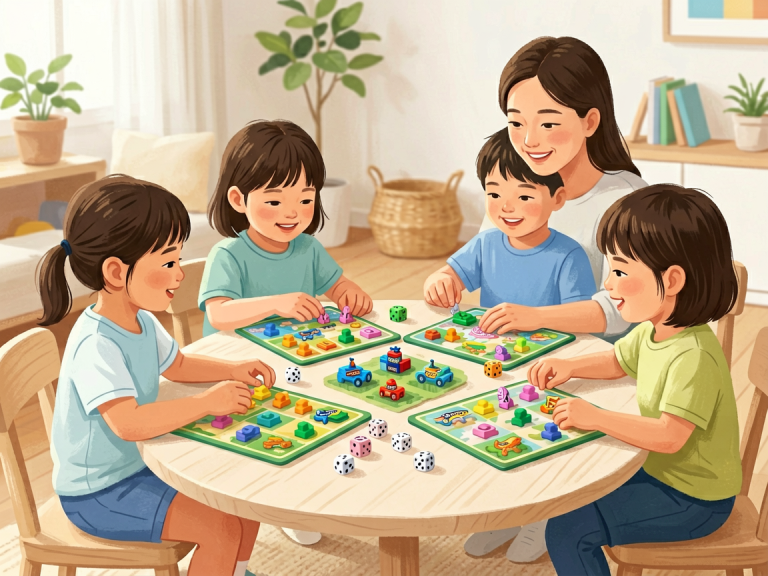
Language-learning card games—such as memory match with vocabulary pairs, bingo with picture cards, or “Go Fish” using language prompts—turn social interaction into a learning opportunity. Unlike solo toys, games often require turn-taking, asking questions, and responding, which naturally practices conversational skills. For beginners, the game structure provides a safe framework: the rules are clear, the goal is concrete (e.g., collect the most pairs), and the language use is contextualized. A simple game like “I Spy” adapted with a set of vocabulary cards forces the learner to produce descriptive language: “I spy something red and round—it is a ball.” Board games that incorporate dice and moving pieces can be customized to include language challenges on each square, such as “Name three animals” or “Say ‘hello’ in French.” The competitive or cooperative element adds motivation, and repeated play ensures that vocabulary is recycled naturally.
Storytelling and Role-Play Sets
Puppets, felt boards, dollhouses, and themed playsets (e.g., a doctor’s kit or a kitchen set) encourage imaginative play, which is perhaps the richest context for language development. When a beginner uses a puppet to “talk” to another puppet, they experiment with dialogue, tone, and narrative. They learn not just isolated words but how language functions in real-life situations—ordering food, asking for help, describing emotions. For example, a simple playset with toy fruits, a cash register, and play money can simulate a grocery store, where the learner practices phrases like “How much does this cost?” or “I would like three apples.” Role-play sets are especially effective for children learning a second language, as they allow them to practice without the pressure of real-world consequences. The teacher or parent can model language, and the learner can repeat, modify, and eventually initiate.
Key Features to Look for When Selecting Language Toys
Age-Appropriateness and Developmental Level
The best language toy for a one-year-old is very different from that for a six-year-old or an adult beginner. For infants, toys that produce simple, exaggerated sounds and have high-contrast visuals are ideal, as they support early phonemic awareness. For toddlers, toys with a single word per button and clear picture-word matching work best. For preschoolers, toys that introduce short phrases, questions, and simple narratives are appropriate. For older children or adults who are absolute beginners, look for toys that explicitly teach the target language's core vocabulary (colors, numbers, everyday objects) and basic sentence structures (subject-verb-object). Always check the recommended age range, but also consider the learner’s current language proficiency level. A toy labeled for ages three to six might still be useful for a seven-year-old beginner if it covers unfamiliar content.
Multi-Sensory Engagement
Toys that engage more than two senses tend to be more effective. Ideally, a language toy should involve sight, sound, and touch. Some toys also incorporate smell or movement (e.g., a toy that vibrates when a correct answer is given). Visual elements should be clear and uncluttered; audio should be clear and spoken at a moderate pace; tactile components should be varied in texture and shape. Avoid toys that are overly reliant on screens or that primarily produce noise without meaningful linguistic content. A well-designed toy encourages the learner to interact physically—pressing, sliding, turning, matching—rather than passively watching or listening.
Progressive Difficulty and Feedback
A superior language toy offers multiple levels or modes, allowing the learner to progress from simple recognition (point to the apple) to production (say the word for apple) to comprehension (what is red and round?). The toy should provide immediate, clear feedback—both positive reinforcement for correct answers and gentle correction for mistakes. For example, a talking puzzle might make a rewarding sound when the piece fits correctly, or it might say “Try again!” if the wrong piece is placed. This feedback loop keeps the learner engaged and helps them self-correct without frustration. Avoid toys that punish mistakes harshly or that have only one mode, as beginners need the chance to revisit material at their own pace.
Cultural Relevance and Authenticity
For learners acquiring a second language, toys that reflect the culture where the language is spoken can be highly motivating. A toy that teaches Spanish with Latin American music, traditional foods, and familiar celebrations (like a piñata) provides context that goes beyond vocabulary. Similarly, a toy that introduces Japanese using simple Kanji characters (with pronunciation) or a story about a Japanese festival helps learners understand language as a living system embedded in culture. Even for native language beginners, toys that include diverse characters and settings expose children to a wider world, which fosters curiosity and empathy.
Practical Strategies for Parents and Educators
Create a Structured Yet Flexible Routine
While free play is crucial, some structure can maximize learning. Set aside a regular “toy time” of 15–20 minutes per day, during which the language toy is the focus. During this time, the adult models language use—for instance, saying “I see a blue square” while placing a magnetic shape on the board—and then invites the learner to imitate. Over time, the adult can gradually reduce support, allowing the learner to take the lead. It is important to follow the learner’s interest; if they become fascinated with the animal sounds on a toy, spend extra time there rather than pushing to the next level. The routine should be consistent but flexible enough to accommodate spontaneous exploration.
Combine Toys with Real-Life Contexts
Language toys are most effective when their content transfers to real life. After playing with a toy that teaches food vocabulary, take the learner to the grocery store and point out the same items. If the toy teaches directions (left, right, straight), use those words while walking in the neighborhood. This bridging between toy world and real world reinforces that language is not just a game but a tool for communication. For beginners, this transfer builds confidence and demonstrates the practical utility of their new skills.
Encourage Peer and Family Interaction
Language toys are even more powerful when used in a social setting. Siblings, parents, or friends can take turns playing together, creating opportunities for meaningful dialogue. For example, using a board game designed for language learning, one player can read a prompt and the others must respond. Even simple toys like alphabet blocks can become a collaborative activity when two learners build words together. The social element provides motivation, models turn-taking, and allows for peer scaffolding—where one learner helps another. For adults learning a language together, using a role-play set can reduce the fear of embarrassment and make practice feel natural.
Monitor Progress and Rotate Toys
Beginner learners may initially be excited by a new toy, but that novelty can wear off. To keep engagement high, rotate the available toys every few weeks. Have a box of three to five toys accessible, and when interest wanes, swap in new ones from storage. Keep a log of words or phrases the learner has mastered—perhaps a sticker chart or a simple checklist. This not only provides a sense of achievement but also helps the adult know when to introduce more advanced toys. Avoid overloading the learner with too many toys at once; focus on depth rather than breadth.
Beyond the Toys: Creating a Language-Rich Environment
The Role of Adult Speech
No toy, no matter how sophisticated, can replace the quality of human interaction. Adults should use the language toys as springboards for conversation, not as babysitters. While the toy says “elephant,” the adult can expand: “Yes, that’s an elephant. Elephants are big and grey. They have long trunks. Can you make a trunk with your arm?” This expansion provides richer input, introducing new vocabulary and grammatical structures in a natural, contextualized way. For beginners, this adult modeling is crucial because it demonstrates how words combine into sentences and how sentences connect to create meaning.
Integrating Reading and Writing
For beginners who are old enough (typically around age four or five), language toys can be paired with simple books and writing tools. After playing with a letter puzzle, read an alphabet book together. After using a set of word cards, try writing the words with crayons or markers on a whiteboard. This multisensory approach—hearing, seeing, saying, and writing—strengthens neural pathways and supports literacy development. For older absolute beginners, consider toys that include a “spelling mode” where the learner is prompted to build words from letters, reinforcing orthographic awareness.
Digital vs. Physical Balance
In an era of apps and screens, it is worth noting that physical language toys offer unique advantages: they develop fine motor skills, require three-dimensional spatial reasoning, and allow for social interaction without a screen barrier. However, well-designed digital toys (such as interactive story apps with touch gestures) can also be valuable, especially for learners who are already drawn to technology. The key is balance. A beginner should spend the majority of their language-play time with physical objects that they can manipulate and share, with digital tools used sparingly as a supplement. The tactile feedback of a wooden block or a plush puppet cannot be replicated by a tablet screen.
Conclusion
Language toys for beginners are far more than simple playthings; they are carefully engineered tools that tap into the innate human drive to explore, imitate, and create. By engaging multiple senses, providing immediate feedback, and embedding language in meaningful, fun contexts, these toys lay a solid foundation for lifelong linguistic competence. Whether it is a toddler discovering the sound of a cow, a preschooler learning the alphabet through magnetic letters, or an adult practicing basic greetings with a flashcard game, the principles remain the same: start with the concrete, repeat with variation, and always keep the experience joyful. As you choose and use language toys, remember that the goal is not to rush toward fluency but to cultivate a love of language itself. When a beginner laughs while learning, they are not just playing—they are building the brain pathways that will one day allow them to speak, read, and think in a new language with ease. So go ahead, pick up that talking globe or that set of animal puzzles, and watch as the world of words opens up, one toy at a time.