Building Words, One Playtime at a Time: The Best Toys for Language Development in 4-Year-Olds
Introduction
At the age of four, children are linguistic whirlwinds. Their vocabulary expands from roughly 1,000 to 1,600 words, they begin to form complex sentences, ask endless “why” questions, and experiment with storytelling. This is a critical window for language acquisition—not through formal lessons, but through play. The right toys can transform everyday fun into a rich linguistic environment, fostering vocabulary growth, narrative skills, turn-taking, and phonological awareness. But not all toys are created equal. The best toys for language development at this age are those that spark conversation, encourage imaginative thinking, and require verbal interaction. This article explores the most effective categories of toys for boosting a 4-year-old’s language skills, with specific recommendations and explanations of how each supports communication development.
1. Pretend Play Sets: The Theater of Everyday Language
Pretend play is the bedrock of language development for a 4-year-old. When children engage in make-believe, they naturally adopt different voices, negotiate roles, and narrate scenarios. Toys that facilitate this kind of play—such as play kitchens, doctor’s kits, tool benches, or dollhouses—are invaluable.
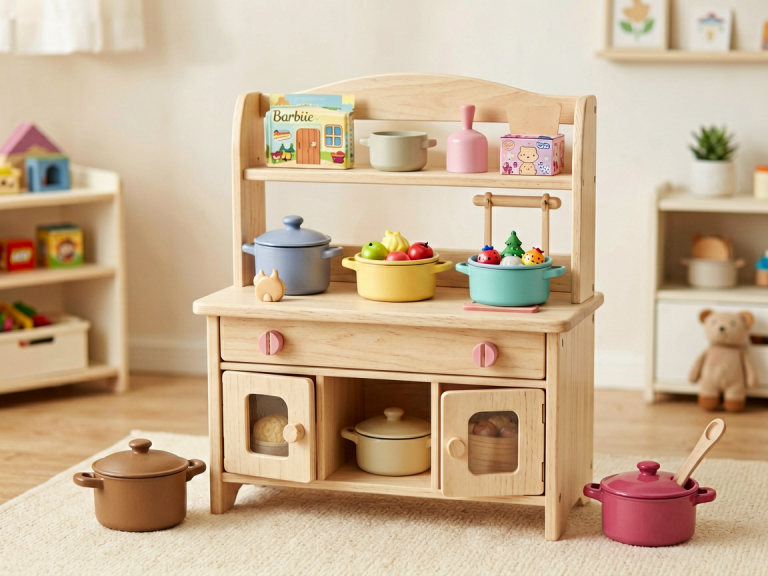
A play kitchen, for example, invites a child to become a chef, a customer, or a waiter. As they “cook” a meal, they might say, “I need eggs and milk. Can you help me stir it?” This forces them to use imperative sentences, question forms, and descriptive vocabulary. The parent or caregiver can join in, modeling more complex language: “What are you making for dessert? Should we add some sugar?” The back-and-forth dialogue strengthens pragmatic language skills—knowing how to take turns, ask for clarification, and respond appropriately.
Doctor kits are especially powerful because they encourage children to use empathy-based language: “Don’t worry, I’ll make you feel better. Open wide and say ‘ah.’” This type of speech involves understanding the listener’s perspective, a key component of social communication. Moreover, children learn vocabulary related to body parts, emotions, and actions.
Key recommendation: *Melissa & Doug Let’s Play House! Stainless Steel Pots and Pans Set* paired with a simple wooden play kitchen. The realistic accessories prompt richer language than abstract toys.
2. Storytelling and Sequencing Toys: From Words to Narratives
Narrative ability—the capacity to tell a story with a beginning, middle, and end—is a sophisticated language skill that typically emerges around age four. Toys that support sequencing and storytelling help children organize their thoughts and express them coherently.
Story cubes, such as *Rory’s Story Cubes*, are brilliant for this. Each cube has pictures on its faces, and children roll a set and create a story linking the images. This forces them to generate sentences on the spot, use connecting words like “then,” “because,” and “after,” and develop a plot. For a 4-year-old, you can start with just three cubes and help them create a simple tale. Over time, they learn to add characters, settings, and conflicts.
Another excellent option is magnetic storyboards or felt boards with interchangeable characters and backgrounds. Children can move pieces around and narrate what is happening. This kinesthetic element aids memory and engagement. For instance, a farm set with animals and a barn allows a child to say, “The cow is eating grass. Now the farmer comes to milk the cow. Then the cow says, ‘Moo!’” This kind of structured play builds temporal language and cause-effect relationships.
Key recommendation: *Educational Insights Phonics & Storytelling Activity Set* or *Magnetic Storyboard by Kid O*. Both offer open-ended possibilities that grow with the child.
3. Interactive Books and Audio-Enhanced Toys: The Sound of Language
While traditional picture books are essential for vocabulary and print awareness, 4-year-olds also benefit from toys that incorporate audio feedback. These toys expose children to correct pronunciation, intonation, and new words in a low-pressure, repeatable format.
LeapFrog’s *LeapReader* or *Tad’s Get Ready for School Book* allow children to touch words and hear them spoken aloud. This is particularly useful for children who are auditory learners or who need extra support with phonological awareness—the ability to hear and manipulate sounds in words. By pressing a word and hearing it pronounced, children build the connection between written symbols and spoken sounds, a precursor to reading.
Toys that sing songs, recite rhymes, or ask questions also boost language. For example, the *Fisher-Price Laugh & Learn Smart Stages Chair* includes phrases that prompt responses: “Where is your nose?” or “Can you say ‘apple’?” While these toys are more structured, they provide valuable repetition and exposure to question syntax. However, it’s crucial to balance electronic toys with human interaction—the toy should be a springboard for conversation, not a replacement.
Key recommendation: *LeapFrog LeapStart 3D Interactive Learning System* (with the Preschool-level book pack) offers a rich audio experience combined with hands-on activities.
4. Cooperative Board Games and Card Games: The Rules of Dialogue
Games that require turn-taking, following instructions, and simple verbal exchanges are excellent for language development. Unlike competitive games that may cause frustration, cooperative games (where players work together toward a common goal) encourage children to express ideas, ask for help, and celebrate success with words.
*Hoot Owl Hoot!* by Peaceable Kingdom is a color-matching cooperative game. Players take turns rolling dice and moving owls to the nest. The game naturally prompts language like, “My turn! I got a red card. I can move the purple owl.” Parents can model more elaborate sentences: “Let’s see which owl is closest to the nest. If we move that one, we might win faster.” This exposes children to comparative language (“closest,” “faster”) and hypothetical thinking (“if… then”).
Card games like *Spot It!* or *Zingo!* (a bingo-style word game) build vocabulary and quick retrieval. In *Zingo!*, children must shout out the word matching the picture on their card. This improves word recognition and expressive naming. The fast-paced nature also encourages clear articulation—if you mumble, you might miss your chance.
Key recommendation: *Peaceable Kingdom’s Feed the Woozle* (a cooperative game with silly oral-motor and language tasks) and *ThinkFun Zingo!* (a classic for vocabulary building).
5. Building Blocks and Construction Toys: Spatial Vocabulary and Problem-Solving Talk
Construction toys like wooden blocks, LEGO Duplo, or magnetic tiles might seem purely spatial or motor-focused, but they are surprisingly rich in language opportunities. As children build towers, bridges, or houses, they naturally describe their actions and plans.
A 4-year-old stacking blocks might say, “I need a big one for the bottom. This one is too small. It fell down!” This spontaneous speech includes size comparisons, cause-effect reasoning, and frustration expressions—all of which are authentic language learning moments. When a parent asks, “What are you building? How many blocks do you need?” the child is prompted to use number words, prepositions (on, under, beside), and spatial language.
Magnetic tiles like *Magnatiles* are especially effective because they allow for easy construction of 3D shapes. Children can build a house and then create a story about who lives there. This merges construction with narrative. “This is the kitchen. The mommy bear cooks soup. The baby bear is sleeping upstairs.” The open-ended nature of blocks means the language possibilities are endless.
Key recommendation: *Melissa & Doug Standard Unit Blocks* (classic wooden blocks in various shapes) and *PicassoTiles 100-Piece Magnetic Building Tiles*. Both encourage collaborative building and verbal planning.
6. Puppets and Plush Toys: Dialogues and Voice Modulation
Puppets are a magical tool for language development because they give a child permission to speak in different voices and try out new words without self-consciousness. A child who may be shy speaking directly to an adult will happily chatter away to a sock puppet or a hand puppet.
Using a puppet, a child can “become” a grumpy bear, a silly monkey, or a princess. This role-shifting requires them to adjust their tone, pitch, and vocabulary. For example, a monster puppet might say, “I’m going to eat you!” while a gentle bunny puppet says, “Please share your carrot with me.” This develops understanding of socio-linguistic cues—how the same words can sound different depending on the speaker.
Puppets also encourage dialogue between the child and the adult. The adult can ask the puppet questions, and the child answers for the puppet. This indirect communication reduces anxiety and promotes longer, more complex responses. Children also learn to listen to what the other puppet says and respond appropriately—a crucial conversational skill.
Key recommendation: *Folkmanis Mini Ferret Hand Puppet* (realistic and easy to manipulate) or a simple set of character puppets from a store like *IKEA*. The simpler the puppet, the more room for the child’s imagination.
7. Musical Instruments and Sound Toys: Rhyme, Rhythm, and Phonological Awareness
Language is inherently rhythmic and musical. Toys that produce sound—drums, xylophones, shakers, or singing microphones—help children develop phonological awareness, which is the ability to hear and manipulate sounds in words. This skill is a strong predictor of later reading success.
Simple instruments like a set of *Remo Rhythm Kids* drums allow a child to tap along to nursery rhymes while singing. When a parent sings “Twinkle, Twinkle, Little Star” and the child taps the drum on the stressed syllables, they are learning about the beat of language. This translates into understanding syllables in words later on.
A toy karaoke microphone (like the *Kidzlane Karaoke Machine*) encourages children to sing songs and repeat phrases. Even if the words are garbled, the act of matching voice to sound and trying to produce clear words is beneficial. Parents can pause the song and ask, “What did the song say next?” This builds auditory memory and recall.
Key recommendation: *Hape Early Melodies Xylophone* (tuned correctly for pleasant sound) and *VTech KidiBeats Drum Set* (which includes different modes for learning letters and phonetics through music).
Conclusion
Choosing toys for a 4-year-old’s language development isn’t about buying the most expensive or high-tech items. It’s about selecting tools that invite conversation, storytelling, and social interaction. The best toys are those that a child can use with others—parents, siblings, or friends—and that naturally require words to function. From pretend play sets that spark entire imaginary worlds to puppets that give a shy child a voice, each toy on this list provides a unique avenue for vocabulary expansion, sentence building, and communication confidence.
Remember that the toy itself is only a catalyst. The real magic happens when an adult sits on the floor, picks up a block or a puppet, and says, “Tell me about this. What happens next?” By combining these carefully chosen toys with rich, responsive conversation, you create an environment where language blossoms naturally. Play, after all, is the child’s most powerful teacher—and the best toys are simply the ones that make that play talk.