The Ultimate Math Toys Buying Guide: How to Choose the Best Educational Toys for Every Age
Mathematics is often considered a challenging subject, but it doesn’t have to be boring. With the right tools, children can develop a love for numbers, patterns, and logic from an early age. Math toys are not just playthings; they are powerful learning instruments that build foundational skills in counting, geometry, problem-solving, and spatial reasoning. However, with the overwhelming variety available on the market—from wooden counting blocks to programmable robots—parents and educators often struggle to select the most appropriate options. This comprehensive buying guide will walk you through everything you need to know, from age-appropriate choices to key features, budget considerations, and trusted brands. By the end, you’ll be equipped to make informed decisions that turn playtime into a meaningful mathematical adventure.
Why Math Toys Matter: More Than Just Numbers
Before diving into specific products, it is essential to understand why investing in math toys is worthwhile. Traditional teaching methods often rely on rote memorization and worksheets, which can disengage young learners. Math toys, on the other hand, introduce concepts through hands-on, interactive experiences. When a child physically manipulates objects—stacking rings, sorting shapes, or balancing a scale—they are not just playing; they are internalizing abstract ideas. Research in developmental psychology shows that kinesthetic learning strengthens neural connections, making concepts like addition, fractions, and symmetry intuitive rather than intimidating.
Moreover, math toys foster a growth mindset. When a child builds a tower that keeps falling, they learn to try different approaches, measure angles, and adjust their strategy. This process teaches resilience and logical thinking, skills that extend far beyond mathematics. High-quality math toys also encourage open-ended exploration. Unlike a video game with a fixed outcome, a set of pattern blocks or a geometric puzzle allows for endless creativity. Children can ask their own questions, test hypotheses, and discover patterns on their own terms. Therefore, the right math toy is not merely a teaching aid; it is a gateway to curiosity and lifelong learning.
Age-by-Age Recommendations: Matching Toys to Developmental Stages
One of the most common mistakes in buying math toys is choosing a product that is either too simple or too advanced. Children’s cognitive abilities develop in predictable stages, and toys should align with these milestones to maximize engagement and learning. Below is a breakdown by age group, with specific examples and reasoning.
0–2 Years: Sensory Exploration and Early Number Awareness
For infants and toddlers, math is all about sensory input and cause-and-effect. At this stage, toys should focus on basic concepts like size, shape, and quantity. Soft fabric blocks with contrasting colors allow babies to grasp, stack, and knock down items, introducing the idea of one-to-one correspondence. Nesting cups or stacking rings teach size sequencing and spatial relationships. Look for toys with different textures, sounds, and bright colors to stimulate multiple senses. Avoid small parts that pose choking hazards, and prioritize durable, non-toxic materials. Popular options include the Fisher-Price Rock-a-Stack, Manhattan Toy Skwish Classic, and simple wooden shape sorters. These toys do not require the child to “count” but lay the groundwork for numerical understanding through repetition and physical interaction.
3–5 Years: Counting, Sorting, and Simple Operations
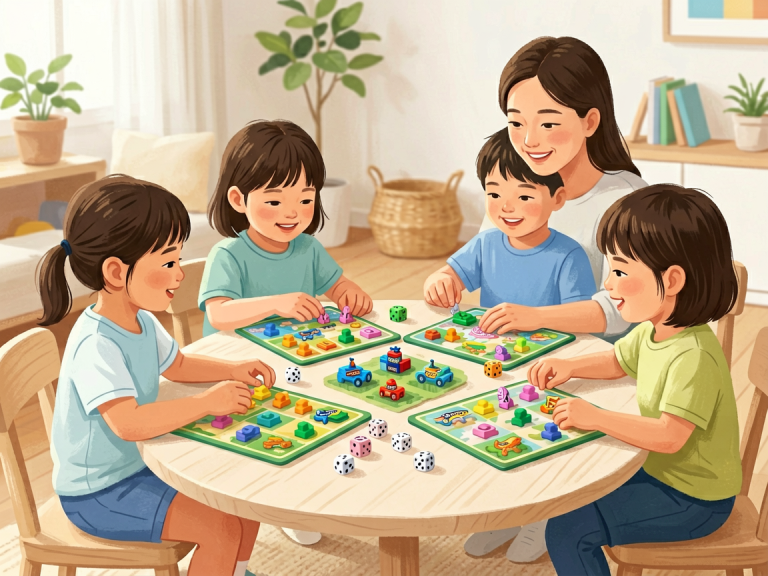
Preschoolers are ready for more structured mathematical play. Their developing language skills allow them to count aloud, and their fine motor skills enable them to handle smaller objects. At this age, toys should emphasize counting, pattern recognition, and basic addition and subtraction. A classic choice is a set of colorful counting bears or dinosaur counters paired with sorting trays—children can group by color, size, or type while practicing one-to-one correspondence. Number puzzles, where each puzzle piece fits only into the correct number slot, reinforce numeral recognition. For early operations, consider a simple abacus with large, colorful beads. Linking cubes (like Learning Resources MathLink Cubes) are particularly valuable because they can snap together, allowing children to physically combine groups and see addition in action. Board games such as “Hi Ho! Cherry-O” or “Count Your Chickens” also integrate counting and turn-taking, making math social and fun.
6–8 Years: Place Value, Geometry, and Problem-Solving
As children enter elementary school, math toys need to address more complex topics like place value, fractions, and basic geometry. Manipulatives become especially important for bridging concrete and abstract thinking. For place value, a set of base ten blocks (units, rods, flats, and cubes) is indispensable. Children can model numbers like 34 as three rods and four units, understanding that the “3” stands for thirty. Fraction circles or tiles allow them to see that two quarters make a half, a concept that is notoriously difficult without visual aids. Geometric building sets, such as Magna-Tiles or Geomag, let children construct 2D and 3D shapes, exploring vertices, edges, and symmetry. Logic puzzles like Sudoku for kids or Rush Hour Junior develop deductive reasoning. Additionally, board games such as “Sum Swamp” or “Money Bags” turn arithmetic and coin counting into playful challenges. At this stage, digital math toys can also be introduced in moderation, such as an Osmo Genius Kit that uses physical pieces to interact with a tablet app.
9–12 Years: Advanced Problem-Solving, Algebra, and Engineering
For pre-teens, math toys should stretch their reasoning and introduce pre-algebraic thinking. Kits that combine math with engineering or coding are particularly effective. For example, a K’NEX education set or LEGO Technic allows children to build machines that require gears, pulleys, and levers—forces that involve mathematical ratios. For algebra, a balance scale with weights can be used to explore equations visually: if 2x + 3 = 9, what must be on the other side? Strategy games like “Blokus” or “Qwirkle” teach spatial planning and pattern matching. For fraction and decimal concepts, consider a folding geometric ruler or a fraction domino set. Coding robots like Sphero or Botley introduce loops, sequences, and variables in a tangible way. Many of these toys require sustained attention and multi-step planning, which builds executive function and mathematical perseverance.
Key Features to Look For: What Makes a Math Toy Effective
Beyond age recommendations, certain features consistently distinguish high-quality math toys from mediocre ones. Here are the critical attributes to evaluate before making a purchase.
Open-Ended Play Potential
The best math toys do not dictate a single right answer. Instead, they offer multiple ways to play and learn. For instance, a set of pattern blocks can be used for mosaics, symmetry exercises, fraction exploration, and even storytelling. Open-ended toys grow with the child, providing new challenges as their skills develop. Avoid toys that are purely “quiz” based or have limited interactions.
Durability and Safety
Children often handle toys roughly, and math toys are no exception. Look for solid construction, especially in items that involve magnets, hinges, or small pieces. For younger children, ensure edges are rounded and that the toy meets safety standards (e.g., ASTM or CE certification). Wooden toys with non-toxic paint are often a safe choice. For magnetic toys, check that magnets are securely encased to prevent ingestion.
Multi-Sensory Engagement
Mathematical concepts become more memorable when multiple senses are involved. Toys that combine visual patterns with tactile feedback—such as raised textures on number cards or click-together cubes—help reinforce learning. Sound features (like a counting robot that claps) can also be beneficial, though they should not overwhelm other senses. Variety in shapes, colors, and materials keeps children engaged.
Scaffolding and Gradual Difficulty
A well-designed toy should include a progression of challenges. Some kits come with activity cards that range from easy to expert. Others allow children to self-regulate by choosing which pieces to use. For example, a set of tangram puzzles might start with 3-piece figures and advance to 7-piece complex shapes. The presence of a guide or parental resource can also help adults facilitate learning without taking over.
Compatibility with Curriculum
While not strictly necessary, toys that align with common math standards (such as Common Core or NCTM) can reinforce what children learn in school. For example, “Ten Frame” sets directly support base-ten understanding taught in early elementary math. If you are a homeschooler or want to supplement schoolwork, look for toys that target specific topics like fractions, telling time, or measurement.
Types of Math Toys: A Categorical Overview
The math toy market is vast, but most products fall into a few distinct categories. Understanding these categories will help you narrow down choices based on your child’s interests and learning style.
Counting and Number Toys
This category includes number puzzles, counting beads, and abacuses. They are essential for early numeracy and remain useful through first grade. Some clever designs combine counting with fine motor skills—such as a wooden board with holes where children drop the correct number of pegs.
Shape and Geometry Toys
Pattern blocks, tangrams, magnetic tiles, and 3D building sets fall here. These toys develop spatial awareness and geometric vocabulary. They are also excellent for teaching symmetry, area, and angles. For older children, products like Zometool or Geodesic Dome kits introduce complex polyhedra.
Operation and Equation Toys
These include balance scales, number line games, and board games that require arithmetic. They turn abstract equations into physical actions. For example, a “Math Dice” game challenges players to roll dice and combine numbers to reach a target, promoting quick mental math.
Logic and Strategy Toys
Puzzles like Rubik’s Cube, Sudoku, and logic grids train deductive reasoning. Strategy games like Chess, Checkers, or “Settlers of Catan” involve resource management and probability. Even simple card games like “War” can be adapted for comparing numbers.
Coding and STEM Math Toys
Robotics kits, coding board games, and programmable calculators blend math with technology. Bee-Bot, a programmable floor robot, teaches sequencing and angles. Sphero RVR allows more advanced coding with sensors. These toys demonstrate real-world applications of math, from algorithms to geometry.
Budget Considerations: Getting the Best Value
Math toys range from a few dollars to hundreds. While price does not always correlate with quality, certain strategies can help you maximize your budget.
- Start Small: For very young children, inexpensive items like a set of colored counting bears (around $10) can provide months of play. Avoid the temptation to buy the largest kit immediately.
- Invest in Multi-Use Sets: A high-quality set of magnetic tiles or building cubes may cost $50–$80, but it can be used from ages 3 to 10 with increasing complexity. This is often better than buying several single-purpose toys.
- Look for Second-Hand Options: Thrift stores and online marketplaces often have gently used math toys. Check for missing pieces and cleanliness.
- Consider Library Lending: Some public libraries have toy-lending programs. This allows you to try before you buy.
- Balance Digital and Physical: Apps and online games can be free or low-cost, but they lack the tactile benefits of physical toys. A hybrid approach often works best.
Where to Buy: From Specialty Stores to Online Retailers
Math toys are widely available, but not all retailers are equal. Here are reliable sources:
- Specialty Educational Stores: Learning Resources, Lakeshore Learning, and MindWare offer curated selections with detailed age labels. Prices can be higher, but quality is consistent.
- Major Online Retailers: Amazon and Walmart have vast inventories, but reviews are essential. Look for products with a high number of verified purchases and positive feedback on durability.
- Direct from Brands: Companies like Magna-Tiles, Fat Brain Toys, and Melissa & Doug often have official websites with sales and bundle deals.
- Local Toy Stores: Independent shops frequently carry unique, high-quality items and knowledgeable staff who can provide personalized recommendations.
Final Tips for Maximizing the Math Toy Experience
Purchasing a great math toy is only half the battle. To truly benefit, parents and educators should engage with the child during play. Ask open-ended questions: “How can you make a square with these triangles?” or “What happens if you add one more block?” Resist the urge to correct mistakes immediately—let the child discover errors through trial and error. Rotate toys every few weeks to maintain novelty, and combine multiple sets for richer creativity. Most importantly, keep the tone light and playful. When math is associated with joy and discovery, children will naturally seek out more challenges.
Remember that no single toy can cover every mathematical concept. Choose a few versatile, high-quality options that align with your child’s current interests and developmental stage, and add gradually as they grow. The goal is not to create a miniature mathematician overnight, but to cultivate a curious mind that sees numbers and patterns everywhere. With this buying guide in hand, you are ready to make thoughtful choices that will spark a lifetime of mathematical wonder. Happy playing—and learning!